KT&G Board Controversy: External Directors Lack Expertise and Failed to Warn of Major Issues
South Korean tobacco giant KT&G’s board lacks professionals, and its decision-making has involved major errors; compared with Philip Morris International, the world’s largest tobacco company, KT&G’s external directors appear to lack sufficient expertise.
According to a recent report by The Korea Economic Daily, Philip Morris International (PMI)’s board is composed of 11 external directors, all of whom are active top-level executives at global companies. Among KT&G’s six external directors, only Lim Min-kyu, representative director and current chairman of SK Materials, is a chief executive from a major corporation.
KT&G’s external directors include the heads of industry associations unrelated to the company, as well as representatives from small entertainment and advertising companies. One member is even the president of an advertising company with fewer than 10 employees, despite the fact that KT&G is not legally allowed to conduct advertising.
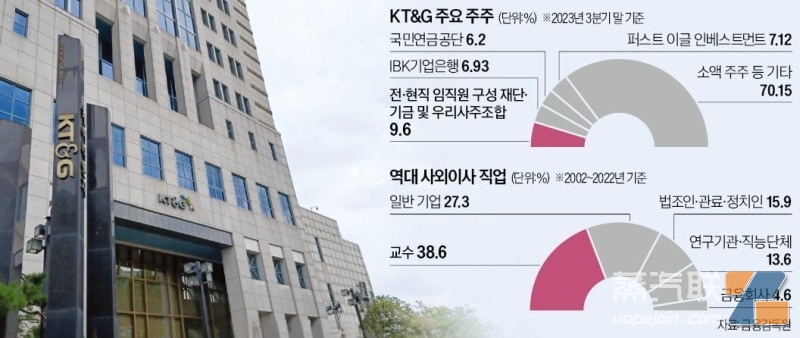
One prominent issue is the lack of expertise among KT&G’s external directors. According to an investigation by Korea Economic News, among the 44 external directors who have served or are serving at KT&G since its privatization in 2001, professors make up the largest group at 17, while there have been only 12 business executives. At Philip Morris International, by contrast, the proportion of corporate executives is significantly higher.
Due to this lack of professional expertise, KT&G’s board failed to provide early warnings on several major issues. A typical example is the recent controversy over the “U.S. deposit non-refund crisis.”
Industry insiders said that at KT&G’s board meeting in December 2021, a proposal related to suspended sales products at its U.S. subsidiary was raised. At that time, not a single external director pointed out the risk that the deposit might not be refundable.
In addition, the external directors did not question KT&G’s executive structure, which is said to be dominated by people with “civil servant backgrounds.” It is understood that from 2001 to the present, KT&G has distributed about 11 million KT&G shares and approximately 100 billion won in cash, free of charge, to various funds and shareholder associations composed of current and former KT&G employees, effectively making them the largest shareholder group, with 9.6% of common shares.
Under such circumstances, the external directors have effectively handed voting rights over to the company, greatly reinforcing the model in which “company chief executives = former civil servants.”
Industry critics say that by appointing non-experts as external directors, KT&G is essentially asking them to act as “vote gatherers,” merely approving the agendas put forward by the company.