US FDA tells ITC Reynolds has no authority to seek Section 337 investigation into vaping companies
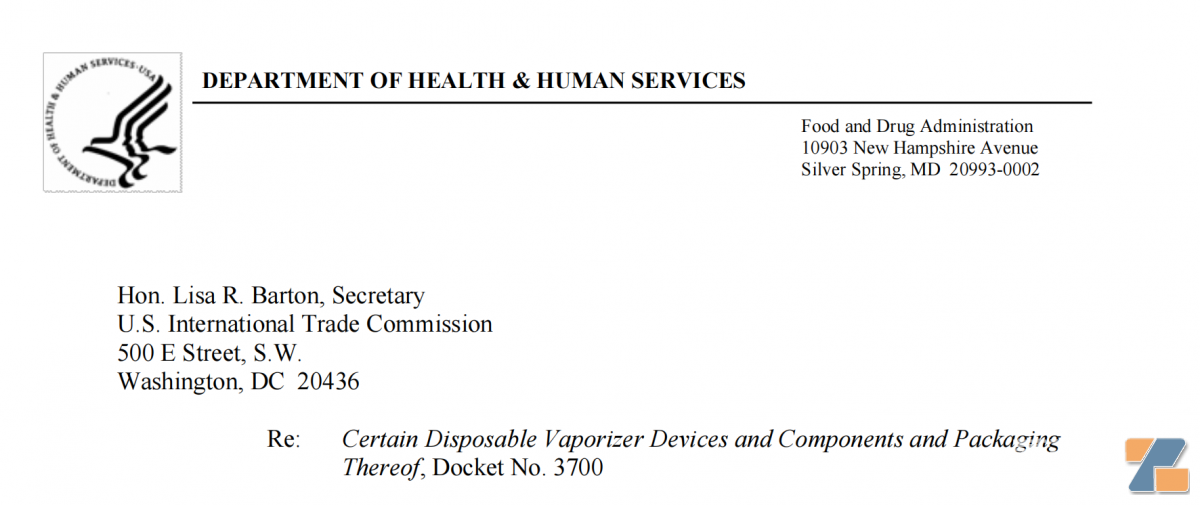
Recently, the US FDA sent a letter to the ITC, emphasizing that Reynolds Tobacco has no authority to request an investigation into 26 vaping companies. Will this letter affect the progress of the case? To answer this question, we consulted Chinese e-cigarette legal expert Lawyer Tang Shunliang. Lawyer Tang believes that the FDA's proactive stance in citing legal grounds to the ITC is beneficial for the investigated vaping companies.
On October 13, Reynolds Tobacco submitted an investigation request (Section 337 investigation) to the US International Trade Commission (ITC), accusing 26 Chinese and American e-cigarette manufacturing and distribution companies of unfair import practices.
Recently, the US FDA sent a letter to the ITC, emphasizing that Reynolds Tobacco has no authority to request an investigation into 26 vaping companies. Will this letter affect the progress of the case? To answer this question, we consulted Chinese e-cigarette legal expert Lawyer Tang Shunliang. Lawyer Tang believes that the FDA's proactive stance in citing legal grounds to the ITC is beneficial for the investigated vaping companies.
Here are Lawyer Tang's views:
The FDA quickly sent a letter to the ITC, which was indeed unexpected. From the meaning expressed in the FDA's letter, it points out that the ITC has no jurisdiction over this case and does not explicitly state that it has taken enforcement actions against the involved companies. However, it clearly states that Reynolds Tobacco, as a private entity, cannot act as a complainant to initiate a Section 337 investigation. Compared to intellectual property Section 337 investigations, this case resembles the administrative enforcement authority of government departments at the FDCA (Federal Food, Drug, and Cosmetic Act) level. The law has granted the FDA the enforcement and litigation rights against non-compliance, without requiring companies to initiate lawsuits through "private remedies."
However, the FDA did not directly state that the ITC has no jurisdiction at all. According to the evidence provided by Reynolds, the defendant companies have issues such as "customs codes" for imported goods, which may be too minor for the ITC to use as grounds for sanctions but fall outside the FDA's management scope.
The letter contains more content where the FDA introduces its regulatory laws and enforcement status regarding vaping products. The FDA stated that it has taken and will continue to take advisory and enforcement actions against tobacco products sold without FDA authorization. For example, as of October 20, 2023, the FDA has issued over 630 warning letters to companies that produce, sell, and/or distribute novel tobacco products that have not been authorized by the FDA for market entry.
Additionally, the FDA has filed civil penalty complaints against 35 vaping manufacturers and 22 retailers, as well as six permanent injunction complaints against companies selling illegal e-cigarettes. Furthermore, the FDA has issued multiple import warnings regarding such products. This content also serves as a defense for its "insufficient enforcement strength."
In fact, the workload of the FDA in reviewing e-cigarettes is enormous. Regarding the issues of "enforcement," "strict enforcement," and "when to enforce" regulations, companies still find it ambiguous. Some companies that applied for review only received a review registration number and can sell normally.
In the letter, the FDA cited many regulations and cases, mainly to strengthen one point: in the areas of food, drugs, cosmetics, tobacco, and e-cigarettes, the provisions of the FDCA and the responsibilities of the FDA are legally grounded, and the FDA has sufficient legal basis to enforce against non-compliance in these areas, a power granted to the FDA by Congress.
The FDA also stated that private enterprises have no right to request the government to enforce the FDCA. The letter mentioned that the FDA is the only expert agency responsible for determining whether products comply with the FDCA, and Congress has authorized the FDA to use various enforcement tools to address the distribution of non-compliant products.
The FDA may file civil injunction lawsuits against companies distributing such products, but Congress prohibits private parties from taking action to enforce the FDCA.
Finally, we analyze that in the issue of e-cigarette compliance regulation in the US, Reynolds' actions demonstrate an ambition to use legal "weapons" to carve up the US vaping market, so the FDA directly naming British American Tobacco's brand (VUSE) also has similar non-compliance issues.
Due to the FDA's statement, if the ITC is ultimately excluded from jurisdiction, Reynolds' Section 337 investigation will not proceed smoothly, but it can appeal to the court regarding the ITC's decision. #p#分页标题#e#
Main points from the letter:
1. The unfair competition rule based on the Lanham Act regarding false advertising for "disposable e-cigarettes being authorized and/or 'allowed' to be sold in the US" is equivalent to accepting an illegal private right of action, which is excluded by the Federal Food, Drug, and Cosmetic Act (FDCA).
2. As a policy issue, the FDA decided not to immediately enforce unauthorized ENDS products that were already on the market before the presumed rule effective date.
3. Over time, through the FDA's revised enforcement policies, the FDA is trying to balance the serious risks posed by e-cigarettes to youth and the potential benefits of helping adult smokers transition completely or significantly reduce combustible cigarette use. These efforts continue in the context of complex regulatory and legal challenges that challenge the FDA's actions regarding certain products and ENDS product groups.
4. The FDA has also filed civil penalty complaints against 35 vaping manufacturers and 22 retailers, as well as six permanent injunction complaints against companies selling illegal e-cigarettes, and has issued multiple import warnings regarding such products.
5. Because the FDA is the expert agency responsible for determining whether products comply with the FDCA, Congress has granted the FDA several enforcement tools to address the distribution of non-compliant products. The FDA may file civil injunction lawsuits against companies distributing such products. See 21 U.S.C. § 331(a) to (d), § 332 includes other enforcement mechanisms including seizure of illegal products, civil penalties, and criminal prosecution of individuals and companies. 21 U.S.C. §§ 331, 333, 334; see also Heckler v. Chaney, 470 U.S. 821, 835 (1985). However, while Congress has granted the FDA these and other tools to enforce the FDCA, Congress prohibits private parties from taking action to enforce the Federal Food, Drug, and Cosmetic Act.
6. POM Wonderful LLC v. Coca-Cola Co., 573 U.S. 102, 109 (2014) ("The FDCA and its regulations provide almost complete enforcement authority to the United States. Private parties may not bring enforcement lawsuits.") Thus, Congress ensured that decisions regarding the regulatory or compliance status of tobacco products, as well as which products should be prioritized for enforcement, reflect the views of the agency responsible for enforcing the Federal Tobacco Control Act.
7. The only specific product statement that the complainant (Reynolds) seeks confirmation of is that "the exemplary product packaging of the illegal disposable e-cigarettes indicated that they were authorized and/or allowed to be sold in the US." Every questioned product has the statement "allowed to be sold in the US." Notably, this statement is required to be printed verbatim on the labels and packaging of all tobacco products sold in the US.
8. In fact, the complainant's own Vuse Alto product also has been sold without FDA authorization, and it must also have the same statement "allowed to be sold in the US."
9. If, according to legal provisions, all tobacco products (whether authorized or not) must carry the word "allowed," then according to the complainant's theory, every product that is not "allowed" by the FDA is obviously false or misleading under the Lanham Act. But as mentioned above (as the complainant admits, Compl. 22), almost every ENDS product currently on the market (including at least one of the complainant's own products) lacks FDA authorization and is therefore illegal.
10. This situation of being unable to enforce two federal regulations simultaneously further forces the exclusion of situations where compliance with the Federal Fair Consumer Protection Act violates the Lanham Act. See POM case, ("The greater specificity of food labeling only makes sense when the Lanham Act and FDCA cannot be fully enforced simultaneously.") The complainant (Reynolds) attempts to avoid this absurd and impermissible result by suggesting an alternative definition of "illegal" products.
11. The FDA is the authoritative agency with the expertise to determine the appropriate circumstances to enforce laws to promote public health. It is certain that, as stated in the complaint, evidence, and the above discussion, the FDA is indeed deploying advisory and enforcement tools to address many tobacco products that it has serious concerns about, including some controversial products. But this power belongs to the FDA, not the plaintiff, and therefore, according to 21 U.S.C. § 337, the ITC should refuse to initiate an investigation into such claims.