Grey channels disrupted? Is Russia entering the era of digital tax stamps for vaping products?

From paper tax stamps to "digital tax stamps"?
Today, I saw news that starting in March next year, all electronic vaping products in Russia must be marked with "digital tax stamps."
According to reports from the Russian consultant website, the Ministry of Finance has proposed a requirement for both nicotine and non-nicotine electronic vaporizers to be marked with digital tax stamps. This proposal will be reviewed by the government, and the regulation is expected to take effect on March 1, 2024.
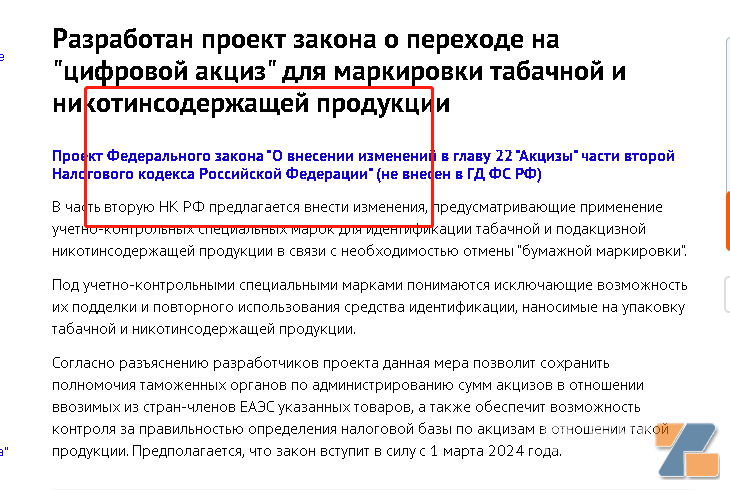
In fact, Russia has been advancing legislation on electronic vapor consumption tax this year, and the tax stamp serves as proof to combat illegal trade.
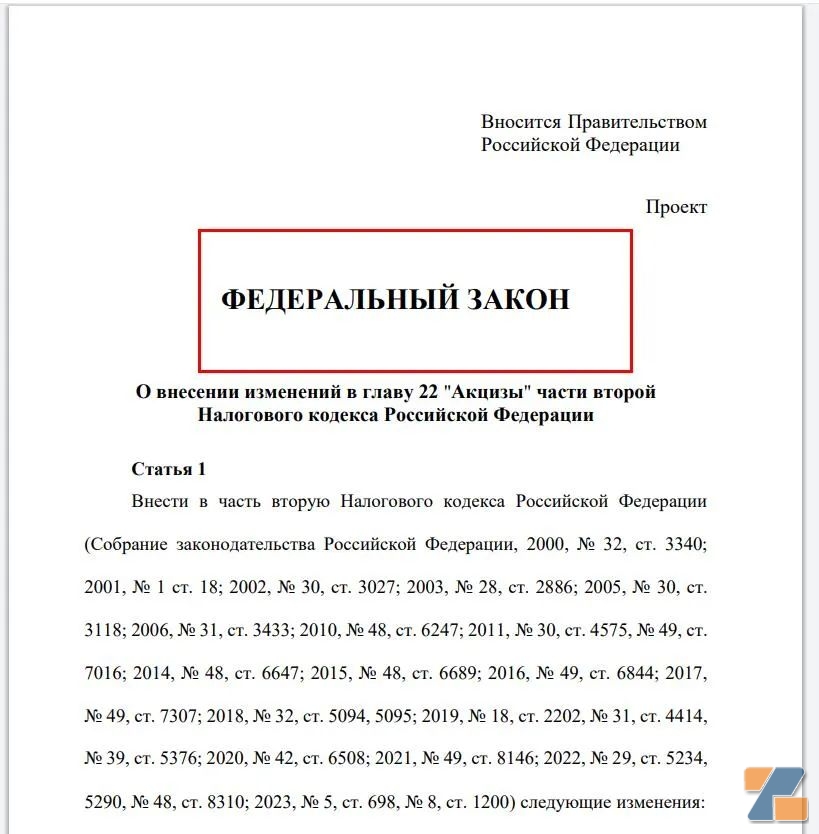

(Document)
This revision suggests amending the second part of the Russian Federal Tax Code to require the use of accounting and control special markings to identify tobacco and taxable nicotine products, in order to meet the need to abolish "paper markings." This identification method can eliminate the possibility of forgery and reuse, and will be applied to the packaging of tobacco and nicotine products.
It also states that this measure will retain the customs authorities' power to levy consumption taxes on these goods imported from member countries of the Eurasian Economic Union, and provide the possibility for supervision to determine correctness.
Notably, starting March 1, 2023, the Russian Federal Tax Service abolished the consumption tax on electronic vapor devices and heated tobacco equipment. This includes electronic nicotine delivery systems (electronic vaporizers) and heated tobacco devices, which are not subject to consumption tax. However, this time, consumption tax will be applied to electronic vapor liquids. When discussing the tax on Russian e-liquids, it was mentioned that after March 1, 2023, the consumption tax rate for regular cigarettes in Russia will increase by 2%, while the consumption tax rate for electronic vapor liquids and heated tobacco will increase by 11%.
Currently, Russia has a systematic regulation regarding honest labeling, electronic vapor licenses, flavor bans, online sales, etc., which is expected to have a profound impact on the local electronic vapor market. For example, the e-liquid consumption tax may lead to a cost-effective development of pod systems and disposable high-capacity devices.
Moreover, the flavor ban and licensing will be uniformly implemented in March next year.
As the fourth largest consumer market globally, Russia is also one of the core markets pursued by many Chinese electronic vapor companies. With a population of 140 million, 30% of adults in Russia are smokers, but less than 2% of the population uses electronic vaporizers, indicating that the market potential is still enormous.