FDA Warning Letters Target U.S. Distributors: How Should Chinese Companies Respond?
Has the FDA named Chinese e-cigarette brands again?
The situation developed on July 27, when the FDA released a press release stating that it had issued warning letters to three distributors—ABS Distribution Inc., EC Supply, Inc., and Easy Wholesale, LLC. The reason was that these companies sold and/or distributed various e-cigarette products that had not passed the PMTA, including Elf Bar/EB Design, Esco Bars, and PUFF Max.
Since the beginning of 2023, the FDA has frequently issued various import alerts and warning letters, expanding its targets from companies to distributors and retailers. Although the warning letters were issued to U.S. distributors, Ge Wu Consumer immediately verified with the production company of ELFBAR/EB Design, IMiracle, regarding this matter. The relevant person in charge provided us with a response:
“IMiracle is aware of the U.S. Food and Drug Administration (FDA) action announced on July 27, 2023. IMiracle understands that our U.S. distributors of vaping products believe in providing responsibly manufactured and high-quality products to retail customers while complying with the law. In the meantime, IMiracle remains committed to supporting its distribution partners and to working with the agency to achieve a resolution to these issues and to its business partners.”
“IMiracle has learned about the FDA's actions taken on July 27. IMiracle understands that our U.S. e-cigarette distributors are committed to providing responsibly manufactured, high-quality products to retail customers while complying with the law. Meanwhile, IMiracle always supports our distribution partners and business partners and works with regulatory agencies to resolve these issues.”
Who exactly is the target of this warning letter? Is this warning related to the previously mentioned “export guidelines”?
Who is the warning letter actually targeting?
This incident has attracted the attention of many industry practitioners, partly because the recently released “e-cigarette export guidelines” mentioned how to handle situations after being reported overseas. After reviewing the background of this incident organized by Ge Wu Consumer, we can draw the following conclusions:
First, the targets of the warning are not Chinese e-cigarette companies. The FDA's official website clearly states that the warning was issued to three U.S. e-cigarette distributors. The reason for the warning is the sale of products that have not passed the PMTA, and it does not specifically refer to Chinese companies.
Second, this warning does not involve product quality issues. Although it mentions e-cigarette brands from China, the FDA's statement does not involve any content related to product quality and safety issues, but rather procedural issues. A typical example is that on July 10, the FDA issued a marketing denial order (MDO) to Imperial Brands' e-cigarette brand myblu, with the reason still being that it had not obtained PMTA.
Third, this warning letter is not unusual. The FDA continues to provide the warning targets with 15 working days to explain how to resolve and prevent violations; if they fail to clarify the situation, subsequent orders, seizures, and/or civil fines may follow.
At the same time, the FDA emphasizes that this warning letter is part of the latest efforts to prohibit the sale of products that have not passed the PMTA in the U.S.; in other words, the warning's intensity has not changed, and it remains a step-by-step process.
Clearly, the FDA's actions are both reasonable and expected. Based on the information released by the FDA in February this year, it is expected that all PMTA applications will be reviewed by December 31 of this year, and as of now, only 23 SKUs have passed the PMTA application. Given this pace, the continued issuance of warning letters is likely to be a routine for the FDA in the near future.
Why did the FDA issue warning letters?
So, why did the FDA issue the above warning letters? It is necessary to consider the current state of the FDA and the tools at its disposal.
First, the FDA focuses on enforcement at the distribution end;
In previous tweets by Ge Wu Consumer, we summarized that over the past two years, the FDA has undergone significant personnel changes and adjustments in work processes. It wasn't until March 27 of this year that the new director of the Center for Tobacco Products' Scientific Review Office took office, allowing the FDA to finally get its act together.
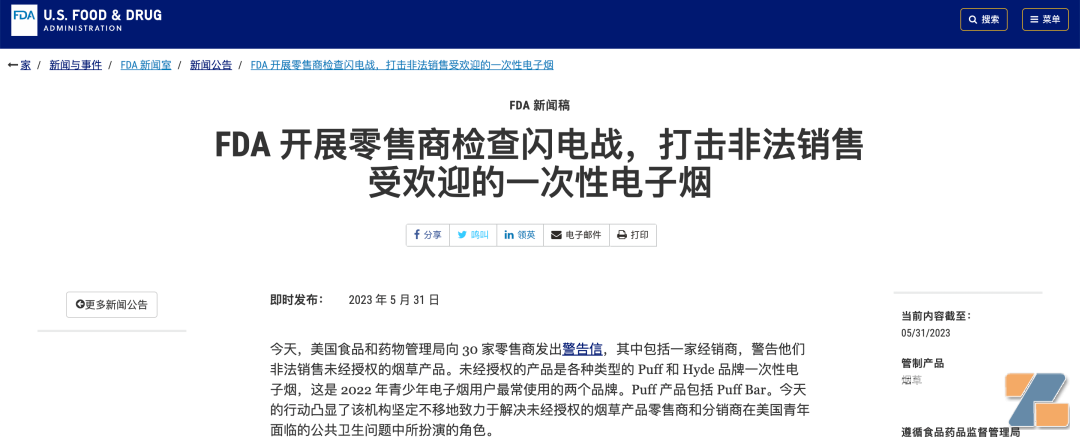
The impact of this is that the FDA's enforcement has become more systematic: it is no longer just issuing warnings to e-cigarette companies but has the capability to expand enforcement targets to distributors and retailers. For example, in Ge Wu's May 31 tweet, it was mentioned that the FDA had already taken action against retailers.
Combining the warning letters issued to distributors, it is clear that the FDA's current focus is primarily on the distribution and market end. Naturally, brands with larger sales in the U.S. market are more likely to come under the FDA's scrutiny. It is common to focus on the big players while letting the smaller ones slide.
Second, the FDA's monitoring capabilities have strengthened;
The last paragraph of the FDA's press release states: The FDA and the National Institutes of Health announced last month that they have provided funding for the Rapid Tobacco Monitoring Center (CRST). This center will supplement the CTP's internal monitoring work by providing more rapid information on changes in the tobacco product market and tobacco use patterns.
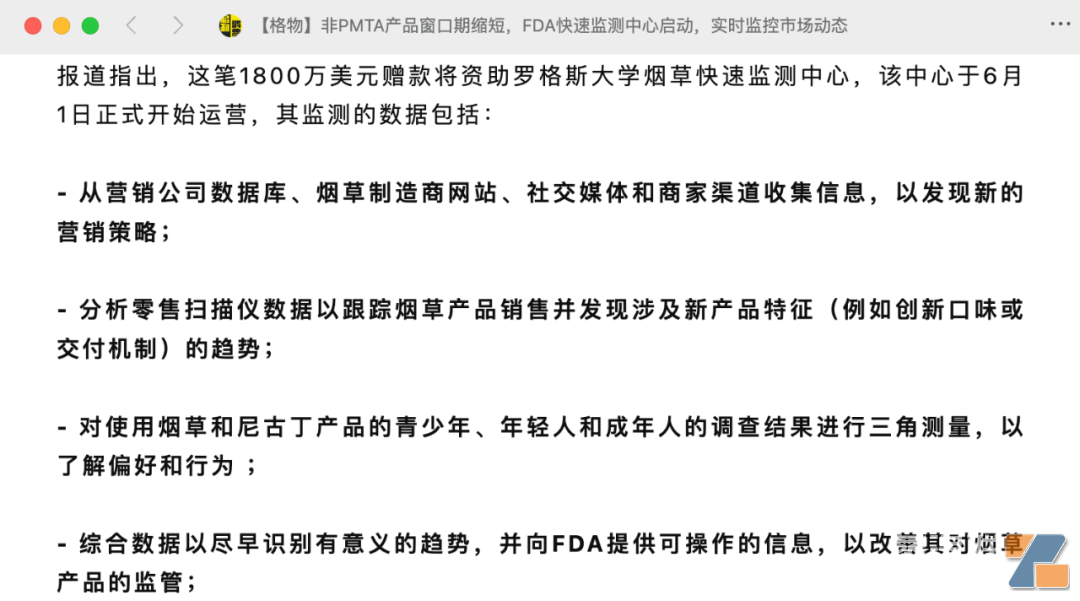
Regarding this Rapid Tobacco Monitoring Center, Ge Wu Consumer has previously introduced it in the article “The Non-PMTA Product Window Shortens, FDA Rapid Monitoring Center Launches, Real-Time Market Monitoring.” It began operations on June 1, monitoring data primarily includes: brand marketing actions, retailer sales data, consumer behavior, etc. (as shown below):
Many industry practitioners deeply involved in the U.S. market have expressed to us that “the FDA is a group of scientists who do not deeply understand the e-cigarette market. This has led to overly conservative and inefficient PMTA application processes and review standards. The launch of the CRST will allow the FDA to further align its enforcement targets with market dynamics.
How should manufacturers respond to such warning letters?
The current U.S. e-cigarette market has a fundamental contradiction: a vast majority of mainstream products on the market have not completed PMTA reviews, while the FDA is under pressure from U.S. legislators and public opinion to remove non-PMTA products from the market.
Essentially, whether it is a warning or a warning letter, there is also an element of “reporting back” to the outside world. Additionally, through continuous actions, the FDA aims to gain more enforcement authority or funding support; the CRST mentioned above is one of the results.
What is more noteworthy is that due to the existence of both state and federal laws in the U.S., and the varying degrees of enforcement, the naming of distributors and retailers is not entirely within the control of manufacturers.
The root cause lies in the fact that unlike the domestic e-cigarette market, which primarily relies on distributors, the European and American markets started earlier and have long established a mature wholesale (distributor) model, where payment and delivery are made simultaneously, making it difficult for manufacturers to control the flow of goods.
Therefore, this warning letter incident serves as a reminder for manufacturers.
Given the current FDA's enforcement focus on distributors and retailers, manufacturers need to be prepared in advance. For example, they could try to impose some restrictions and delineate responsibilities in distribution contracts, and how to cooperate in the event of such situations. Additionally, investing more manpower in tracking the operations of distributors in the U.S. market can help avoid receiving warning letters.
In summary, aside from reaffirming that the PMTA will be “truly enforced” by the end of this year, this incident reflects that for e-cigarette manufacturers, in addition to ensuring product quality and safety, they also need to invest more energy in monitoring FDA developments and adjusting their business strategies in the U.S. market to minimize losses while meeting compliance requirements.