DamnVape Dread RDA Atomizer Review
DamnVape Dread RDA atomizer review: this time we are looking at Dread RDA, the first atomizer from rising brand DamnVape, founded in 2018. In terms of maturity alone, Dread far exceeds what you would expect from a debut product in structure, positioning,
DamnVape Dread RDA Review: This time we share the first atomizer from the emerging brand DamnVape, established in 2018 – the Dread RDA. In terms of maturity, the Dread far exceeds the standards of a debut product in terms of structure, positioning, and compatibility.
The Lolly Coil, a type of coil shaped like a vortex, was previously known as a Stove Top coil. Its main feature is its emphasis on layering, cool vapor, and cotton friendliness. However, this type of atomizer requires a larger internal space, and the airflow range must also be compatible, making it a bit more complicated to produce and set up compared to regular coils. However, I do not have enough experience to assert that its low popularity is due to this.
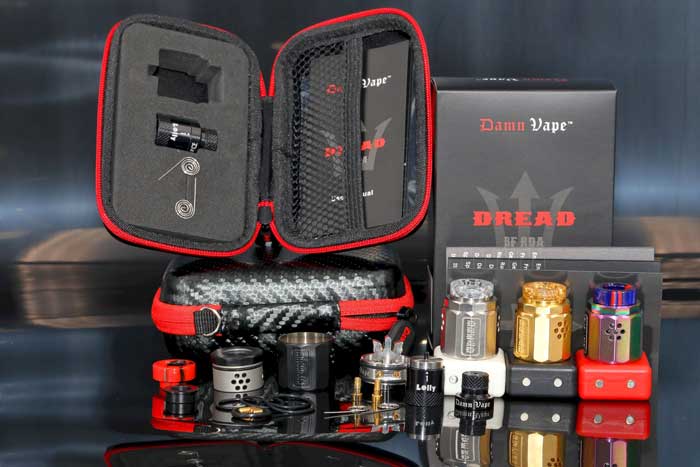 To make the Lolly Coil easier to use, Damn Vape has put in a lot of thought. First, they provide a wire-winding tool that allows for quick and easy creation of Lolly Coils. Secondly, the Dread features a central trident-shaped and outer infinite post design for the build deck, which not only accommodates Lolly Coils but also supports regular coils, vertical coils, and fancy wires. With seven external airflow holes arranged in a regular hexagon and 2+1 internal airflow holes, the airflow can fully act on a wider heating surface, allowing players to easily enjoy Lolly Coils and experience high-level flavors.
Although there is a complete coil evaluation at the bottom, I will still take some space to introduce the Lolly Coil. It shares similarities with steel mesh, as both have a broad heating range but a simple planar structure. Therefore, the Dread's direct airflow to the coil results in noticeably lower vapor temperatures, allowing for better expression of different flavors at various temperatures. Additionally, when self-winding, users can choose materials that correspond to different flavor profiles, providing a high degree of flexibility. For the cotton, simply cut or pull it into a flat shape and place it between the coil and the central trident post, making it quite easy.
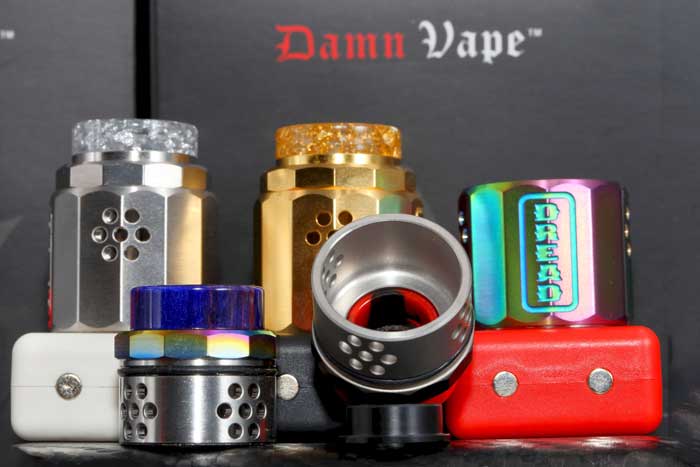 In addition to the internal structure, the external aesthetics should not be overlooked. The straight LOGO, the hard lines of the dodecahedron, and the two-tone PEI + metal ring drip tip are all very distinctive. Furthermore, due to the numerous accessories included, Damn Vape has replaced the inner box with a hard storage case shaped like a card case.
For enthusiasts of 3/6MG or 6NS e-liquids, the Dread can satisfy your desire for layered flavors; those who simply want to inhale large amounts of vapor need not worry either. With the flat four holes and paired vertical posts, players can also challenge the limits of coil building. This is the Dread, the atomizer crowned with the title of the "Fearsome King," and an indispensable presence for every brave soul venturing into the vape world.
Upon opening the outer box, you will find a high-quality hard storage case, and the card case pattern enhances its aesthetics. The contents include: the main body, (forgot to include in the picture) a screwdriver, a 510 drip tip adapter, a Lolly Coil winding tool, two Lolly Coils, screws, O-rings, and a manual; the main body can be disassembled into: 810 drip tip, top cap, outer sleeve, build deck base, and regular and BF-specific positive screws.
The Dread's design configuration feels reminiscent of the Kennedy RDA, but the seven airflow holes arranged in a regular hexagon and the dodecahedron outer sleeve still give it its unique character.
The 810 drip tip has an inner recessed circle near the top edge to collect condensation, and the gold and silver versions have a matching metallic ring at the bottom, which I find more aesthetically pleasing than the titanium or black versions.
The Dread features seven airflow holes arranged in a regular hexagon and an infinitely rotating top cap for airflow adjustment. The 2+1 internal airflow holes also cater to players who want to try single coil setups or higher resistance for denser flavors. The top cap's upper edge has a common rounded dome to gather vapor and assist with condensation return. Although the exposed part is slightly thin, its twelve corners make disassembly and adjustment quite easy.
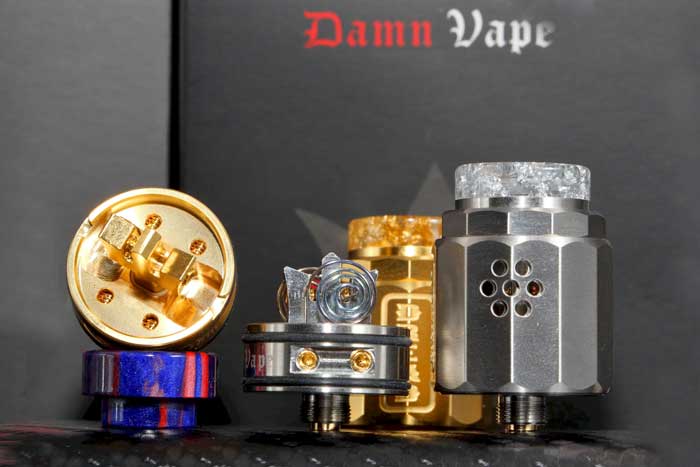 The most interesting aspect is the build deck with the central trident and bottom infinite post. This combination requires the coil's legs to be positioned at right angles to be installed. Additionally, as mentioned earlier, the internal airflow hole configuration allows the Dread to accommodate single or dual Lolly Coils, fancy wires, and vertical coils. Since all four holes at the bottom infinite post are negative, players who enjoy challenging limits can also try a simpler four-coil vertical setup.
#p#分页标题#e#
The hidden build deck's lower edge also features a subtle Damn Vape logo, and combined with the prominent trident, removing the outer sleeve reveals a very distinctive design. Beyond the visual effect, the trident-shaped build deck also helps stabilize airflow at both ends of the coil and allows e-liquid to directly saturate the cotton placed in a flat shape.
When actually building a Lolly Coil, although the Dread has high compatibility with coils, to accommodate the large area of the Lolly Coil, the airflow holes are slightly higher overall, and the internal airflow hole adjustment has three main variations: one hole in the middle, two holes above, and seven holes fully open. Most will open to the top airflow hole. This means that when building regular coils, they need to be positioned slightly higher to ensure that the top airflow effectively acts on the coil, maintaining resolution, while also requiring longer cotton legs. Long or continuous firing should also be monitored. If an additional set of internal airflow holes could be added to only open the lower five holes, it would be even more perfect; this is a point I find somewhat regrettable.
When wicking, simply cut or pull the cotton into flat shapes, insert it between the central trident and the coil, and ensure that the lower cotton covers the bottom of the coil.
The included dual Lolly Coils can also be used with the winding tool to create your own. Simply place the L-shaped coil into the hole at the bottom of the winding tool, and pass the orthogonal coil through the hole in the tool's top cover and rotate it. However, if you want to create a spaced winding like the included coils, the wire cannot be too soft or too thin, and you need to loosen the force slightly while rotating.
This time, I tested the included and self-wound 316, Ni80 Lolly Coils, Ni80 26ga*2+38ga Fused Clapton, and Ni80 24ga 3.0mm 7 wraps vertical coils.
In terms of performance with fancy wires, it is balanced but slightly biased towards large vapor; dual vertical coils focus more on layering, but I would recommend opening one or two holes, and because the evaporation area is narrower than the Lolly Coil, it should be positioned slightly towards the edge to align the coil with the airflow holes. However, vertical coils are not the original intention of the Dread's design, so there shouldn't be many players testing this.
Finally, the highlight is the Lolly Coil. The included wire is KA1, and I also used Ni80 and 316. The material of the coil significantly affects its style and must be matched with the choice of e-liquid. Initially, I used 12NS and lighter fruit-flavored salt e-liquids, but the performance with KA1 was quite tragic, lacking the aromatic stacking of evaporation and amplifying the harshness and irritation. When switching to dairy-flavored e-liquids with more layers and aromas, it was a different story, with a more delicate flavor of cool vapor filling the nasal cavity, which was truly pleasant. When switching the aforementioned fruit-flavored e-liquids to Ni80 and 316 coils, the main characteristic was fullness, but I still prefer using complex flavored e-liquids. After all, for single flavors, it is more time-efficient to use fancy wires, and if 316 material is used with cotton that has poor oil absorption, it may lead to burning of the cotton parts that are farther from the oil path due to insufficient oil delivery efficiency.
Overall, the Lolly Coil produces vapor at a lower temperature due to its broad evaporation area, and under effective airflow cooling, it is easy to perceive the multi-layered aromas of the e-liquid. The vertical setup also eliminates the possibility of e-liquid splashing into the mouth (although if the cotton or output settings are poor, there is still a chance of e-liquid splattering through the airflow holes).
Is there a significant difference between this type of coil and steel mesh? Both have a broad heating range and focus on layering, but the Lolly Coil leans more towards detailed layering, while steel mesh increases thickness through larger evaporation volumes. The Lolly Coil has less contact area between coils and more contact area with cotton, so unless using low-resistance coils like the aforementioned 316, the difficulty of wicking is not too high, which is an advantage over steel mesh.
In conclusion, the characteristics are summarized as follows:
1. Airflow resistance ranges from high to low, categorized as levels 3-8.
2. The flavor profile is balanced but slightly biased towards large vapor (dual fancy wires) and heavy layering but slightly balanced (Lolly Coil).
3. The Lolly Coil shows significant performance in cool vapor and layering, with variations provided by different wire materials.
4. The Dread's extensive airflow area is more conducive to the Lolly Coil's advantages.
5. It can also accommodate single coils, fancy wires, or vertical coils.
6. The included winding tool makes it very easy to create Lolly Coils.
7. With numerous accessories, replacing the inner box with a storage case shows the manufacturer's thoughtfulness.
#p#分页标题#e#
There are also some designs that are difficult to define:
1. The airflow adjustment has limited freedom; if it could be designed to cover the top airflow holes, it would be more user-friendly for players using fancy wires or vertical coils. Perhaps a disc-shaped adjustment structure that opens/closes airflow from outside to inside would be more suitable.
2. The force point for the Lolly Coil tool is relatively small; if, like me, you roll ten or so coils for photography and testing, your fingertips may feel a bit sore...
This concludes the review of the DamnVape Dread RDA. I hope it helps everyone understand its features, and thank you for your support.
The Lolly Coil, a type of coil shaped like a vortex, was previously known as a Stove Top coil. Its main feature is its emphasis on layering, cool vapor, and cotton friendliness. However, this type of atomizer requires a larger internal space, and the airflow range must also be compatible, making it a bit more complicated to produce and set up compared to regular coils. However, I do not have enough experience to assert that its low popularity is due to this.
To make the Lolly Coil easier to use, Damn Vape has put in a lot of thought. First, they provide a wire-winding tool that allows for quick and easy creation of Lolly Coils. Secondly, the Dread features a central trident-shaped and outer infinite post design for the build deck, which not only accommodates Lolly Coils but also supports regular coils, vertical coils, and fancy wires. With seven external airflow holes arranged in a regular hexagon and 2+1 internal airflow holes, the airflow can fully act on a wider heating surface, allowing players to easily enjoy Lolly Coils and experience high-level flavors.Although there is a complete coil evaluation at the bottom, I will still take some space to introduce the Lolly Coil. It shares similarities with steel mesh, as both have a broad heating range but a simple planar structure. Therefore, the Dread's direct airflow to the coil results in noticeably lower vapor temperatures, allowing for better expression of different flavors at various temperatures. Additionally, when self-winding, users can choose materials that correspond to different flavor profiles, providing a high degree of flexibility. For the cotton, simply cut or pull it into a flat shape and place it between the coil and the central trident post, making it quite easy.
In addition to the internal structure, the external aesthetics should not be overlooked. The straight LOGO, the hard lines of the dodecahedron, and the two-tone PEI + metal ring drip tip are all very distinctive. Furthermore, due to the numerous accessories included, Damn Vape has replaced the inner box with a hard storage case shaped like a card case.For enthusiasts of 3/6MG or 6NS e-liquids, the Dread can satisfy your desire for layered flavors; those who simply want to inhale large amounts of vapor need not worry either. With the flat four holes and paired vertical posts, players can also challenge the limits of coil building. This is the Dread, the atomizer crowned with the title of the "Fearsome King," and an indispensable presence for every brave soul venturing into the vape world.
Upon opening the outer box, you will find a high-quality hard storage case, and the card case pattern enhances its aesthetics. The contents include: the main body, (forgot to include in the picture) a screwdriver, a 510 drip tip adapter, a Lolly Coil winding tool, two Lolly Coils, screws, O-rings, and a manual; the main body can be disassembled into: 810 drip tip, top cap, outer sleeve, build deck base, and regular and BF-specific positive screws.
The Dread's design configuration feels reminiscent of the Kennedy RDA, but the seven airflow holes arranged in a regular hexagon and the dodecahedron outer sleeve still give it its unique character.
The 810 drip tip has an inner recessed circle near the top edge to collect condensation, and the gold and silver versions have a matching metallic ring at the bottom, which I find more aesthetically pleasing than the titanium or black versions.
The Dread features seven airflow holes arranged in a regular hexagon and an infinitely rotating top cap for airflow adjustment. The 2+1 internal airflow holes also cater to players who want to try single coil setups or higher resistance for denser flavors. The top cap's upper edge has a common rounded dome to gather vapor and assist with condensation return. Although the exposed part is slightly thin, its twelve corners make disassembly and adjustment quite easy.
The most interesting aspect is the build deck with the central trident and bottom infinite post. This combination requires the coil's legs to be positioned at right angles to be installed. Additionally, as mentioned earlier, the internal airflow hole configuration allows the Dread to accommodate single or dual Lolly Coils, fancy wires, and vertical coils. Since all four holes at the bottom infinite post are negative, players who enjoy challenging limits can also try a simpler four-coil vertical setup.#p#分页标题#e#
The hidden build deck's lower edge also features a subtle Damn Vape logo, and combined with the prominent trident, removing the outer sleeve reveals a very distinctive design. Beyond the visual effect, the trident-shaped build deck also helps stabilize airflow at both ends of the coil and allows e-liquid to directly saturate the cotton placed in a flat shape.
When actually building a Lolly Coil, although the Dread has high compatibility with coils, to accommodate the large area of the Lolly Coil, the airflow holes are slightly higher overall, and the internal airflow hole adjustment has three main variations: one hole in the middle, two holes above, and seven holes fully open. Most will open to the top airflow hole. This means that when building regular coils, they need to be positioned slightly higher to ensure that the top airflow effectively acts on the coil, maintaining resolution, while also requiring longer cotton legs. Long or continuous firing should also be monitored. If an additional set of internal airflow holes could be added to only open the lower five holes, it would be even more perfect; this is a point I find somewhat regrettable.
When wicking, simply cut or pull the cotton into flat shapes, insert it between the central trident and the coil, and ensure that the lower cotton covers the bottom of the coil.
The included dual Lolly Coils can also be used with the winding tool to create your own. Simply place the L-shaped coil into the hole at the bottom of the winding tool, and pass the orthogonal coil through the hole in the tool's top cover and rotate it. However, if you want to create a spaced winding like the included coils, the wire cannot be too soft or too thin, and you need to loosen the force slightly while rotating.
This time, I tested the included and self-wound 316, Ni80 Lolly Coils, Ni80 26ga*2+38ga Fused Clapton, and Ni80 24ga 3.0mm 7 wraps vertical coils.
In terms of performance with fancy wires, it is balanced but slightly biased towards large vapor; dual vertical coils focus more on layering, but I would recommend opening one or two holes, and because the evaporation area is narrower than the Lolly Coil, it should be positioned slightly towards the edge to align the coil with the airflow holes. However, vertical coils are not the original intention of the Dread's design, so there shouldn't be many players testing this.
Finally, the highlight is the Lolly Coil. The included wire is KA1, and I also used Ni80 and 316. The material of the coil significantly affects its style and must be matched with the choice of e-liquid. Initially, I used 12NS and lighter fruit-flavored salt e-liquids, but the performance with KA1 was quite tragic, lacking the aromatic stacking of evaporation and amplifying the harshness and irritation. When switching to dairy-flavored e-liquids with more layers and aromas, it was a different story, with a more delicate flavor of cool vapor filling the nasal cavity, which was truly pleasant. When switching the aforementioned fruit-flavored e-liquids to Ni80 and 316 coils, the main characteristic was fullness, but I still prefer using complex flavored e-liquids. After all, for single flavors, it is more time-efficient to use fancy wires, and if 316 material is used with cotton that has poor oil absorption, it may lead to burning of the cotton parts that are farther from the oil path due to insufficient oil delivery efficiency.
Overall, the Lolly Coil produces vapor at a lower temperature due to its broad evaporation area, and under effective airflow cooling, it is easy to perceive the multi-layered aromas of the e-liquid. The vertical setup also eliminates the possibility of e-liquid splashing into the mouth (although if the cotton or output settings are poor, there is still a chance of e-liquid splattering through the airflow holes).
Is there a significant difference between this type of coil and steel mesh? Both have a broad heating range and focus on layering, but the Lolly Coil leans more towards detailed layering, while steel mesh increases thickness through larger evaporation volumes. The Lolly Coil has less contact area between coils and more contact area with cotton, so unless using low-resistance coils like the aforementioned 316, the difficulty of wicking is not too high, which is an advantage over steel mesh.
In conclusion, the characteristics are summarized as follows:
1. Airflow resistance ranges from high to low, categorized as levels 3-8.
2. The flavor profile is balanced but slightly biased towards large vapor (dual fancy wires) and heavy layering but slightly balanced (Lolly Coil).
3. The Lolly Coil shows significant performance in cool vapor and layering, with variations provided by different wire materials.
4. The Dread's extensive airflow area is more conducive to the Lolly Coil's advantages.
5. It can also accommodate single coils, fancy wires, or vertical coils.
6. The included winding tool makes it very easy to create Lolly Coils.
7. With numerous accessories, replacing the inner box with a storage case shows the manufacturer's thoughtfulness.
#p#分页标题#e#
There are also some designs that are difficult to define:
1. The airflow adjustment has limited freedom; if it could be designed to cover the top airflow holes, it would be more user-friendly for players using fancy wires or vertical coils. Perhaps a disc-shaped adjustment structure that opens/closes airflow from outside to inside would be more suitable.
2. The force point for the Lolly Coil tool is relatively small; if, like me, you roll ten or so coils for photography and testing, your fingertips may feel a bit sore...
This concludes the review of the DamnVape Dread RDA. I hope it helps everyone understand its features, and thank you for your support.