
Why Is Vaping Being Banned? A Windfall-Profit Industry in the Spotlight
Why is vaping being banned? Many people have heard that Hong Kong has banned e-cigarettes, and online discussions often focus on the harms of vaping. For many people who have never tried vaping products, this becomes their first impression. So what is the
Why is vaping being banned? It is said that Hong Kong has banned e-cigarettes, and there are claims online that e-cigarettes are harmful. For many who have not yet been exposed to e-cigarettes, these are likely their first impressions. What is the real situation of the e-cigarette industry? Below, we analyze the true state of e-cigarettes.
On December 26, news from American tech media reported that Juul Labs, the startup producing Juul e-cigarettes, decided to distribute a total of $2 billion in year-end bonuses to all 1,500 employees in the form of special dividends this year, averaging $1.3 million per person.
How well did Juul perform in 2018 to allow management to be so generous with bonuses?
The success stories abroad are impressive, and domestic capital is quickly positioning itself.
Juul Labs originated from Pax Labs, a company founded in 2007 by two Stanford graduates specializing in e-cigarette production.
This company launched a product called Juul in 2015, and in 2017, the department responsible for Juul e-cigarettes, Juul Labs, separated from the company to become an independent entity.
Currently, Juul e-cigarettes are extremely popular among young people in the U.S., capturing 72% of the U.S. e-cigarette market by September 2018. After just one year of independence, it quickly became a super unicorn.
How rapid was this growth? In July 2018, the company's valuation was $15 billion, and by December, it secured a $12.8 billion investment agreement from Altria Group, the producer of Marlboro cigarettes, for a 35% stake, doubling its valuation to $38 billion.
 Surprised? Exciting?
In fact, domestic capital has long been aware of Juul's rapid growth and has begun investing in the domestic market.
In May 2018, the e-cigarette brand Aizhuoyi announced a 300 million yuan Series A financing but did not disclose the investors.
In June 2018, Source Code Capital, IDG Capital, and Sequoia Capital jointly invested 38 million yuan in an angel round in a startup called Shenzhen Wuxin Technology, which has an e-cigarette brand named RELX. Wang Ying, the former general manager of Uber China, joined as the founder and CEO.
In July 2018, Chongqing Weiye invested "tens of millions" in Naps Industrial (Shenzhen) Co., Ltd., which has an e-cigarette brand called Gippro Longwu.
In November 2018, Dongyu Capital invested 20 million yuan in Shenzhen Jingyan Technology, which has an e-cigarette brand called EVOVE.
In December 2018, Zhenge Fund's investors proactively contacted Shenzhen Leiyan Technology, which had just been established for about a month and represented the American e-cigarette brand MOTI, quickly finalizing a $10 million Pre-A round investment, which was their most generous investment in a Pre-A round.
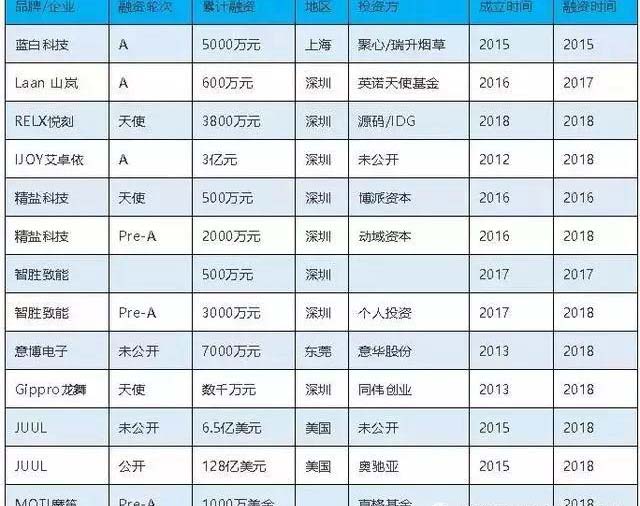
 The media reporting on the e-cigarette industry, "Aibang ESMOKE Industry News," has also compiled financing data for the e-cigarette industry over the past four years:
In fact, entering 2019, on January 5, another e-cigarette company—Shenzhen Qianhai Longxing Technology Co., Ltd. (which has an e-cigarette brand called BTM) received a strategic investment of 50 million yuan from Qianwu Co., Ltd., with team members coming from IBM, Huawei, and OPPO.
At the end of December 2018, Shanghai also held an "2018-2019 E-Cigarette Investment and Financing Conference," where everything in the e-cigarette field appeared to be thriving.
A report from Citigroup analyzed that in the face of the rise of the e-cigarette industry, the market share of the tobacco industry is bound to decrease.
Industry reports are forward-looking, and capital is also sensitive; when e-cigarettes begin to impact traditional tobacco, it seems that a new technology is about to disrupt the traditional industry, accompanied by a new wave of entrepreneurship and wealth creation.
What kind of entrepreneurs are in the e-cigarette sector?
Currently, the e-cigarette field is a mixed bag.
The reason why Zhenge Fund dared to invest millions of dollars in Shenzhen Leiyan Technology, which was less than a month old, is due to the background of the team behind it. They are backed by a company that has been operating for many years in the e-cigarette product sector, Shenzhen Aimuchi Technology Co., Ltd., which previously produced the MT (Xiao Mo e-cigarette brand) that is very similar to the now "just entering the Chinese market MOTI brand." #p#分页标题#e#
The intricate relationships in this sector could actually fill an article on their own, which we will explore later.
Some of the financing companies mentioned earlier have founders who are not all seasoned professionals in the e-cigarette field but have transitioned from other industries.
These cross-industry entrepreneurs can at most be called "big smokers," but their entry into the e-cigarette field is more about chasing new opportunities than genuine interest.
Take RELX's CEO Wang Ying, for example; she previously held executive positions in the transportation sector, having worked for Uber China and Didi for nearly four years combined.
Wang Ying
She left Didi in April 2018, joined the parent company of RELX, Wuxin Technology, in May, and secured 38 million yuan in investment by June. Her partner, Du Bing, is a 1991-born graduate of Zhejiang University in industrial design, who studied abroad in France.
However, RELX's growth has been rapid; the company now has 108 employees, with an average age of 27, making for a very young team.
Looking at Gippro Longwu, although this e-cigarette brand secured angel funding in 2018, its parent company, Naps Industrial (Shenzhen) Co., Ltd., was established in 2013 and has a brand called Karl Luch, which is a company that integrates research, production, and sales of automotive products, having no relation to e-cigarettes.
Another e-cigarette brand we haven't mentioned is YOOZ, whose parent company is Beijing Qiwut Technology Co., Ltd. Can you guess who the two co-founders of this company are?
Cai Yuedong, haven't heard of this name? He is the former "Tongdao Dashi"! After selling the "Tongdao Dashi" IP, he has now entered the e-cigarette field.
His co-founder is someone you might be familiar with—He Chang, the founder of Huang Taiji pancakes! Dozens of shareholders invested 250 million yuan in the Huang Taiji project, but unfortunately, the marketing-savvy He Chang couldn't make that project succeed. How many people still remember the name Huang Taiji today?
 Cai Yuedong and He Chang
Also, Zhu Xiaomu, the first employee of Smartisan Technology and a former partner of Luo Yonghao, recently announced that he has also ventured into the e-cigarette industry. The product he is working on is called "flow福禄," and his company was registered on November 12, 2018, with a registered capital of 1 million yuan, of which Zhu Xiaomu invested 960,000 yuan, holding 96% of the shares.
Luo Yonghao has not yet appeared on the investor list of this company, so Zhu Xiaomu will have the final say in the future.
After this overview, it is evident that the e-cigarette sector has three characteristics:
1. E-cigarette companies or products often like to include the word "fog," perhaps because e-cigarettes primarily operate on a vaporization mechanism;
2. E-cigarette brand names often prefer to use English letters or at least a mix of Chinese and English. It is unclear whether this is an attempt to cater to young people's trends. After all, foreign monks are good at chanting scriptures!
3. Serial entrepreneurs and those who have failed in previous ventures are crossing over into the e-cigarette field. This somewhat resembles what I respect someone once said: "We all come from all corners of the world to come together for a common goal."
What is the common goal of these e-cigarette entrepreneurs? Of course, it is to make money and become big shots!
With millions of smokers and trillions in profits, as long as they focus on making good products, even a small slice of the pie could mean tens of billions, hundreds of billions, or even trillions in revenue...
The reason e-cigarettes are being banned can be said to be that this industry has become too hot and is already threatening the interests of the China National Tobacco Corporation. You may have missed many opportunities to make money, but e-cigarettes may be another opportunity.
On December 26, news from American tech media reported that Juul Labs, the startup producing Juul e-cigarettes, decided to distribute a total of $2 billion in year-end bonuses to all 1,500 employees in the form of special dividends this year, averaging $1.3 million per person.
How well did Juul perform in 2018 to allow management to be so generous with bonuses?
The success stories abroad are impressive, and domestic capital is quickly positioning itself.
Juul Labs originated from Pax Labs, a company founded in 2007 by two Stanford graduates specializing in e-cigarette production.
This company launched a product called Juul in 2015, and in 2017, the department responsible for Juul e-cigarettes, Juul Labs, separated from the company to become an independent entity.
Currently, Juul e-cigarettes are extremely popular among young people in the U.S., capturing 72% of the U.S. e-cigarette market by September 2018. After just one year of independence, it quickly became a super unicorn.
How rapid was this growth? In July 2018, the company's valuation was $15 billion, and by December, it secured a $12.8 billion investment agreement from Altria Group, the producer of Marlboro cigarettes, for a 35% stake, doubling its valuation to $38 billion.
Surprised? Exciting?In fact, domestic capital has long been aware of Juul's rapid growth and has begun investing in the domestic market.
In May 2018, the e-cigarette brand Aizhuoyi announced a 300 million yuan Series A financing but did not disclose the investors.
In June 2018, Source Code Capital, IDG Capital, and Sequoia Capital jointly invested 38 million yuan in an angel round in a startup called Shenzhen Wuxin Technology, which has an e-cigarette brand named RELX. Wang Ying, the former general manager of Uber China, joined as the founder and CEO.
In July 2018, Chongqing Weiye invested "tens of millions" in Naps Industrial (Shenzhen) Co., Ltd., which has an e-cigarette brand called Gippro Longwu.
In November 2018, Dongyu Capital invested 20 million yuan in Shenzhen Jingyan Technology, which has an e-cigarette brand called EVOVE.
In December 2018, Zhenge Fund's investors proactively contacted Shenzhen Leiyan Technology, which had just been established for about a month and represented the American e-cigarette brand MOTI, quickly finalizing a $10 million Pre-A round investment, which was their most generous investment in a Pre-A round.
The media reporting on the e-cigarette industry, "Aibang ESMOKE Industry News," has also compiled financing data for the e-cigarette industry over the past four years:In fact, entering 2019, on January 5, another e-cigarette company—Shenzhen Qianhai Longxing Technology Co., Ltd. (which has an e-cigarette brand called BTM) received a strategic investment of 50 million yuan from Qianwu Co., Ltd., with team members coming from IBM, Huawei, and OPPO.
At the end of December 2018, Shanghai also held an "2018-2019 E-Cigarette Investment and Financing Conference," where everything in the e-cigarette field appeared to be thriving.
A report from Citigroup analyzed that in the face of the rise of the e-cigarette industry, the market share of the tobacco industry is bound to decrease.
Industry reports are forward-looking, and capital is also sensitive; when e-cigarettes begin to impact traditional tobacco, it seems that a new technology is about to disrupt the traditional industry, accompanied by a new wave of entrepreneurship and wealth creation.
What kind of entrepreneurs are in the e-cigarette sector?
Currently, the e-cigarette field is a mixed bag.
The reason why Zhenge Fund dared to invest millions of dollars in Shenzhen Leiyan Technology, which was less than a month old, is due to the background of the team behind it. They are backed by a company that has been operating for many years in the e-cigarette product sector, Shenzhen Aimuchi Technology Co., Ltd., which previously produced the MT (Xiao Mo e-cigarette brand) that is very similar to the now "just entering the Chinese market MOTI brand." #p#分页标题#e#
The intricate relationships in this sector could actually fill an article on their own, which we will explore later.
Some of the financing companies mentioned earlier have founders who are not all seasoned professionals in the e-cigarette field but have transitioned from other industries.
These cross-industry entrepreneurs can at most be called "big smokers," but their entry into the e-cigarette field is more about chasing new opportunities than genuine interest.
Take RELX's CEO Wang Ying, for example; she previously held executive positions in the transportation sector, having worked for Uber China and Didi for nearly four years combined.
Wang Ying
She left Didi in April 2018, joined the parent company of RELX, Wuxin Technology, in May, and secured 38 million yuan in investment by June. Her partner, Du Bing, is a 1991-born graduate of Zhejiang University in industrial design, who studied abroad in France.
However, RELX's growth has been rapid; the company now has 108 employees, with an average age of 27, making for a very young team.
Looking at Gippro Longwu, although this e-cigarette brand secured angel funding in 2018, its parent company, Naps Industrial (Shenzhen) Co., Ltd., was established in 2013 and has a brand called Karl Luch, which is a company that integrates research, production, and sales of automotive products, having no relation to e-cigarettes.
Another e-cigarette brand we haven't mentioned is YOOZ, whose parent company is Beijing Qiwut Technology Co., Ltd. Can you guess who the two co-founders of this company are?
Cai Yuedong, haven't heard of this name? He is the former "Tongdao Dashi"! After selling the "Tongdao Dashi" IP, he has now entered the e-cigarette field.
His co-founder is someone you might be familiar with—He Chang, the founder of Huang Taiji pancakes! Dozens of shareholders invested 250 million yuan in the Huang Taiji project, but unfortunately, the marketing-savvy He Chang couldn't make that project succeed. How many people still remember the name Huang Taiji today?
Cai Yuedong and He ChangAlso, Zhu Xiaomu, the first employee of Smartisan Technology and a former partner of Luo Yonghao, recently announced that he has also ventured into the e-cigarette industry. The product he is working on is called "flow福禄," and his company was registered on November 12, 2018, with a registered capital of 1 million yuan, of which Zhu Xiaomu invested 960,000 yuan, holding 96% of the shares.
Luo Yonghao has not yet appeared on the investor list of this company, so Zhu Xiaomu will have the final say in the future.
After this overview, it is evident that the e-cigarette sector has three characteristics:
1. E-cigarette companies or products often like to include the word "fog," perhaps because e-cigarettes primarily operate on a vaporization mechanism;
2. E-cigarette brand names often prefer to use English letters or at least a mix of Chinese and English. It is unclear whether this is an attempt to cater to young people's trends. After all, foreign monks are good at chanting scriptures!
3. Serial entrepreneurs and those who have failed in previous ventures are crossing over into the e-cigarette field. This somewhat resembles what I respect someone once said: "We all come from all corners of the world to come together for a common goal."
What is the common goal of these e-cigarette entrepreneurs? Of course, it is to make money and become big shots!
With millions of smokers and trillions in profits, as long as they focus on making good products, even a small slice of the pie could mean tens of billions, hundreds of billions, or even trillions in revenue...
The reason e-cigarettes are being banned can be said to be that this industry has become too hot and is already threatening the interests of the China National Tobacco Corporation. You may have missed many opportunities to make money, but e-cigarettes may be another opportunity.


