
FDA Approves IQOS Marketing Application, Signaling Big Industry Change
The electrification of tobacco is not simply tobacco plus electronics, but a deeper industrial transformation and upgrade. FDA approves IQOS for the U.S. market. After two years of rigorous review, on April 30 the FDA announced authorization for Philip Mo
The electronic transformation of tobacco is not just about tobacco + electronics; it represents a profound industrial upgrade.
The FDA has approved IQOS for the U.S. market.
After two years of rigorous review, the FDA announced on April 30 that it has authorized Philip Morris International to market a new type of tobacco product for the IQOS "Tobacco Heating System," including IQOS devices and Marlboro, Marlboro Menthol, and Marlboro Fresh Mint categories. The FDA believes that IQOS offers fewer harmful substances compared to traditional cigarettes, and its market entry in the U.S. will benefit public health.

Industry insiders know that IQOS, as the first heated tobacco product to enter the U.S. market, marks a milestone event: it clarifies that heated tobacco electronic cigarettes have significant harm reduction characteristics compared to traditional cigarettes.
Based on my over ten years of industry experience, I foresee a sustained and explosive growth in the e-cigarette market:
1. First, IQOS is expected to serve as an industry standard for future similar product applications;
2. The approval of IQOS for legal sales in the U.S. signifies that the country has officially entered the heated tobacco era, likely replicating the success of Japan's heated tobacco market, with an expected addition of a $10 billion market scale, indicating significant industry potential;
3. This will further accelerate the replacement of traditional cigarettes by e-cigarettes, leading to a dual pattern in the e-cigarette market of "heated tobacco" and "vaping devices."
In the face of a trillion-dollar market opportunity, which industries will benefit?
From related events, we can predict the following trends:
1. Direct beneficiaries of IQOS
Listed company Yingqu Technology, a precision plastic component supplier for IQOS, is expected to benefit from a surge in production orders for IQOS devices, and as a secondary supplier for IQOS, it will gain a good reputation in the market, replicating the rapid growth brought by e-cigarettes in new fields.
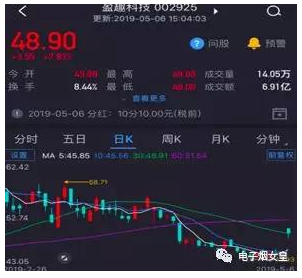
Following the announcement, Yingqu Technology's stock surged against the trend
(On the same day, the ChiNext index fell by 7.94%)
2. IQOS will drive domestic tobacco groups to accelerate their layout of heated tobacco products
In fact, China Tobacco has already made extensive and in-depth layouts in the new tobacco field, with six provincial tobacco companies in the China Tobacco system having developed new tobacco products and tested them in overseas markets. The launch of IQOS in the U.S. will positively influence the domestic new tobacco rollout, and the State Tobacco Monopoly Administration is expected to accelerate the research and promotion of related products, directly benefiting domestic tobacco supply chain service providers. Typical representatives include: Jinjia Co., Ltd. (partnering with Yunnan Tobacco and Xiaomi's ecological chain to position new tobacco main channels), and Shunhao Co., Ltd. (dual approach in the layout of pods and devices).
3. Private investment institutions are betting on the e-cigarette track, directly promoting industrial upgrades
If IQOS's heated tobacco technology is driving the upgrade of traditional cigarettes, then JUUL's e-liquid vaping products have the potential to disrupt traditional cigarettes. This is also the reason why JUUL, in less than three years since its launch, has surpassed Tesla with a valuation of $38 billion. Influenced by JUUL in the U.S., domestic brands like "RELX," "jouz," "whale," and "VFOLK" have emerged since early last year, commonly referred to as "small cigarette" brands, and have attracted attention from well-known institutions like IDG and Shunwei. With the entry of these cross-industry elites, the e-cigarette industry will be propelled towards "regulation," "standardization," "branding," "internationalization," and "capitalization."
Queen's Perspective
In the face of a scorching market, as a veteran with 12 years in the industry, I am more determined to root myself in the e-cigarette sector, while also feeling some concerns. After all, a wild and extensive market, suddenly facing enormous market temptations, is bound to lead to industry chaos such as "mud and sand mixed together" and "substandard products masquerading as quality goods," which may prompt regulatory agencies to impose harsh penalties, ultimately detrimental to the sustainable development of the industry. #p#分页标题#e#
To avoid similar situations, I am leveraging over a decade of industry resources and experience to create a global e-cigarette supply chain service platform—"Little Flying Box," hoping that through this platform, more domestic e-cigarette factories can transition from traditional "Chinese OEM" to "Chinese creation," allowing more brand owners to expand beyond the emerging domestic market into more mature international markets.
If you see someone still using a "brick" mobile phone that once symbolized status and identity, you would certainly consider them a relic; just as in a few years, when you see someone pulling out a lighter to smoke, you might think the same way.
As the saying goes: history may not repeat itself simply, but it often rhymes remarkably. Let's wait and see.
The FDA has approved IQOS for the U.S. market.
After two years of rigorous review, the FDA announced on April 30 that it has authorized Philip Morris International to market a new type of tobacco product for the IQOS "Tobacco Heating System," including IQOS devices and Marlboro, Marlboro Menthol, and Marlboro Fresh Mint categories. The FDA believes that IQOS offers fewer harmful substances compared to traditional cigarettes, and its market entry in the U.S. will benefit public health.
Industry insiders know that IQOS, as the first heated tobacco product to enter the U.S. market, marks a milestone event: it clarifies that heated tobacco electronic cigarettes have significant harm reduction characteristics compared to traditional cigarettes.
Based on my over ten years of industry experience, I foresee a sustained and explosive growth in the e-cigarette market:
1. First, IQOS is expected to serve as an industry standard for future similar product applications;
2. The approval of IQOS for legal sales in the U.S. signifies that the country has officially entered the heated tobacco era, likely replicating the success of Japan's heated tobacco market, with an expected addition of a $10 billion market scale, indicating significant industry potential;
3. This will further accelerate the replacement of traditional cigarettes by e-cigarettes, leading to a dual pattern in the e-cigarette market of "heated tobacco" and "vaping devices."
In the face of a trillion-dollar market opportunity, which industries will benefit?
From related events, we can predict the following trends:
1. Direct beneficiaries of IQOS
Listed company Yingqu Technology, a precision plastic component supplier for IQOS, is expected to benefit from a surge in production orders for IQOS devices, and as a secondary supplier for IQOS, it will gain a good reputation in the market, replicating the rapid growth brought by e-cigarettes in new fields.
Following the announcement, Yingqu Technology's stock surged against the trend
(On the same day, the ChiNext index fell by 7.94%)
2. IQOS will drive domestic tobacco groups to accelerate their layout of heated tobacco products
In fact, China Tobacco has already made extensive and in-depth layouts in the new tobacco field, with six provincial tobacco companies in the China Tobacco system having developed new tobacco products and tested them in overseas markets. The launch of IQOS in the U.S. will positively influence the domestic new tobacco rollout, and the State Tobacco Monopoly Administration is expected to accelerate the research and promotion of related products, directly benefiting domestic tobacco supply chain service providers. Typical representatives include: Jinjia Co., Ltd. (partnering with Yunnan Tobacco and Xiaomi's ecological chain to position new tobacco main channels), and Shunhao Co., Ltd. (dual approach in the layout of pods and devices).
3. Private investment institutions are betting on the e-cigarette track, directly promoting industrial upgrades
If IQOS's heated tobacco technology is driving the upgrade of traditional cigarettes, then JUUL's e-liquid vaping products have the potential to disrupt traditional cigarettes. This is also the reason why JUUL, in less than three years since its launch, has surpassed Tesla with a valuation of $38 billion. Influenced by JUUL in the U.S., domestic brands like "RELX," "jouz," "whale," and "VFOLK" have emerged since early last year, commonly referred to as "small cigarette" brands, and have attracted attention from well-known institutions like IDG and Shunwei. With the entry of these cross-industry elites, the e-cigarette industry will be propelled towards "regulation," "standardization," "branding," "internationalization," and "capitalization."
Queen's Perspective
In the face of a scorching market, as a veteran with 12 years in the industry, I am more determined to root myself in the e-cigarette sector, while also feeling some concerns. After all, a wild and extensive market, suddenly facing enormous market temptations, is bound to lead to industry chaos such as "mud and sand mixed together" and "substandard products masquerading as quality goods," which may prompt regulatory agencies to impose harsh penalties, ultimately detrimental to the sustainable development of the industry. #p#分页标题#e#
To avoid similar situations, I am leveraging over a decade of industry resources and experience to create a global e-cigarette supply chain service platform—"Little Flying Box," hoping that through this platform, more domestic e-cigarette factories can transition from traditional "Chinese OEM" to "Chinese creation," allowing more brand owners to expand beyond the emerging domestic market into more mature international markets.
If you see someone still using a "brick" mobile phone that once symbolized status and identity, you would certainly consider them a relic; just as in a few years, when you see someone pulling out a lighter to smoke, you might think the same way.
As the saying goes: history may not repeat itself simply, but it often rhymes remarkably. Let's wait and see.
Related Articles

Vaping News
Ahead of a Nationwide Ban, Hundreds of Russian Retailers Voluntarily Stop Selling Vapes
2026-04-16

Vaping News
Illegal Vape Brands Try to Evade FDA Scrutiny by Posing as “Made in the USA”
2026-04-08

Vaping News
Jordan’s New Tobacco Control Rules: Waterpipe Tobacco Market Set for Major Changes
2026-03-17