What Is Bluetooth on an E-cigarette Used For?
What is the use of Bluetooth on an e-cigarette? This is not a new topic. As early as 2014, some companies launched Bluetooth e-cigarettes that could make phone calls, but they did not become popular, leading many industry insiders to be skeptical about e-cigarettes + Bluetooth. In fact, Bluetooth is divided into low-energy Bluetooth, classic Bluetooth, and dual-mode Bluetooth. Most people's understanding of Bluetooth only stays at classic Bluetooth, which is used for making calls, playing music, etc. What can truly bring e-cigarettes into a new development stage is low-energy Bluetooth technology.
Recently, Shenzhen Shengrun Technology Co., Ltd., which focuses on Bluetooth module product sales and Bluetooth solution design, launched a Bluetooth heating non-combustion product solution. Currently, foreign companies like JUUL and Japan Tobacco are also intensively investing in the research and development of this technology, and the e-cigarette + Bluetooth technology has garnered increasing attention from industry manufacturers!
Why are major companies doing this? Why does e-cigarette need Bluetooth? I will analyze the significance and value of e-cigarette + Bluetooth technology from the perspectives of e-cigarette innovation, market regulation, improving smoker health, enhancing user experience, and increasing user stickiness.
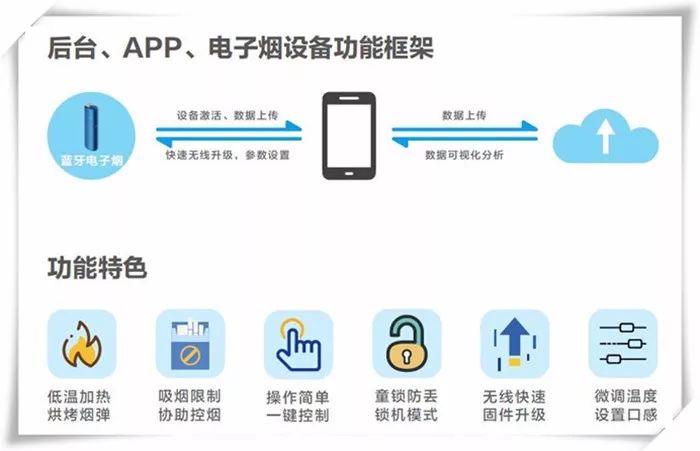 Bluetooth BLE technology, how close are we?
From the perspective of smartphones equipped with Bluetooth BLE functionality, Bluetooth BLE has become a standard feature of new smartphones, with a market penetration rate close to 100%. As the most widely used and user-friendly wireless communication technology, Bluetooth BLE plays a crucial role in enhancing user experience with products, naturally becoming one of the best choices for upgrading and transforming traditional products into smart ones.
E-cigarette + Bluetooth becomes an innovation point
Bluetooth BLE, as a new generation of data transmission technology, is also one of the most mainstream technologies for near-field wireless communication in IoT devices. It is widely used in lithium batteries, button batteries, and other terminal devices that require ultra-long standby time. Coupled with mobile applications and backend servers, it enables systematic applications in various scenarios. Bluetooth BLE not only has a high threshold but also requires strong cross-border integration capabilities.
Whether responding to government-level regulations, helping smokers gradually reduce their cravings through regulated and controllable methods, or enabling e-cigarette manufacturers to quickly collect and respond to various issues encountered in market feedback, reducing maintenance costs, Bluetooth BLE technology is the best choice, without exception. JUUL in the U.S. and Japan Tobacco are both evaluating and researching the integration of Bluetooth technology into e-cigarettes.

E-cigarette + Bluetooth is more conducive to market regulation
Integrating Bluetooth BLE technology into e-cigarettes allows them to be activated via a mobile application scan, with warnings against underage use before activation. When necessary, a backend registration function can also be added to determine the age of smokers and restrict minors from activating the device. This can effectively respond to government-level regulatory policies.
Taking the U.S. as an example, as the largest market for e-cigarette sales, the development of the e-cigarette industry has experienced several ups and downs with changes in regulatory policies. From the FDA's defeat in 2010 to the formal introduction of e-cigarette regulatory drafts in 2016, the six-year regulatory gap allowed e-cigarettes to have unprecedented development opportunities.
By the end of 2016, approximately 9 million American smokers were using e-cigarettes, and the number continues to grow rapidly. However, the government is particularly concerned about the popularity of e-cigarettes among young people. A study published in the Journal of the American Medical Association in 2016 showed that 11% of high school students and 4% of middle school students had tried e-cigarettes.
In response to this issue, U.S. federal regulators recently issued a threat that if manufacturers cannot effectively control the demographic of e-cigarette users, they will remove all e-cigarette products from the market. The FDA is also intensifying efforts to combat the use of tobacco products by minors and has specifically requested major U.S. e-cigarette brands like JUUL and Vuse to submit operational plans within the next two months, detailing how they will improve marketing and sales strategies to prevent youth from using their products until the issue is resolved.
Currently, JUUL is actively conducting a comprehensive evaluation of new technologies and plans to invest heavily in research and development to integrate low-energy Bluetooth technology into its products to prevent youth from using its products. Japan Tobacco is also attempting to develop e-cigarettes with wireless connectivity features for use with mobile applications.
China is the birthplace of e-cigarettes, with over 90% of the world's e-cigarettes produced in China. How to respond to regulatory policies from various countries and seek future development opportunities amid market competition and government regulation is a common concern for domestic e-cigarette manufacturers. The cross-border technological integration of e-cigarettes and Bluetooth signifies a new direction for e-cigarette technology, further promoting the development of the e-cigarette market.
Improving smokers' dependence on traditional cigarettes
With Bluetooth BLE added to e-cigarettes, smokers can flexibly set their daily smoking count or sticks through a mobile app, creating a personalized quitting plan based on their level of cravings. By relying on human self-discipline and the flexible configuration of devices, it is believed that Bluetooth e-cigarettes will become the first choice for more smokers looking to quit.
As a new type of smoking alternative, e-cigarettes can only help users reduce their dependence on traditional cigarettes and lessen the chronic damage caused by nicotine to the body. However, they cannot enable smokers to gradually reduce their cravings or quit smoking entirely through regulated methods. While many people may manage to quit smoking in the short term through self-discipline, very few can maintain it over time.
The first generation of IQOS products attempted this by requiring a 6-minute charge after smoking one stick before it could be used again, but it faced criticism for its lack of flexibility. The new generation of IQOS has completely removed this limitation.
Most consumers initially approach e-cigarette products with the goal of quitting smoking, and the vast majority of e-cigarette users are former traditional smokers. Compared to other smoking alternatives, e-cigarettes, especially new heated tobacco products, not only closely resemble the taste of traditional cigarettes but also have significantly lower tar and nicotine content than traditional cigarettes, making them the most popular choice. The heated tobacco product IQOS achieved great success upon its launch, with Philip Morris International shipping 36.23 billion sticks by the end of 2017. This indirectly reflects the strong demand among smokers for health-conscious choices.
More conducive to enhancing smoker experience
E-cigarettes with Bluetooth allow smokers to experience different flavors while using the same device, simply by purchasing pods of different brands that fit the same size. Users can also adjust the heating temperature according to the brand to fine-tune the flavor. For heated tobacco products, the principle is to use a heating rod to heat the tobacco to around 300°C to produce vapor. Different tobaccos have slightly different heating temperature curves, allowing smokers to adjust the temperature based on their actual experience to achieve their preferred flavor.
In practice, the qualitative issues of e-cigarettes have always been controversial, and the uncertainty of regulations and policies has made tobacco companies cautious about entering the market. Meanwhile, many private e-cigarette companies face insufficient research and development investment. Although China is the global production base for e-cigarettes, most manufacturers are small-scale, primarily assembling components, with serious imitation and plagiarism issues, lacking technological innovation and product experience.
In contrast, foreign e-cigarette products, especially those from the four major companies—Philip Morris International, Imperial Brands, Japan Tobacco, and British American Tobacco—as well as rapidly growing domestic brands in the U.S., have invested heavily in the research and development of new e-cigarette products, prompting domestic smokers to seek various ways to experience and purchase them. This also indicates consumer recognition of high-quality new e-cigarette products to some extent.
Only through continuous technological integration and innovation, thinking from the consumer's perspective on how to enhance the experience, and diligently creating quality products can manufacturers be accepted by consumers. This is the law of survival in the market; violating this law will not lead to longevity, and even if it does, it will only be fleeting.
Quickly responding to market feedback and increasing user stickiness
E-cigarettes with Bluetooth are more conducive to manufacturers quickly collecting and responding to various market feedback issues, reducing maintenance costs. By utilizing Bluetooth BLE technology to grasp user needs, it can also increase user stickiness. We know that Bluetooth BLE must be paired with mobile apps and backends to form a complete system application, and mobile apps can help consumers solve problems when necessary.
On one hand, when smokers encounter issues while using e-cigarette devices, they can directly report feedback to the manufacturer's operation center through the app's after-sales feedback channel. This more intuitive and convenient feedback method can effectively alleviate user anxiety and allow manufacturers to better understand the problems consumers face and suggestions for product improvement.
On the other hand, manufacturers can analyze consumer feedback on product issues and push firmware updates through the app to improve product performance. For e-cigarette manufacturers focusing on product operation and user stickiness, this is undoubtedly the best solution to stand out in the market.
Looking at future trends
It is expected that with the rationalization and normalization of regulations, continuous technological integration, innovation, and breakthroughs, the future development potential of the foreign e-cigarette market remains promising. Under the guidance of the international market, companies like Hubei Tobacco, Yunnan Tobacco, Guangdong Tobacco, and Sichuan Tobacco have begun to increase their research and development of new tobacco products.
According to the latest statistics from the Ministry of Health, China has approximately 350 million smokers, accounting for nearly 30% of the global smoking population. Considering China's large smoker base and the increasing pursuit of quality health in recent years, quitting smoking has become a demand for more families, making the domestic e-cigarette market a potential hotspot.
The technology of the products themselves is quite similar, but what is more important is how to apply these technological features to market operational strategies. This way, your brand can have more vitality in the fierce market competition. E-cigarettes with Bluetooth can meet the needs of consumers, manufacturers, and government regulations from multiple perspectives, allowing good products to stand out and guiding the healthy development of the e-cigarette market.
Related Articles

Ahead of a Nationwide Ban, Hundreds of Russian Retailers Voluntarily Stop Selling Vapes

Illegal Vape Brands Try to Evade FDA Scrutiny by Posing as “Made in the USA”