How Should Chinese Vaping Companies Respond to Reynolds Tobacco’s “337 Investigation”? Hear What US
always beenheating non-burningande-cigarettesRenault Tobacco, which provoked patent litigation, pointed the finger at 26 Sino-US companiese-cigarette enterprises--Initiate a "337 investigation" application with the U.S. International Trade Commission (ITC). In this regard, what should e-cigarette companies involved in the case, especially China companies, do? Two Supremes (2FIRSTS) interviewed Grace, a practicing lawyer in the United States, and Tang Shunliang, a legal expert on e-cigarettes in China.
[Two Top Origins] Recently, Renault Tobacco, which has always provoked litigation over its patents on heating non-burning and e-cigarette, pointed its finger at 26 Chinese and American e-cigarette companies-filing a "337 investigation" application with the US International Trade Commission (ITC). nbsp;
This 337 investigation is followingJUULA series of investigations since 2018, the largest case since Renault Tobacco's 2021 investigation into IQOS 337.& nbsp;
This year, the world's e-cigarettes are in a complex environment where single-use products are controversial, various countries have differentiated legislation, the FDA is almost exhausted, and the FCTC Framework Convention meeting is about to be held in November. nbsp;
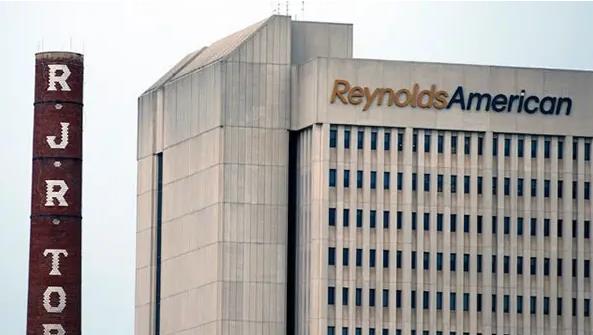
Reynolds Tobacco| Source: Tobacco Online
Previously, the patent litigation between BAT and PMI came to a temporary end. But things are unpredictable. The butterfly effect in Europe of public opinion about BAT testing for excessive ELFBAR compliance has not yet ended. IQOS iluma is preparing to enter the U.S. market. At such a complex and changeable time point, Renault Tobacco used unusual methods to conduct 26 Chinese and American electronic cigarette companies launched a 337 investigation, which shocked the industry. nbsp;
In this regard, what should e-cigarette companies involved in the case, especially China companies, do? Two Supremes (2FIRSTS) interviewed American practicing lawyer Grace and China e-cigarette legal expert Tang Shunliang. nbsp;
Renault Tobacco points out three major unfair competition behaviors
2FIRSTS: How is the 337 investigation launched by Renault Tobacco different from the past?
Grace: What makes this case very special is that it is not a traditional intellectual property case. Most of the 337 investigations we see on weekdays are based on intellectual property infringement and involve infringement issues of certain patents, trademarks and copyrights. nbsp;
But in fact, it is not the only case of intellectual property infringement that can reach ITC's litigation platform. The U.S. 337 investigation is based on the Customs and Excise Act of 1930, a trade relief law designed to protect U.S."domestic industries" from unfair imports. The unfair behaviors prohibited by this law include not only infringement of intellectual property rights, but also other unfair competition behaviors. nbsp;
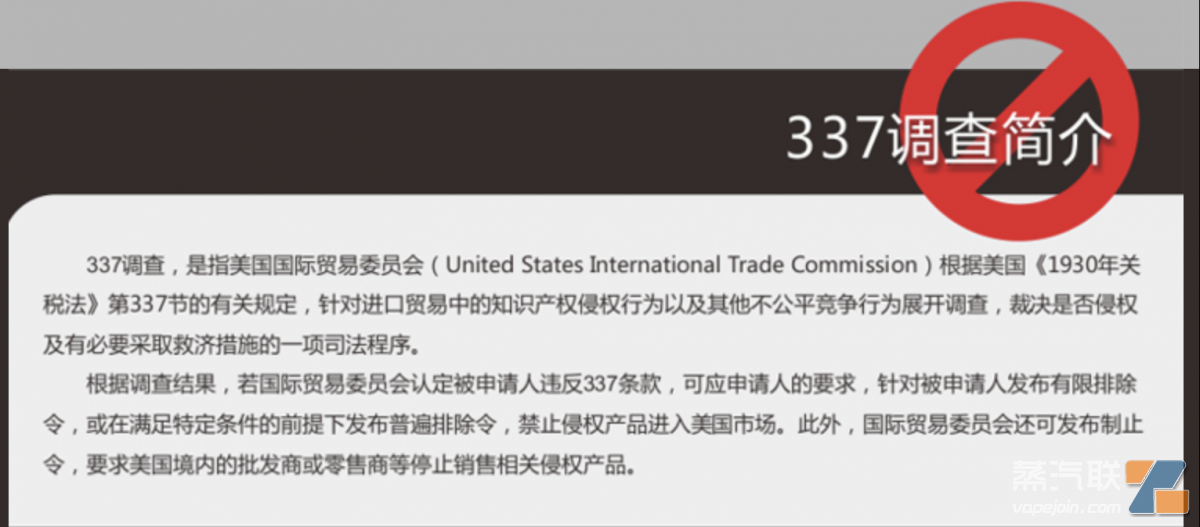
337 investigation| Source: Ministry of Commerce of China
In this case, Renault Tobacco claimed that all or part of the defendants in the case committed three categories of unfair competition:
First, there are false and misleading advertisements, such as falsely claiming that the product is a product "approved" by the US FDA but in fact it is not approved, claiming that the product is "Clear" but in fact it has flavor, using misleading or false names of origin;
Second, some defendants violated laws and regulations related to the federal regulation of the Electronic Nicotine Delivery System ("ENDS") in the United States;
Third, some defendants used incorrect customs codes. nbsp;
2FIRSTS: What impact will this case have on the sued company and industry?
Grace: We need to understand the relief methods of the 337 investigation. Anyone familiar with the U.S. 337 investigation process knows that the remedy for the 337 investigation is not compensation, but injunction, including exclusion orders and cessation orders. The exclusion order prohibits products with unfair competition from entering the United States, while the cessation order prohibits the continued sales of products (stocks) that have been imported into the United States. The latter is to prevent the defendant company from passing through the import window by hoarding large quantities. nbsp;
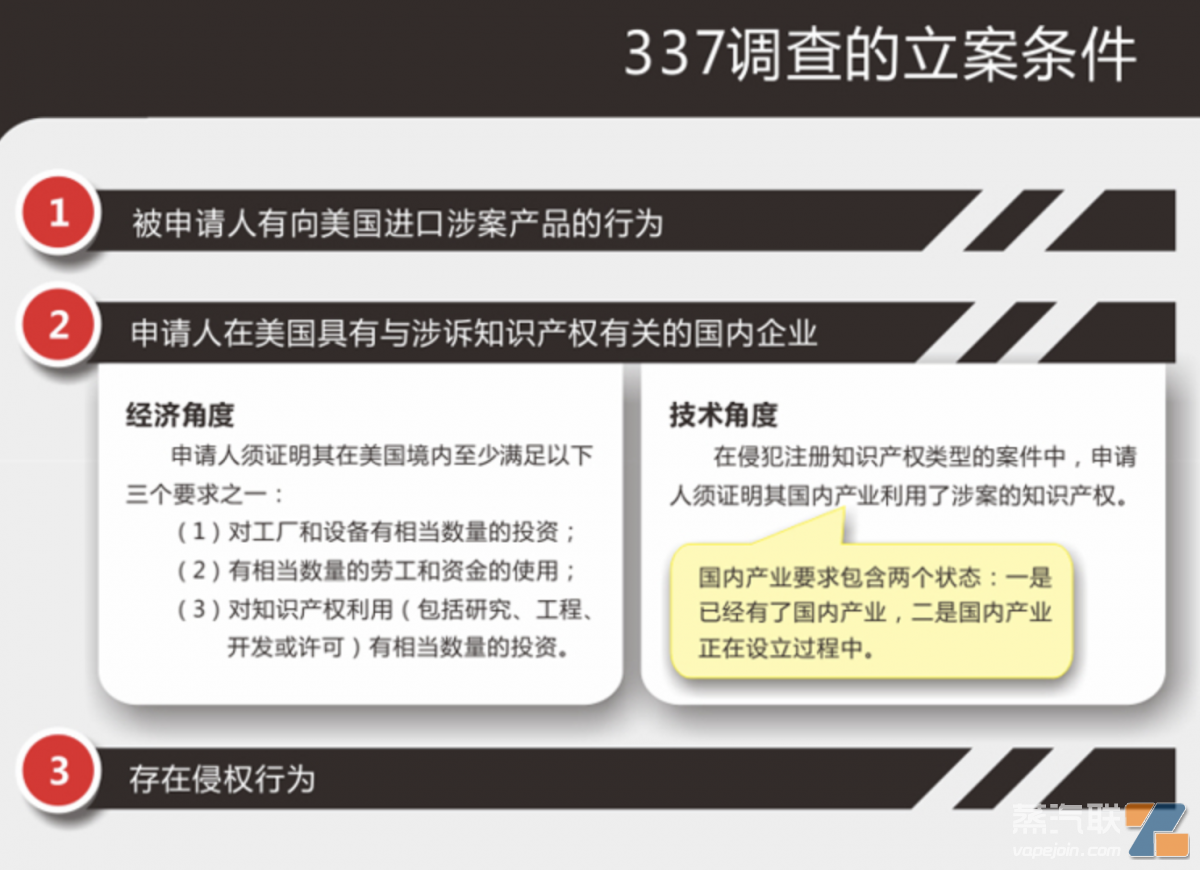
337 investigation| Source: Ministry of Commerce of China
Exclusion orders are divided into general exclusion orders and limited exclusion orders. The General Exclusion Order prohibits the import of all related products regardless of source. In other words, even if he is not the defendant (respondent) in the case, he will be prohibited from importing if he is not related to the respondent. Once a general exclusion order is issued, it will have a huge impact on the entire industry; as opposed to a general exclusion order is a Limited Exclusion Order, which prohibits imports from identified sources.# p#pagination title #e#
In this case, Renault applied for a general exclusion order. Renault specifically mentioned in the indictment that it is precisely because some China manufacturers and importers can easily circumvent the limited exclusion order by renaming and/or classifying their products. Therefore, Renault believes that only issuing a general exclusion order can protect domestic industries in the United States. nbsp;
In addition, it should be noted that the scope of the 337 investigation is very broad and is not limited to the product brands and models listed in the complaint. One-time imports into the United States suspected of related to unfair competition.e-cigarette productsand components may fall within the scope of the investigation.& nbsp;
Companies are advised to actively respond and comprehensively consider the cost of responding to the challenge
2FIRSTS: What is the procedure for this 337 investigation? How should China e-cigarette companies respond?
Grace: The pace of the 337 investigation is very fast. Generally, the ITC will decide whether to initiate an investigation within 30 days after the complaint is filed. In most cases, an investigation will be initiated. Evidence will be revealed soon after the investigation is launched, and litigation is generally completed in 16 to 18 months. Compared with cases in federal district courts, ITC progress much faster, which is a severe test of the company's ability to respond. nbsp;
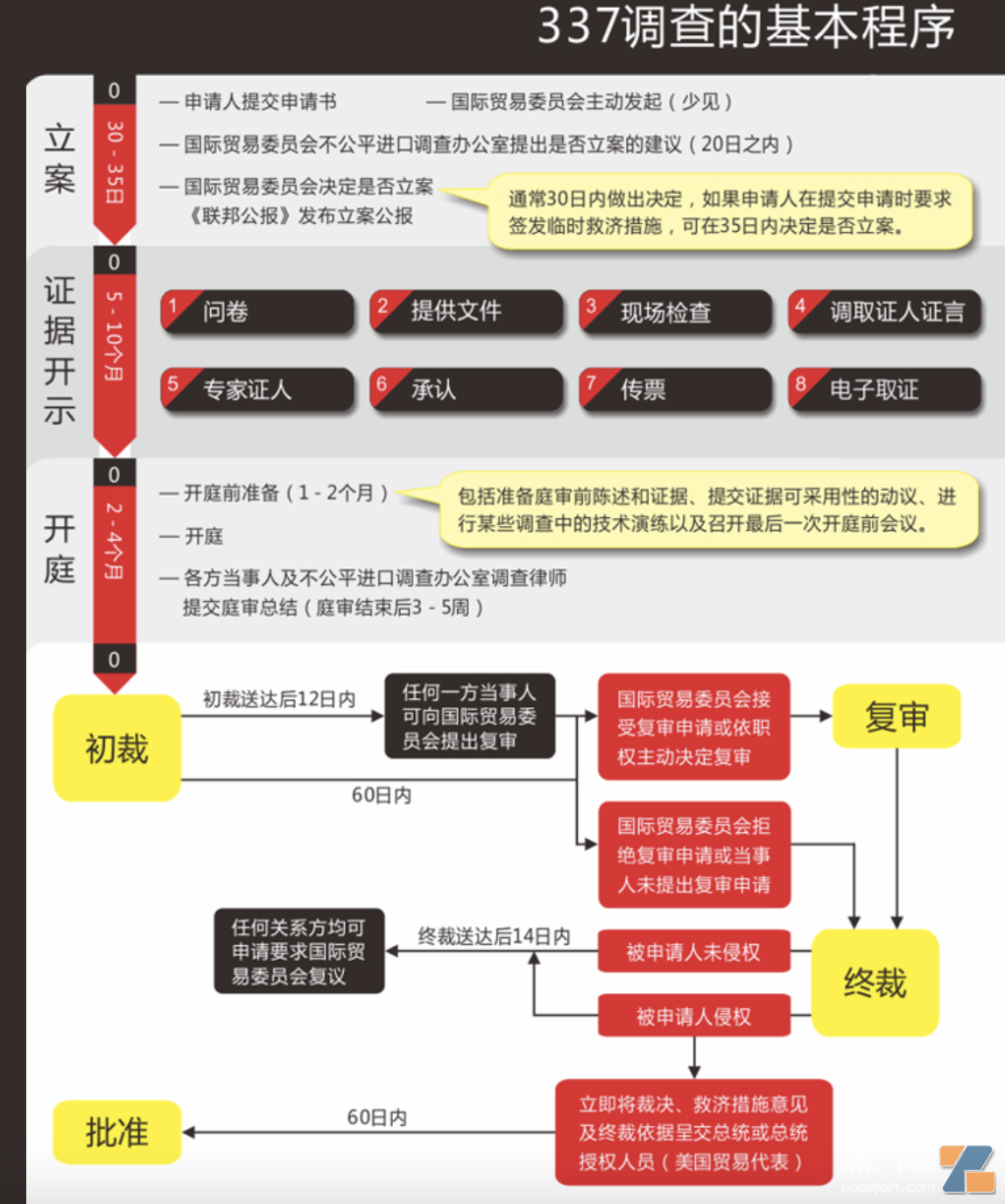
337 investigation| Source: Ministry of Commerce of China
We usually refer to the 30 days before the launch of an investigation as the "calm before the storm". These 30 days are a golden period for preparing to respond to the lawsuit. However, in reality, many China companies have been "wait-and-see" and "hesitant" after being sued, consulting lawyers but unable to make decisions, wasting an excellent response period. nbsp;
If we were not planning to abandon the U.S. market completely, we would advise companies to actively fight. There are many ways to fight, including seeking low-cost settlements; but if they did not fight or ignored them, they would be in a situation where they were being bullied, especially if the other party sought a general exclusion order. As for how much it costs to fight, companies can comprehensively consider it from the following perspectives:
1. How important is the U.S. market to the company, how much does it contribute to the company's turnover, and how much its future potential is;
2. In addition to the impact on turnover, how much impact will the case have on the company's brand image;
3. Whether the company has solid defense reasons;
4. The company's affordability of litigation costs.& nbsp;
Lawyers familiar with the business logic of e-cigarettes are needed more
2FIRSTS: As an expert who has long studied compliance and intellectual property issues in the field of e-cigarettes, what good suggestions does Lawyer Tang have on how to respond to the "337 Investigation" for China e-cigarette companies?
Tang Shunliang: In response to this investigation, China e-cigarette companies need lawyers who are familiar with the business logic of e-cigarettes, rather than previous patent lawyers. The relevant rules on e-cigarette supervision in the United States have been under frequent revision. The impact of this case involves the past, present and future of the U.S. e-cigarette supervision rules. It requires a lot of familiarity with the FDA's tobacco and e-cigarette rules, and also requires a review of previous e-cigarette jurisprudence. nbsp;
First, behind the frequent litigation is intensified competition, with big tobacco companies competing for the market and influencing rules.
This year, I have handled several cases involving foreign trade in e-cigarettes, all involving relatively large amounts of money. I have two points of experience:
1. China e-cigarette companies have no experience in responding to and managing overseas litigation, lack pertinent opinions from domestic professional lawyers in decision-making, insufficient coordination capabilities of the company's legal affairs, high budget costs and poor results;
2. Ignore other legal measures to contain opponents. Recently we were together abroade-cigarette brandsIn cases of breach of contract and complaint, litigation was decisively filed in accordance with China law, and important domestic trademarks of the opponent were preserved, achieving a very good counter-effect. In another patent lawsuit, countries other than the United States filed invalidity declarations against rival patents, opening a front to increase litigation costs and accelerating a settlement. nbsp;
Second, the impact of this case may exceed previous patent litigation and 337 investigation cases, and is related to the overall situation of China's e-cigarette industry.
1. The accusation in this case is not specific patents, but unfair competition on the face. The result will affect the entire industry and relevant government departments will also attach great importance to it. Judging from the content of Renault Tobacco's application documents, sufficient preparations have been made, and the lawyers have a large workload. The accused company is more divergent in preparing evidence and case cases than in responding to patent infringement, and it is more troublesome to deal with it than the 337 investigation into patent infringement. The prosecution and defense are more subjective and controversial;#p#paginated title #e#
2. Each business model needs to be considered, including its relationship with American brand owners and distributors. Especially if the U.S. partner is also included in this case, the response strategies, budget costs and agreements on how to coordinate and allocate the accused U.S. partners need to be finalized at a faster time. Otherwise, the two parties will entrust lawyers, and in the end, China companies will pay the bill, and the response costs will be difficult to control;
3. We do not recommend that China companies deal with it alone. If we do so, the professional levels of different lawyers entrusted will be different, and their defense opinions will even be contradictory. They will face the risk of breaking each other or high settlement, and the cost of connection and communication will also increase. From the perspective of lawyer recruitment, let's listen to Grace's opinions. nbsp;
Grace: At present, this case does not involve specific intellectual property infringement, but it does not rule out the possibility that Renault will subsequently add reasons and evidence for intellectual property infringement. At present, this case involves more broader concepts of unfair competition. It is recommended that companies need to take into account two aspects when selecting a lawyer team: the lawyer team must have sufficient ITC litigation experience (often an intellectual property team), and must also be sensitive to tobacco, especiallye-cigarette industryHave an in-depth understanding of its laws and regulations. Therefore, it is recommended that the team also need lawyers who are deeply involved in Sino-US e-cigarette regulatory compliance and litigation. Only by combining the professional skills and industry background of lawyers in China and the United States can we most efficiently help companies defend and respond to lawsuits. nbsp;
Grace is a practicing lawyer in the United States focusing on assisting China companies with legal and compliance challenges in the U.S. market. Grace has accumulated rich experience in U.S. litigation, including U.S. patent litigation, trade secret litigation, copyright infringement, antitrust and anti-unfair competition, the U.S. International Trade Commission's 337 investigation, and the U.S. Department of Justice investigations. Grace once served as a legal officer for a Shenzhen-listed company, responsible for all U.S. litigation of the company, and has unique insights on how to manage and respond to overseas litigation from a legal perspective. Grace is an intellectual property leader in the Guangdong-Hong Kong-Macao Greater Bay Area from 2021 to 2022, an expert in the overseas intellectual property rights protection assistance expert database of China (Shenzhen) Intellectual Property Protection Center, an expert in drafting the "International Compliance Management Code for Enterprise Intellectual Property Rights" standard, and an expert on the Expert Committee of the Guangzhou Development Zone Commercial Secret Protection Workstation, often teaches enterprises in the Greater Bay Area their experience in responding to U.S. litigation.