How Can Vaping Expand and Strengthen Its Share of the Market?
Analysis of Recent Developments in the Global Cigarette Market
According to the latest market trends, cigarette sales increased only in two regions: Asia-Pacific and Latin America. Meanwhile, Western Europe recorded its biggest decline in cigarette sales in a decade (down 4.4%), and North America posted the largest drop on record (down 8.5%).
Experts point out that under the combined pressure of health regulations and the rapid growth of reduced-risk products, the global cigarette market is expected to shrink by one-third by 2027 (Will the e-cigarette market claim one-third of the market?). However, the Chinese market may prove to be an exception.
Reduced-risk products are emerging and driving market divergence
In addition to regulation, the rise of new reduced-risk products is a major factor behind declining cigarette sales. Heated tobacco has become a leading reduced-risk option, with a market value far exceeding that of vaping devices. Although disposable vaping devices have seen strong growth, they also face controversy over environmental concerns and their appeal to younger consumers. Last year, reduced-risk products such as heated tobacco and vaping devices reached market values of US$32 billion and US$18.3 billion respectively, demonstrating robust growth. The market value of disposable vaping devices surged by 91%, and in Western Europe, one of their key regions, growth was close to 1000%.
The vaping market continues to expand
According to a new research report, the global vaping market is expected to grow from US$18.32 billion in 2022 to US$46.98 billion by 2030, with a compound annual growth rate of 12.49% during the forecast period.
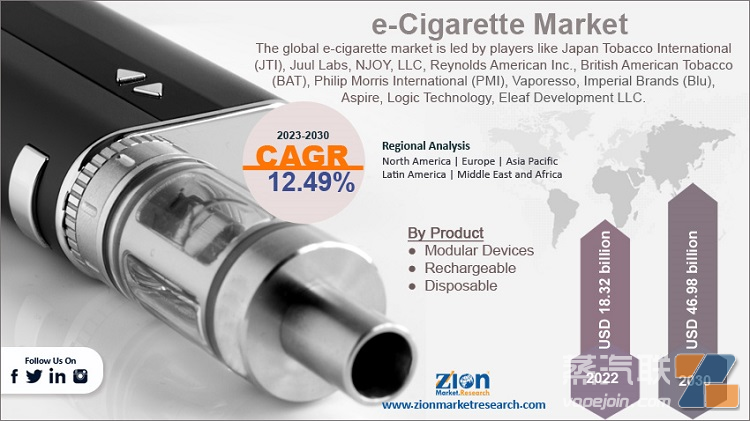
Although the vaping market is growing, it also faces challenges and safety concerns, along with stricter restrictions and regulation. Because of concerns about the appeal of disposable products to younger consumers, as well as environmental issues related to single-use lithium batteries, electronics, and plastic shells that must be discarded after each use, disposable products are particularly vulnerable to regulatory risk compared with existing rechargeable electronic products.
Disposable vaping devices have already been banned in New Zealand, and similar restrictions are being considered in a range of other markets including Germany, France, and the UK. In fact, the upcoming EU Battery Directive is also set to ban this type of product.
These market trends show that the cigarette market is evolving in different directions, but the rise of reduced-risk products is unstoppable. Over time, the industry will continue to be shaped by regulation and consumer demand, and future development remains highly uncertain.