One Year Since New E-Cigarette Regulations Took Effect: Shanghai Jiao Tong University Research Team
Recently, the research team from the School of Public Health at Shanghai Jiao Tong University released the "Report on the Characteristics of E-Cigarette Users and Public Health Impacts in China (2023)."

The "E-Cigarette Management Measures" and the mandatory national standard for "E-Cigarettes" are about to mark their one-year anniversary. According to the new regulations, only tobacco-flavored e-cigarette products are allowed for sale in the country, and all stages of production and retail must be certified, ushering the e-cigarette industry into a new era of standardized development.
Recently, the research team from the School of Public Health at Shanghai Jiao Tong University released the "Report on the Characteristics of E-Cigarette Users and Public Health Impacts in China (2023)." This study, led by Associate Professor Cai Yuyang, covers 31 provinces, cities, and autonomous regions in the country, with a total sample size of 2,000 people, making it the first research outcome focusing on the public health impact of e-cigarette users since the new regulations were implemented.
"There are about 16.9 million e-cigarette users in China, and their usage behavior may have changed somewhat over the past year," Cai Yuyang stated. "This study profiles the domestic e-cigarette user population and further investigates their awareness of the health impacts of e-cigarettes and their views on the new national standards for e-cigarettes and other aspects."
E-cigarette users are generally well-educated and have higher incomes, with 90% being former smokers
The survey found that domestic e-cigarette users are primarily well-educated, middle to high-income, and non-manual laborers, with 89% holding a college degree or higher; 61% of users have a monthly income of over 7,000 yuan.
At the same time, 92% of e-cigarette users in China are former smokers, meaning they started with traditional cigarettes before switching to e-cigarettes, indicating that e-cigarettes have little appeal to non-smokers, and the "gateway effect" is not significant.
"Previously, public health experts were concerned that e-cigarettes would become the 'first cigarette' for non-smokers," Cai Yuyang noted. "This survey found that the majority of e-cigarette users are traditional smokers, which is consistent with the findings published by the Chinese Center for Disease Control and Prevention in The Lancet - Public Health in 2020."
After switching to e-cigarettes, nearly 70% of users report health improvements
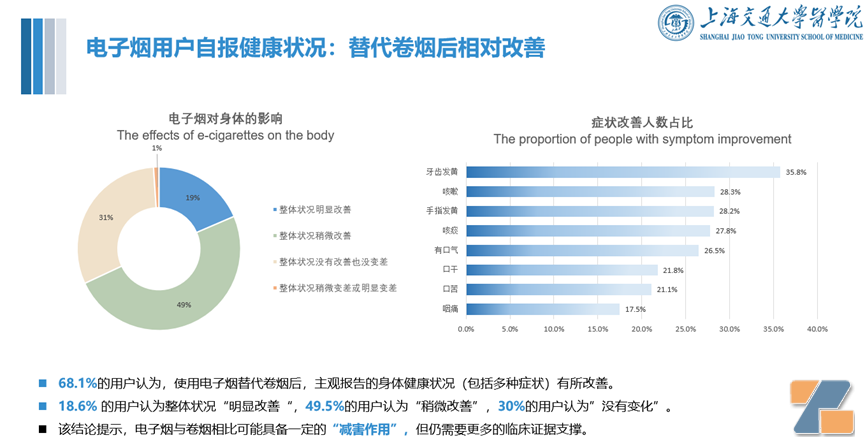
The survey focused on the impact of e-cigarette use on the health of smokers. Statistical data shows that 68.1% of those who switched from traditional cigarettes to e-cigarettes reported an improvement in their overall health, with 18.6% of users stating "significant improvement" and 49.5% stating "slight improvement."
The survey found that the use of national standard e-cigarette products is related to the degree of symptom improvement. Among users of national standard products, 30.3% reported improvement in coughing symptoms, while only 23.9% of non-national standard product users reported improvement in this symptom. Additionally, symptoms such as phlegm, sore throat, yellowing of teeth and fingers, bad breath, dry mouth, and bitter mouth also showed similar proportions.
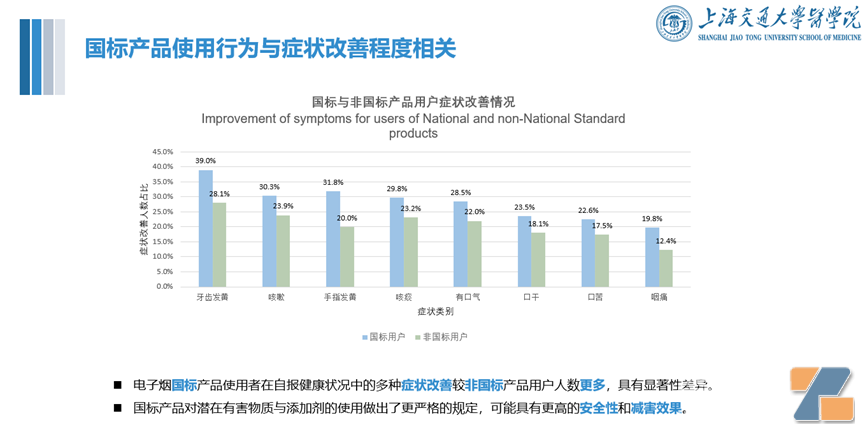
The report suggests that the national standard for e-cigarettes, which has been in effect since October 2022, has imposed stricter regulations on potentially harmful substances and additives, thus possibly increasing the safety of national standard products.
It is important to note that about 1% of users reported a deterioration in their health after using e-cigarettes, primarily manifesting as dry mouth and bitter mouth. The research team believes that the glycerin and propylene glycol in the e-liquid are hygroscopic, which may lead to mucosal dryness and oral discomfort. At the same time, 86% of e-cigarette users also use traditional cigarettes, necessitating further research on the health impacts of dual use.
E-cigarette gray market persists, with only 40% of users using national standard products
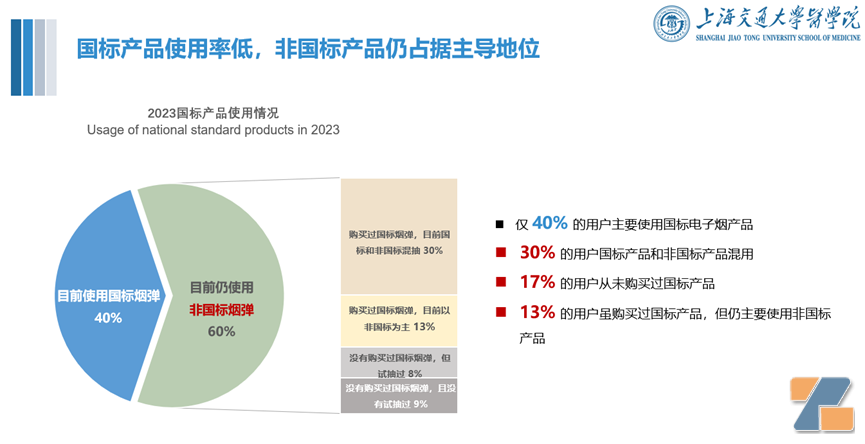
The survey found that only 40% of e-cigarette users primarily use national standard products, while non-national standard products dominate the current e-cigarette market, indicating a large gray market scale.
Among the non-national standard products recently used, 88% were refillable flavored e-cigarettes, with the most common flavors being mixed fruit/menthol pods, accounting for as much as 37%.
Additionally, the survey found that users generally have limited knowledge of e-cigarette regulatory policies. For example, the awareness rate for the prohibition of selling flavored e-cigarettes other than tobacco flavor is only 40%; nearly 10% of users are completely unaware of regulatory policies.
Illegal products such as mixed fruit flavors circulate through the black market, posing a serious threat to consumer health. Cai Yuyang suggests that regulatory agencies should adhere to the national standards for e-cigarettes and the "E-Cigarette Management Measures," intensifying efforts to combat the gray market and prevent the proliferation of illegal products to avert public health crises.
Expert Opinion: Changes in Symptoms of "Former Smokers" After Using National Standard E-Cigarettes Are Worth Noting
The report concludes that e-cigarette users report improved health status compared to when they used traditional cigarettes, and the issuance of national standards for e-cigarettes has somewhat standardized user behavior. However, Cai Yuyang also cautions that the survey data is based on user self-reports and perceptions, and further epidemiological and clinical research is needed for validation.
Based on the findings of this survey, the report presents five expert opinions.
1. With the principle of minimizing public health risks, actively consider the harm reduction demands of smokers and explore the application possibilities of harm reduction strategies.
2. E-cigarettes still carry health risks; minors must be prohibited from accessing and using them, and e-cigarettes should not be used in smoke-free areas.
3. Adhere to national regulations, strengthen market supervision, and avoid the proliferation of illegal products with unclear safety.
4. Emphasize scientific knowledge dissemination to enhance users' awareness of e-cigarettes and health literacy.
5. Conduct precise toxicological, cellular, animal, clinical, and epidemiological studies to clarify the long-term effects of e-cigarettes.
Cai Yuyang believes that further health economic assessments and analyses should be conducted based on scientific evidence. At the same time, attention should be paid to the health risks of dual users, with more clinical trials and longer-term follow-up studies to clarify the public health impacts of e-cigarettes.