Authorities Crack Down on 'High-Inducing E-Cigarettes' in Multiple Regions; New Drug Threat Requires
Recently, the police in Yangxin County, Hubei Province, seized a case involving the sale of "high-inducing e-cigarettes". The police confiscated 125 pods containing etomidate and 23 e-cigarette devices on-site.
It is understood that these "high-inducing e-cigarettes" are difficult to distinguish from regular e-cigarettes, but criminals have added synthetic cannabinoids and other components to the e-liquid, making it a new type of drug. Some criminals use various methods to entice young people to consume "high-inducing e-cigarettes", which is highly concerning. Regions such as Guangxi, Guangdong, Qinghai, and Shandong have launched actions to crack down on related crimes.
Frequent Cases of "High-Inducing E-Cigarettes"
Earlier this year, the Qinnan District Public Security Bureau in Qinzhou City, Guangxi, received reports from the public about someone selling "high-inducing e-cigarettes" in the urban area. After receiving the report, the police arrested three users and confiscated two used devices and three pods, subsequently capturing the supplier, Huang. Huang was sentenced to three months of detention and fined 3,000 yuan by the Qinnan District People's Court, with two mobile phones used in the crime confiscated.
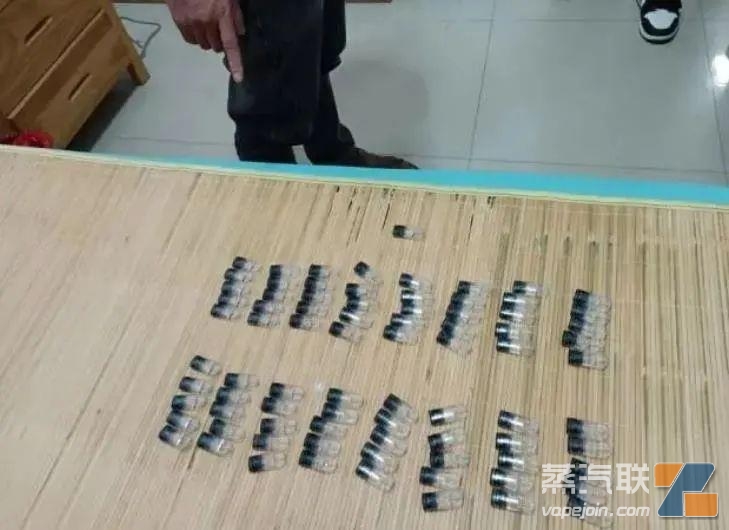
This is the "high-inducing e-cigarette" seized by the Qinnan District Public Security Bureau. (Photo provided by the Qinnan District Public Security Bureau)
Recently, the People's Court of Ruichang City, Jiangxi Province, tried a case where a "post-00" individual sold "high-inducing e-cigarettes" to minors, with defendants Wang and Ke sentenced to four years in prison; in another case in Tianxin District, Changsha City, Hunan Province, a "post-00" defendant named Xiao was sentenced to six months in prison...
Ouyang Xiaojin, head of the Criminal Trial Division of the Qinnan District People's Court, stated that new drugs disguised as trendy products are highly deceptive. Some teenagers and young adults, either lacking discernment or unable to resist temptation, view consuming "high-inducing e-cigarettes" as a fashionable lifestyle, often leading them astray.
New Characteristics of Drug Crimes
Investigations reveal that under the coordinated crackdown by various departments, the rampant situation of new drugs has been significantly curbed, but some criminals still take risks for profit. Police in multiple regions have indicated that current crimes exhibit the following characteristics:
——"Internet + Logistics + Electronic Payment" Crime Model.
The Beijing High People's Court reported that drug crime methods have become increasingly networked, with nearly 70% of drug transactions relying on the internet, commonly using non-contact methods such as "Internet + logistics + electronic payment", making evidence collection and case handling more challenging.
Industry insiders explain that criminals use social media like WeChat to facilitate transactions, relying on logistics services like express delivery for shipping. The Haiyan County People's Court in Zhejiang previously ruled on a case where a delivery person specialized in delivering "high-inducing e-cigarettes", selling to 18 clients through mailing and delivery methods, with drug sales reaching 255 times. Research indicates that "online transactions" make the buying and selling of new drugs more concealed and widespread, with parties typically using coded language for communication.
——Concealed "Circle Transactions".
Interviews reveal that those selling new drugs often conduct transactions offline through acquaintances. Sun Lingling, vice president of the Beijing High People's Court, noted that since 2020, among the 1,143 drug offenders legally punished, 48.2% were repeat offenders, with over 60% engaging in "selling to support use".
Li Yang, head of the Criminal Division of the Intermediate People's Court in Chongzuo City, Guangxi, stated that the sale of drugs like "high-inducing e-cigarettes" across provinces is common, with drug dealers distributing through online transactions.
Strengthening Full-Chain Crackdown
As of July 1, 2021, China officially classified all synthetic cannabinoids and other new psychoactive substances as controlled substances, meaning all varieties of synthetic cannabinoids are legally considered drugs. Police in multiple regions have indicated that "high-inducing e-cigarettes" have become significant tools related to drug offenses.
Li Yang and others stated that relevant departments should actively trace sources, conduct special operations periodically, and legally investigate the sale of e-cigarettes to minors, as well as severely crack down on cases involving the addition of synthetic cannabinoids to e-liquids, implementing a full-chain crackdown.
Industry insiders suggest that with the development of internet technology, the logistics industry, and online payment platforms, drug crimes are gradually forming a characteristic of delivery in circulation links, with logistics personnel and mail recipients potentially becoming part of the criminal chain.
"We should continuously strengthen delivery safety supervision and enhance online regulation," Ouyang Xiaojin said, emphasizing the need for periodic inspections targeting the "Internet + delivery" drug crime model, and implementing multiple measures in the express delivery industry to block the sales channels of "high-inducing e-cigarettes."#p#分页标题#e#
Additionally, there should be increased anti-drug publicity regarding new drugs, enhancing public awareness and ability to identify, prevent, and refuse drugs. Yang Hongwen, a professor at the Law School of Guangxi Minzu University, stated that addressing new drug crimes requires not only post-event crackdowns but also strengthening prevention, guiding the public to fully recognize the dangers of new drugs. Relevant departments should enhance anti-drug publicity, and society, schools, and families should work together to educate young people about relevant legal knowledge.