200,000 mental health patients die from cigarettes each year, latest study says switching to e-cigar
Recently, a research team from the University of California published a paper in the prestigious medical journal The Journal of General Internal Medicine, stating that e-cigarettes can help smokers with mental health issues, such as depression and autism, quit traditional cigarettes, and have significant harm reduction effects. Psychiatrists should promote e-cigarettes to their smoking patients to save their lives.
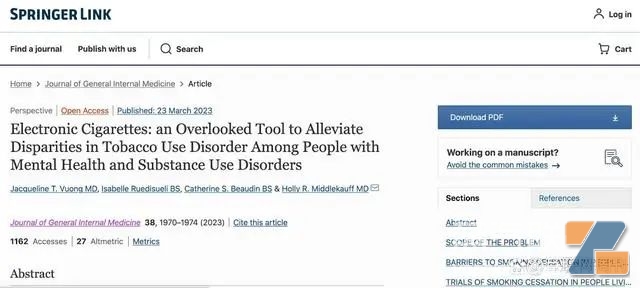
Image: The research paper published in The Journal of General Internal Medicine
Patients with mental health issues are among the most severely affected by the dangers of smoking. In the United States, the smoking rate among individuals with mental health issues (number of cigarette users/total number * 100%) is about 25%, which is double that of the general population. Among the 520,000 deaths caused by cigarettes each year, approximately 40% are individuals with mental health issues. "We must help smokers with mental health issues quit smoking. However, they have a high level of nicotine dependence, making traditional quitting methods nearly ineffective. We need to find new methods tailored to their characteristics and needs," the authors wrote in the paper.
The World Health Organization defines quitting smoking as "Quitting tobacco," meaning the cessation of tobacco use, as nicotine in cigarettes is not carcinogenic; the health risks come from the nearly 7,000 chemicals and 69 carcinogens produced by the combustion of tobacco. E-cigarettes do not contain the combustion process of tobacco, which can reduce 95% of the harm caused by traditional cigarettes, and researchers believe they have the potential to become a new quitting tool.

Research shows that smokers with mental health issues who use e-cigarettes to quit have a significantly higher success rate than those using other quitting methods. The authors of the paper pointed out that this is because individuals with mental health issues find it more challenging to overcome withdrawal symptoms such as irritability, anxiety, and headaches, while the actions and experiences of using e-cigarettes are similar to those of traditional cigarettes, making them effective in alleviating nicotine withdrawal symptoms.
E-cigarettes are also more readily accepted by smokers with mental health issues. Studies have found that many patients with mental health issues resist quitting medications offered by doctors, but among those who want to quit, 50% actively choose to switch to e-cigarettes.
Psychiatrists should take the initiative to make changes. For a long time, to bridge the gap with patients, most psychiatrists have not actively encouraged patients to quit smoking, and some even give cigarettes as rewards to hospitalized patients. E-cigarettes have significant harm reduction effects, are easily accepted by smokers with mental health issues, and have clear quitting assistance effects. Psychiatrists can certainly recommend e-cigarettes as a "treatment" tool for smoking patients.
"The smoking rate in the United States is declining year by year, but the smoking rate among individuals with mental health issues continues to rise. We need to pay attention to this. E-cigarettes may not be a panacea, but they are particularly effective in helping smokers with mental health issues quit and reduce harm. If mental health institutions can recognize this scientific evidence and promptly promote e-cigarettes to smoking patients, it could save hundreds of thousands of lives in the future," the authors wrote in the paper.