RELX Is Still Pedaling Hard While Other Brands Struggle in Cutthroat Competition
Recently, RELX's parent company, Fogcore Technology, released its unaudited financial report for the second quarter of 2023.
The report shows that the company's revenue for the second quarter was 380 million RMB, a year-on-year decrease of 83.1%; the adjusted net profit under non-GAAP was 86.2 million RMB, a year-on-year decline of approximately 86.4%, compared to 634.7 million RMB in the same period last year.
As the "big brother" of the e-cigarette market, RELX has experienced significant ups and downs in recent years. It rapidly rose to prominence in just three years, with distributors spread across the country and RELX stores visible in shopping malls, but within just two years, it faced severe regulatory challenges, leading to declines in profitability, scale, and secondary market performance.
Fortunately, the market leader position still belongs to RELX. With the implementation of a series of policies, the e-cigarette market is gradually becoming standardized. RELX is starting to regain its vitality in this slightly recovering market, leveraging its existing advantages.
However, the e-cigarette industry has a low technical threshold and relatively low production costs. Despite RELX occupying half of the market, it still faces considerable competitive pressure. Especially in the current uncertain market environment, RELX's future remains quite challenging.

Year-on-Year Decline, Quarter-on-Quarter Recovery
The revenue and profit decline reported by Fogcore Technology was not unexpected by the market, and even exceeded market expectations.
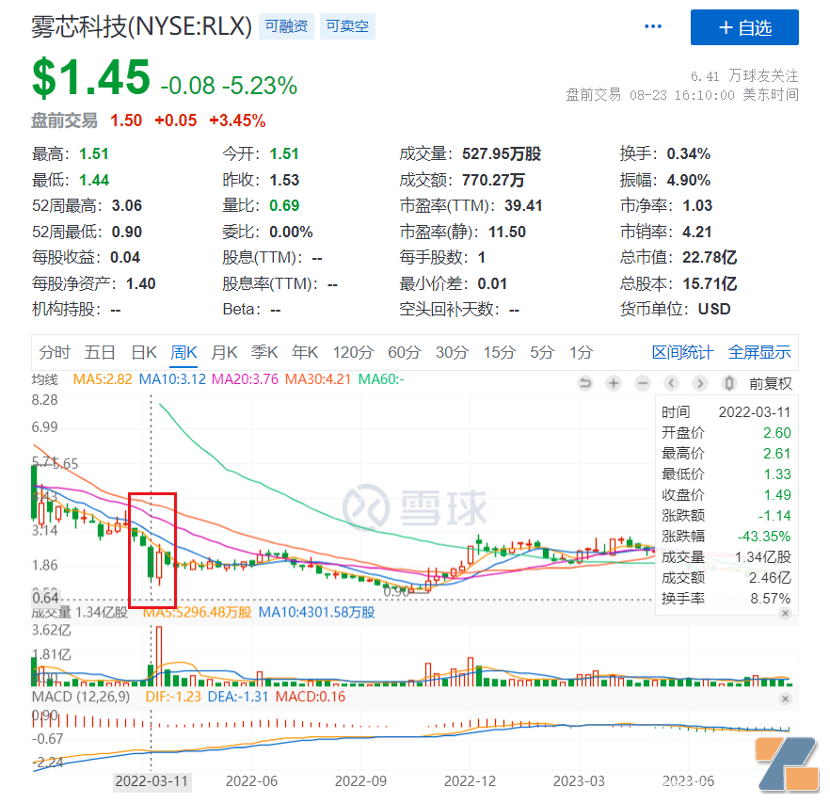
On March 11 last year, China's "E-cigarette Management Measures" were released, requiring companies in the industry to obtain licenses for manufacturing and selling products, including disposable e-cigarette devices.
On that day, Fogcore Technology, listed on the US stock market, plummeted by 20%, hitting a low of $1.88, a staggering 95% drop compared to its historical high of $39.11 shortly after its listing.
Source: Xueqiu
It is understood that the subsequent release of new national standards for e-cigarettes clarified the basic components, processes, additives, and the temperature of the aerosolization area. For example, the new standards require that the aerosol should contain nicotine, should not induce minors, and should not present flavors other than tobacco.
The variety of flavors is a major reason why consumers are gradually attracted to and dependent on e-cigarettes. Data shows that fruit flavors and other types previously accounted for about 90% of the market share. The ban on producing "fruit-flavored" e-cigarettes is akin to losing half of one's life for Fogcore Technology.
This policy's impact does not stop there; to survive, Fogcore Technology must also develop and produce new products that meet the standard requirements, which means significant expenditures.
The fourth quarter financial report from last year showed that Fogcore Technology's product development costs skyrocketed from 17.8 million RMB in the same period last year to 130 million RMB, a sevenfold increase.
But the "bad" news doesn't end there. At the end of September 2022, the National Tobacco Monopoly Administration issued a notice on strengthening the regulation of e-cigarettes, pointing out a series of related issues. By November 2022, regulatory agencies began imposing a 36% consumption tax on e-cigarettes.
A series of "iron fist" policies have plunged e-cigarette players into a dark moment, and the era of high profits has become a thing of the past. As the industry leader, the losses for Fogcore Technology are immeasurable.
The good news is that with a proactive attitude towards rectification, Fogcore Technology is beginning to become more standardized. In mid-July 2022, Fogcore Technology announced that it had obtained a tobacco monopoly production enterprise license, with approved annual production capacity including 15.05 million vape pens, 329 million pods, and 6.1 million disposable e-cigarette products.
Although this limits production capacity, it also serves as a "stabilizing factor" for Fogcore Technology. As long as it operates legally and compliantly, things will eventually improve.
In fact, Fogcore Technology's revenue decreased by over 80% year-on-year in the second quarter, but there was a quarter-on-quarter improvement. The financial report shows that Fogcore Technology's net revenue for the second quarter of 2023 was 380 million RMB, a quarter-on-quarter increase of 100.2%.
Some analysts believe that the quarter-on-quarter growth indicates improvement, but this may be due to the replenishment of inventory needs after the first quarter's sales of previous stock.
#p#分页标题#e#
Illegal Products Resurge
Regarding the "year-on-year decline" in financial data, Fogcore Technology attributes the main reason to "illegal products".
Fogcore Technology's founder, chairman, and CEO Wang Ying stated: "The recent resurgence of illegal products has affected the industry's recovery pace, but we believe these disturbances are temporary, and national standard products will gradually replace inferior illegal products and regain user trust."
Fogcore Technology's CFO Lu Chao also stated: "In the face of external challenges, especially the interference from illegal products, we still focused on improving operational efficiency and profitability in the second quarter."
Indeed, after the national new standards were introduced, the banned fruit-flavored e-cigarettes became "scarce goods". Some "underground" e-cigarette manufacturers and distributors are still producing and selling fruit-flavored e-cigarettes without licenses.
Since the beginning of this year, a large number of e-cigarettes labeled with "milk tea cup" and "cola can" have been seized across various regions, all featuring cartoon designs and various fruit flavors.
Even with significant crackdowns, the lure of huge profits still drives many to take risks. Numerous illegal operators utilize social media to sell large quantities of non-compliant e-cigarettes through express logistics.
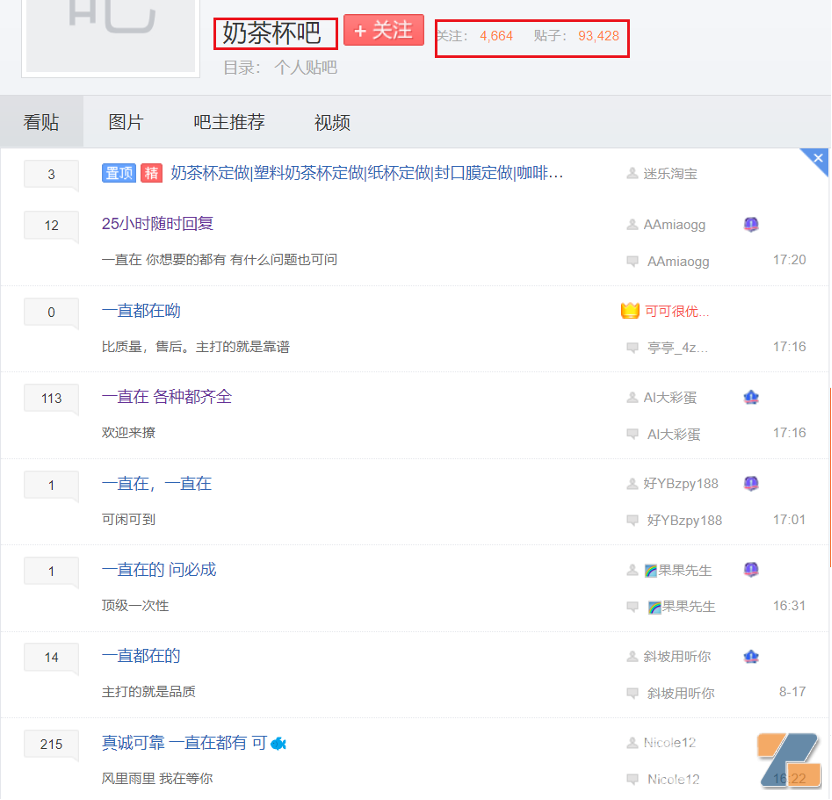
Through Baidu Tieba's "Milk Tea Cup Bar", Zinc Finance discovered that the bar is filled with various advertising posts, mostly titled "Available for all flavors!", "Always here", "Always fully stocked"... with WeChat IDs left in the posts.
Source: Baidu Tieba - Milk Tea Cup Bar
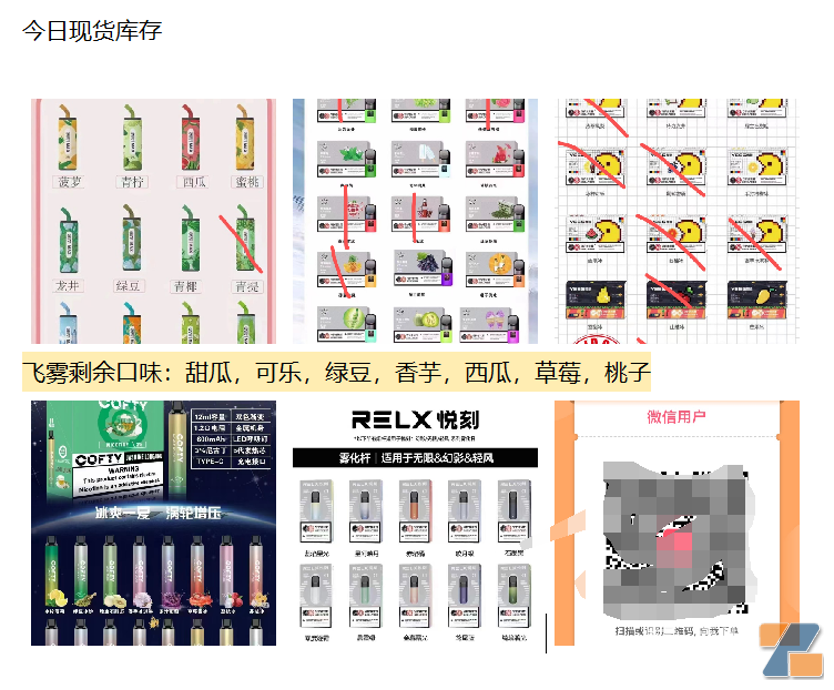
According to the "guidelines", Zinc Finance added a contact named "Twenty-Three" who is an e-cigarette "distributor". This distributor sent Zinc Finance a note titled "Today's Stock Inventory", showing remaining flavors like sweet melon, cola, mung bean, and taro, along with RELX's "fruit-flavored" series products, accompanied by relevant images.
Source: Zinc Finance
After a brief conversation, this distributor offered e-cigarette pods with specifications of "3%, net content 1.9ml 3PODS" for 90 RMB for three boxes with free shipping. Throughout the conversation, there was no inquiry about the "buyer's" age or any specific product introduction.
In addition to "Twenty-Three", Zinc Finance also connected with several other e-cigarette "distributors" through other social media, with similar selling methods. These distributors display illegal e-cigarette products in images and use "misspellings" to evade account bans, as well as using other accounts for payment to avoid financial risks.
It is understood that the cost of producing a counterfeit e-cigarette is only a few RMB, but it can be sold to consumers for as much as one or two hundred RMB. The lure of huge profits has led to an increase in those who take risks, forming a black industrial chain that significantly impacts e-cigarette manufacturers who have obtained the necessary production and sales permits.
Of course, attributing the main reason to this seems somewhat "shifting the blame".
Hard to Return to Glory, Future is Grim
RELX's growth process can only be described as "rapid advancement".
Founded in January 2018, RELX officially launched with the paradoxical core selling point of "smoking cessation". Within just a few months, it became China's best-selling e-cigarette. In June of the same year, RELX secured 38 million RMB in financing led by Source Code Capital and followed by IDG Capital, becoming a darling of capital.
With the backing of capital, RELX formed strategic partnerships with well-known companies like Tencent and Baidu, leveraging their strong traffic and resource advantages to rapidly increase exposure and user attention.
By the second quarter of 2020, RELX's market share had reached 74%, effectively monopolizing the industry. Since then, domestic e-cigarette brands have been reduced to two: RELX and "others".
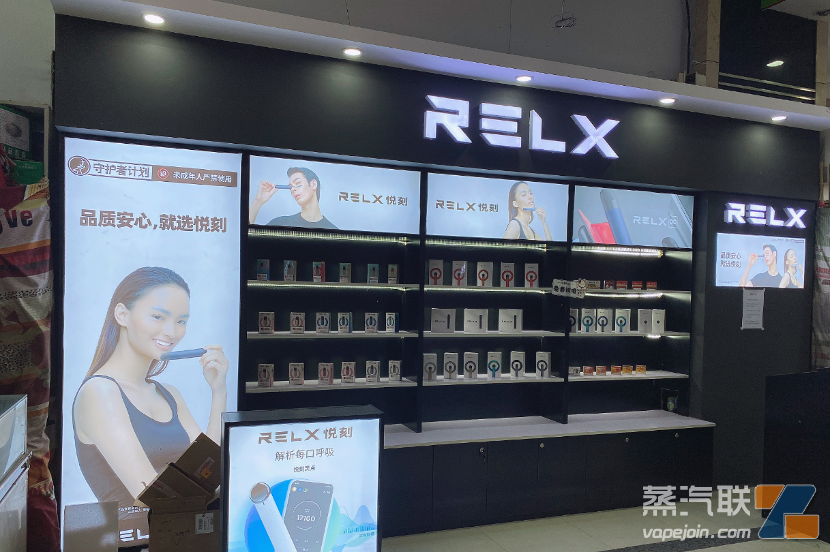
Image: RELX store in a shopping mall
#p#分页标题#e#On January 22, 2021, just three years after its establishment, RELX's parent company, Fogcore Technology, successfully listed on the New York Stock Exchange, becoming the "first e-cigarette stock".
On its first day of trading, Fogcore Technology's issue price was $12 per share. The opening price was $22.34, an 86% increase from the issue price, and due to a surge during trading, it triggered a trading halt. By the end of the day, Fogcore Technology closed at $29.51 per share, a rise of approximately 145.92%, with a market capitalization of $45.8 billion, equivalent to 300 billion RMB.
After the glory, there must be shadows. The subsequent story is well-known; with the landing of various "boots", the "tower" built by RELX collapsed.
As of August 24, Fogcore Technology's stock price was $1.45 per share, with a total market capitalization of $2.278 billion.
Overall, Fogcore Technology's current "decline" is not limited to the capital market. As mentioned earlier, e-cigarette manufacturers are currently required to pay a 36% consumption tax, which means that to maintain profitability, RELX must raise prices. However, raising prices may lead to a loss of market competitiveness.
Moreover, aside from the impact of "black workshops", competition in the e-cigarette industry remains fierce.
From the product perspective, most domestic e-cigarettes currently have low technical content, with almost all brands mastering the "core" technology of e-cigarettes, while the business model is generally based on OEM, with brand owners primarily investing in marketing and promotion.
RELX's products may exceed those of other brands, but other brands will not be far behind. With the continued tightening of regulations, it is expected that e-cigarette players will further increase their investments in marketing, brand building, and other areas.
A true industry reshuffle may be on the horizon. Faced with such a harsh reality and a grim future, it seems difficult for RELX to return to its peak.