Revisiting the Australian Market: Why Pharmacy Sales Are Highly Likely to Become the Norm
In last week's tweet "Australia Tightens Regulations: RELX, IGET, and Others Found with Prohibited Ingredients, Compliance for E-cigarette Companies is Urgent", we provided an overview of Australia's e-cigarette regulations, indicating that the regulation of e-cigarettes in Australia has actually entered a "transitional period." Mark Butler, the Minister of Health and Aged Care who took office last year, has roughly outlined the following directions:
● Disposable products will be phased out of the Australian market;
● Strict enforcement against products not fully registered as prescription medicines in the ARTG;
● Push for updates to existing e-cigarette product standards TGO110;
● E-cigarettes in Australia will further align with medicines;
Due to space constraints, we omitted many details in the previous tweet. To help everyone better understand Australia's e-cigarette regulations, we will provide further supplements in this tweet for better reading.
What other restrictions exist for e-cigarettes in Australia?
As mentioned in the previous article, e-cigarettes in Australia were classified as prescription medicines in 2021 and are regulated by the Therapeutic Goods Administration (TGA), which is part of the Department of Health and Aged Care (DHAC). Therefore, they must meet two standards: the first is the Nicotine E-cigarette Product Standard (TGO 110), and the second is to complete the prescription medicine registration in the ARTG.
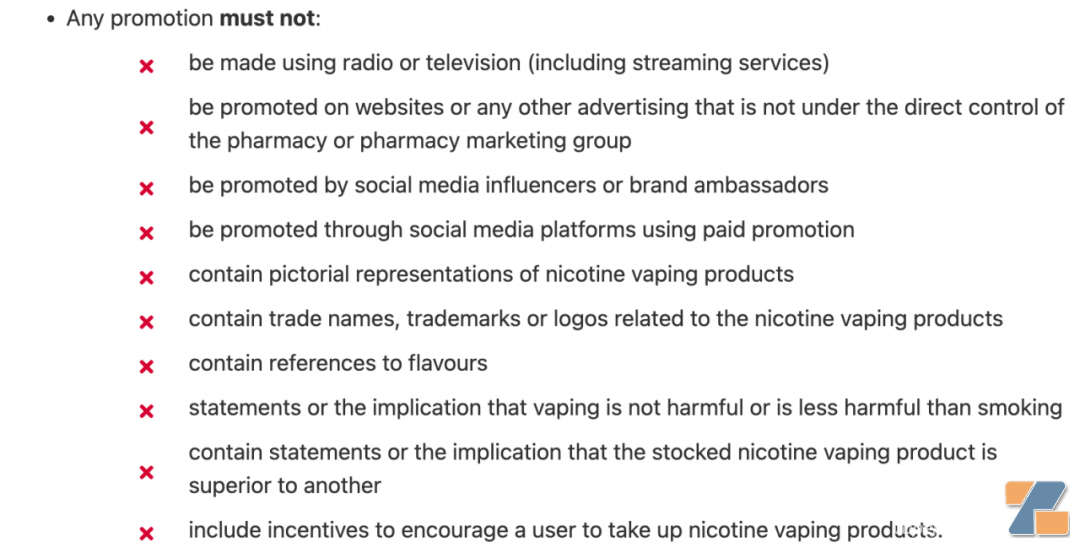
So, another question arises: can e-cigarettes be advertised in Australia? The answer is no. They enjoy the same advertising restrictions as prescription medicines—there is almost no marketing space. The official definitions of promotional restrictions include:
● Advertising via broadcast or television (including streaming services);
● Promotions on websites or any other advertisements not directly controlled by pharmacies or pharmacy marketing groups;
● Promotions by social media influencers or brand ambassadors;
● Paid promotions through social media platforms;
● Displaying images of nicotine e-cigarette products;
● Including product names, trademarks, or logos related to nicotine e-cigarette products;
● Mentioning flavors;
● Stating or implying that vaping is less harmful or less dangerous than smoking;
● Claims or implications that stock nicotine e-cigarette products are superior to other products;
● Incentives encouraging users to use nicotine e-cigarettes;
Additionally, aside from the restrictions imposed by being classified as prescription medicines, Australia has two product standard restrictions that must be adhered to: child safety packaging and information retention systems.
Can products not registered as prescription medicines be sold? How does Australia regulate this?
Regarding this issue, Australia has left a way out, but it is essentially negligible. For prescription medicines that have not yet completed registration (e-cigarettes are currently in this state), Australia has provided three pathways: Special Access Scheme (SAS), Authorised Prescriber (AP) Scheme, and clinical trials for legal supply:
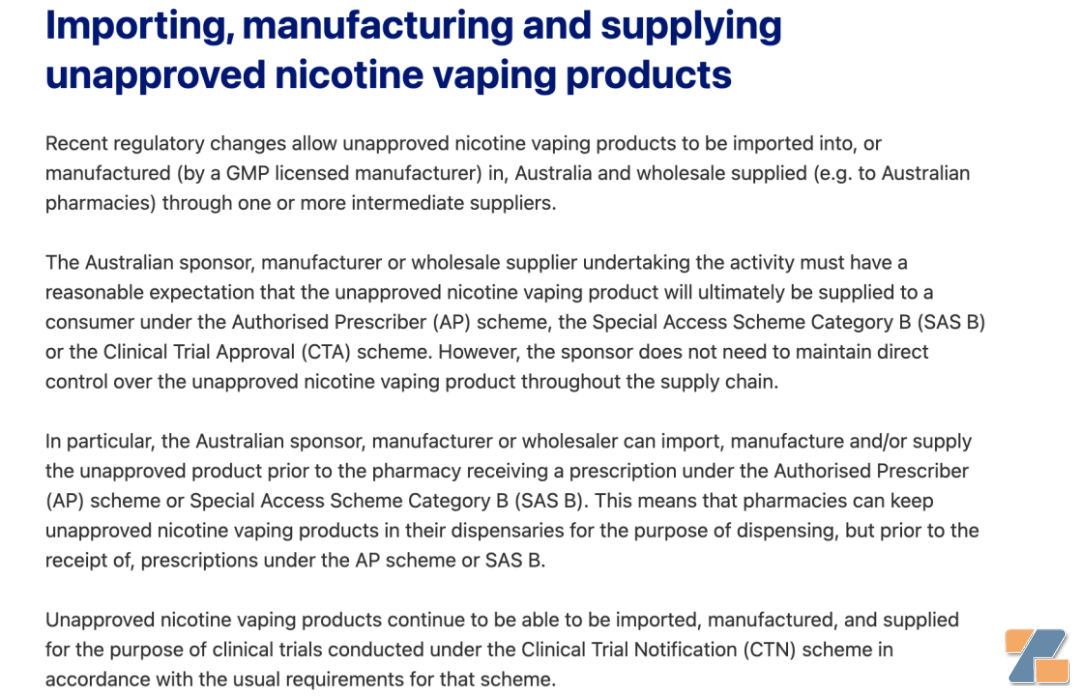
As the names suggest, those who can take these paths are either key new drugs or a few doctors who can endorse them. Clearly, none of these options are viable for e-cigarettes—this has led to all e-cigarettes entering Australia being in an unapproved state.
So, how has Australia ensured that products meet standards when no e-cigarettes have completed ARTG registration in recent years? Unlike some countries or regions that directly declare compliance with testing reports, Australia requires the TGA laboratory to test products entering the Australian market, with the standards being the previously mentioned TGO110, focusing on:
● Nicotine testing: Checking if the nicotine content is within compliance limits;
● Prohibited ingredient testing: Checking for the presence of the eight prohibited ingredients specified in TGO110;
● Product label testing: Monitoring whether the packaging labels of e-cigarette products comply with TGO 110 regulations;
If any of the above three tests fail, the likelihood of receiving a warning, being seized, and having the products destroyed is very high.
The tightening of regulations in Australia is not without warning
On May 2 this year, Mark Butler officially announced the "May New Policy": measures include: stopping the import of non-prescription e-cigarettes; raising the minimum quality standards for e-cigarettes; requiring e-cigarettes to use packaging similar to medicines; reducing nicotine; and banning all disposables. For the e-cigarette industry, these measures are potentially fatal. However, there were signs before this.
On April 20 this year, the TGA issued a notice of infringement, mentioning that it had sent nine infringement notices to three companies in Sydney and two related individuals for "attempting to import nicotine e-cigarette products (prescription medicines) that are not registered in the Australian Register of Therapeutic Goods (ARTG), and (the relevant products) cannot be exempt from registration."
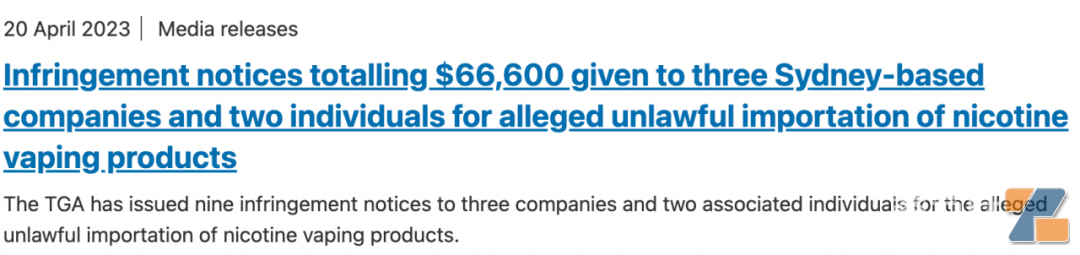
Click to input image description (up to 30 characters)
This can actually be seen as a signal from the TGA declaring war on non-prescription e-cigarettes, as prior infringement notices issued by the TGA regarding e-cigarettes were mainly focused on prescription e-cigarettes not being allowed to advertise illegally or individuals making unauthorized declarations:
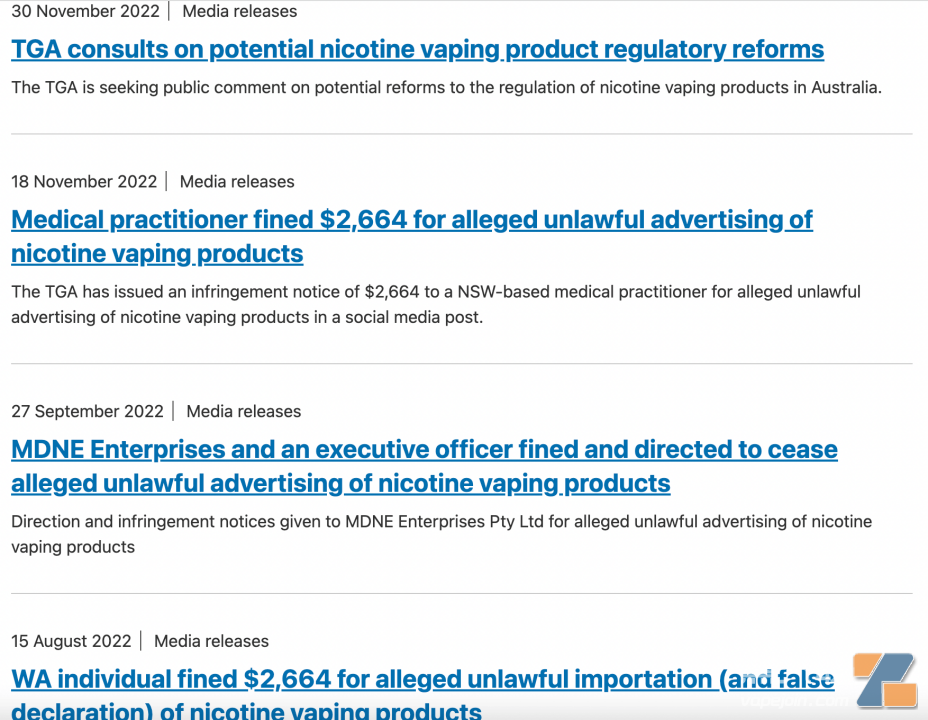
Only after this did the TGA take action. On June 13, 2023, the TGA issued 38 infringement notices to four companies in Sydney, totaling AUD 588,840, for allegedly importing 22 batches of goods, including a total of 379,600 nicotine e-cigarettes. The official wording in the TGA notice explicitly stated:
"Attempting to import nicotine e-cigarettes (prescription medicines) that are not registered in the Australian Register of Therapeutic Goods (ARTG) and do not meet relevant standards; TGA laboratories tested samples of imported IGET, GUNPOD, and HQD brand disposable e-cigarettes and found that they contained prohibited ingredients listed in TGO 110."
The handling measures were that they were intercepted by the Australian Border Force and will be seized and destroyed according to TGA recommendations; it was also emphasized again that "on May 2, the Minister for Health and Aged Care announced that the Australian government is taking strong action to combat illegal e-cigarette supply."
In other words, the June 13 action can be seen as a warning to the e-cigarette industry that "serious measures are being taken." One signal is that we have organized the recent movements announced by Minister Mark Butler, which in June focused on collaborating with Australian states and territories to strengthen e-cigarette regulation through state law.
In conclusion
Based on the recent trends in Australia, we speculate that the entire market logic may be overturned in the future. In the previous tweet, we mentioned that Philip Morris International directly offered 80% profit to pharmacies as bait to sign supply agreements for the VEEV e-cigarette. Given Philip Morris International's sensitivity to regulation—selling e-cigarettes only in pharmacies may very well become the norm in the future.
Although Simon Chapman, an honorary professor of public health and tobacco control at the University of Sydney, accused PMI of playing a long game by disrupting market competition to undermine the prescription model for obtaining e-cigarettes, he believes that pharmacists should not reach agreements with VEEV; a spokesperson for the Pharmaceutical Society of Australia also stated that the association "urges pharmacists to be skeptical of any commercial offers from large tobacco companies," as no e-cigarette has yet obtained AGTG registration.
However, Richard Lee, CEO of Liber Pharmaceuticals, which supplies nicotine e-cigarettes to retail pharmacies across Australia, confirmed that he knows many pharmacies have signed agreements with VEEV—pharmacies find it hard to resist the financial pressure.
How to connect sales channels with pharmacies across Australia may be a challenge that Chinese e-cigarette companies will have to face in the future.