Involving E-Cigarette Regulation: FDA to Hold Public Discussion on 5-Year Strategic Plan on August 2
According to recent updates from the FDA, a public hearing will be held on August 22 regarding the FDA's 5-year strategic plan. This hearing is a response to the recommendations made by the Reagan-Udall Foundation (RUF) regarding the FDA's work in the PMTA area, which stated that the FDA's regulation of e-cigarettes lacks a clear, comprehensive long-term plan, with vague and unnecessarily complex regulatory standards. As a result, the FDA has undertaken a series of internal reviews and reorganizations based on these recommendations. On June 29, Brian King, the director of the FDA's Center for Tobacco Products (CTP), announced the results of these efforts and previewed related plans, including: 1. The CTP is expected to draft a strategic plan this summer and release a final plan by December 2023. 2. The CTP's Office of the Inspector General is leading the development of an operational plan to enhance transparency and information sharing across all plans, including establishing transparency contacts. 3. The CTP plans to hold a public meeting this summer to solicit feedback from tobacco industry stakeholders on the strategic plan. 4. The CTP has reviewed PMTA applications submitted over the past three years and authorized 23 tobacco-flavored e-cigarettes. 5. The CTP currently plans to hold a public meeting in the fall of 2023 to discuss the PMTA application review process. 6. The CTP has recently introduced new requirements for tobacco product manufacturers regarding the manufacturing, design, packaging, and storage of their products. 7. The CTP is determining regulations related to menthol cigarettes and flavored cigars to propose a rule that will set a maximum nicotine content to reduce addiction. In this context, the upcoming public hearing on August 22 will primarily focus on the implementation of the first and third items. Based on Brian King's previous public statements, the FDA is progressing according to the timeline for these matters. For the e-cigarette industry, this ongoing plan means that the window for products that have not yet applied for PMTA in the US market is rapidly closing. We previously analyzed this in our tweet "Dialogue with Zheng Zhi: PMTA Enters a Critical Period in the Second Half of the Year, Major Changes Await the US Market," providing predictions that the PMTA will enter a sprint phase starting in March. In the second half of the year, there will likely be a large number of alerts, warning letters, and denial orders issued, and the FDA's related processes will further improve, with the "real effect" of the PMTA likely occurring by the end of 2023.
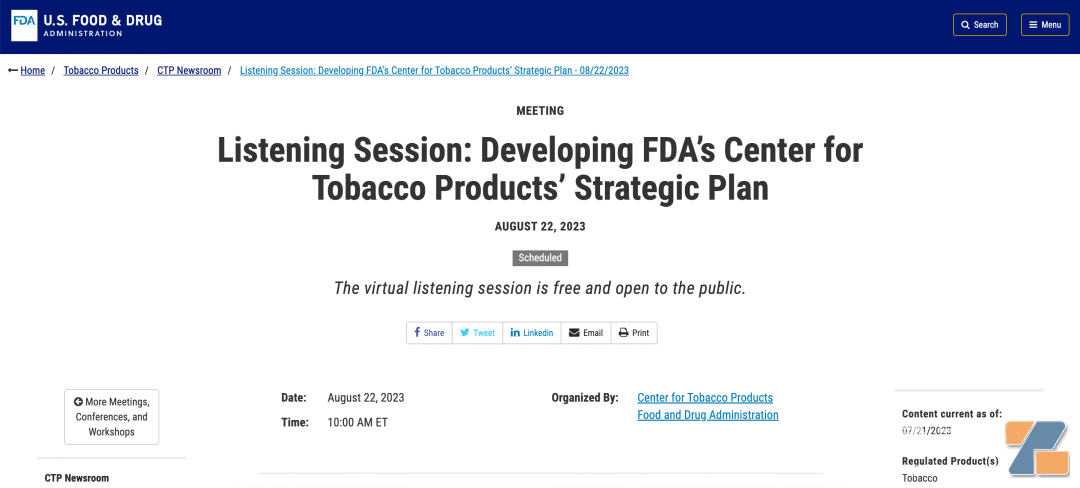
On July 21, the FDA announced that the Center for Tobacco Products (CTP) will hold a public online hearing on August 22 regarding the development of the 5-year strategic plan. During this hearing, the FDA will propose a strategic plan focusing on the following five aspects. According to the FDA's official statement, they are:
1. Develop, advance, and promote comprehensive and impactful tobacco regulations and guidelines. This goal includes activities related to the development and implementation of the regulatory and policy agenda of the Center for Tobacco Products (CTP); articulating and publishing clear, comprehensive public policy statements; and striving to promote health equity. 2. Ensure timely, clear, and consistent product application reviews to protect public health. This goal includes activities related to workflow, such as optimizing the efficiency, consistency, and effectiveness of product application review processes; enhancing public understanding of regulatory requirements through increased transparency and stakeholder engagement; and ensuring that review processes are supported by robust regulatory science programs. 3. Utilize all available tools, including strong enforcement actions, to ensure compliance within the regulated industry and tobacco products. This goal includes taking enforcement actions to reduce violations; strengthening collaboration with federal and state agencies on tobacco enforcement; prioritizing flexible market intelligence and monitoring to promote awareness and effective responses to the evolving tobacco landscape. 4. Improve public health by enhancing awareness and understanding of tobacco product regulations and the risks associated with tobacco product use through the Tobacco Control Program. This goal includes conducting timely, clear, and understandable health communications and education for various public audiences, including discouraging youth smoking, encouraging cessation, and informing adult smokers about the relative risks of tobacco products. 5. Advance superior operational practices. This goal includes prioritizing workforce growth, engagement, and retention, as well as CTP's commitment to diversity, equity, inclusion, and accessibility; modernizing business processes to improve information management and planning efficiency; and seeking and applying the necessary resources to support the full range of CTP's regulatory activities.