How an E-Cigarette Airflow Sensor Works
microphoneise-cigarettesWith the current mainstream starting components, e-cigarettes can simulate the traditional smoking process, which is inseparable from the credit of the microphone.
Speaking of e-cigarette mips, it generally refers to the combination of capacitive mips + chip, which is installed on the square chopping board and connected through wiresheating wire, battery, which plays the role of intelligent startup, charge and discharge management, status indication, output power management, etc.
1. Capacitive microphone head
The principle of the capacitive microphone responding to external actions is realized by the deformation of the conductive film caused by the airflow, which in turn causes a change in the equivalent capacitance. At the same time, in order to avoid external interference, when the change reaches a certain value, the detection module outputs a smoking signal internally.
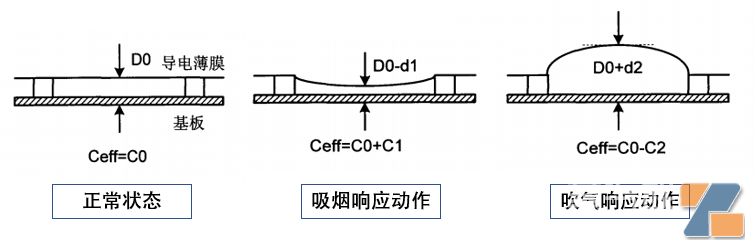
Figure The response action of the capacitive microphone head, derived from patent CN203353677U
How it works: It can be deduced from two formulas, C=εS/4πkd…① and C=Q/V…②.
It can be seen from the above figure that suction/blowing causes the conductive film to deform, changes the distance between it and the polar plate, and produces a change in Δd. Therefore, it can be seen from Formula ① that a change in ΔC must be produced. It can be seen from Formula ② that due to the change in ΔC, the charging charge is fixed, so a change in ΔV must be produced.
This generates an electrical signal, which is then transformed and amplified by impedance, and finally triggers the e-cigarette to work.
2. Mitou chip
After the capacitive mitehead senses the activation signal, the signal needs to be processed and feedback for the next step. At this time, it is the mitehead chip's turn to take effect.
Midehead chips generally adopt ASIC design, and the manufacturing process includes chip design, streaming, packaging, testing and other aspects, and can be integratedairflow sensorElectronic cigarette functions such as circuit, output power management, function control, charging management, status indication and protection circuits.
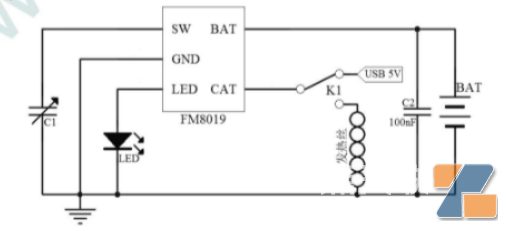
Typical application circuits of Midehead chips, rich and micro
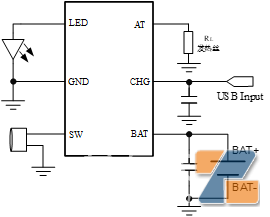
Typical application circuits of Midehead chips are stable and micro
3. Assembly and functional iteration of e-cigarette heads
The production process of e-cigarette mites mainly includes assembly, sealing, pasting, testing, welding, and inspection. Among them, the welding part was manual welding in the early days, and consistency was difficult to ensure. With the introduction and maturity of automated equipment, leading manufacturers now basically use automated welding.
In terms of types, the current e-cigarette airflow sensor solutions, in addition to the microphone head, actually also include MEMS differential pressure sensors, MEMS flow sensors, TPD barometers and other solutions.
In terms of functions, in order to respond to the requirements of national standards and some overseas countries and regions, child locks were once a hot spot in industry research and development. Problems such as self-starting, water and oil resistance have also been solved one by one with the development and application of technologies such as nano-coating and new design of the microphone head structure.
Related Articles

Ahead of a Nationwide Ban, Hundreds of Russian Retailers Voluntarily Stop Selling Vapes

Illegal Vape Brands Try to Evade FDA Scrutiny by Posing as “Made in the USA”