Disposable Vaping Devices Fuel Surge in Fires at UK Waste Treatment Plants
Today, on May 14, industry experts warned that disposable e-cigarettes are the cause of a sharp increase in fires at recycling plants last year, raising the risk of large fires releasing toxic smoke and polluting the air.
Recycling companies are now dealing with so many e-cigarettes that they are struggling to insure their facilities. Some companies are now using artificial intelligence to detect e-cigarettes and their lithium-ion batteries, and are installing thermal imaging cameras and automatic foam sprayers.
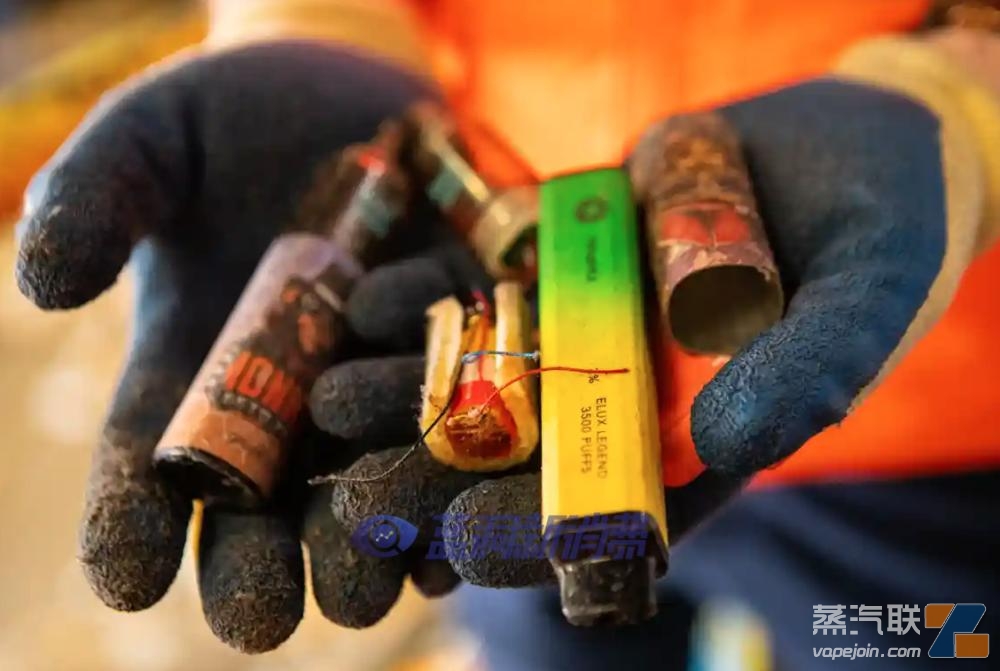
The hazardous materials handled by waste and recycling plants mean they could trigger fires similar to the Bradford tire fire in 2020, which burned for a week, forced 20 schools to close, and required every firefighter in West Yorkshire to be involved.
In the UK, approximately 1.3 million disposable e-cigarettes are thrown away each week—an astonishing increase since they were first sold in 2019—many of which are discarded on the roadside or in general waste. They contain lithium-ion batteries, which can easily catch fire if damaged, and some e-cigarette users have suffered life-changing injuries after battery explosions.
The nonprofit organization MATerial Focus found that over 700 fires in garbage trucks and recycling centers were caused by batteries dumped in general waste.
Grundon recycles about 80,000 tons of household and municipal waste each year, and the number of disposable e-cigarettes collected by street sweepers has increased, as their circular brushes typically collect leaves and stones.
“They are sold as disposable products, so people just throw them on the ground,” said Owen George, a department manager at Grundon. “About a year ago, we didn’t see any, but now they are everywhere. We might pick up 100 to 150 in an 8-hour shift. That’s just the ones we catch.”
The waste they don’t catch ultimately ends up in non-recyclable waste streams alongside items like Pringles cans, plastic wrappers, and disposable coffee cups. These are shredded and packed into bales, a process that can puncture lithium-ion batteries, which can then easily catch fire. In the past year alone, Grundon has experienced three or four fires at one location.
“We have managed to eliminate them, but the frequency is definitely increasing,” George said. “It’s not just us—it’s affecting everyone in the industry.”
Grundon has installed fire detection equipment worth about £250,000 at each of its facilities. “We have installed thermal imaging cameras, and in some places, we have installed automatic cannons that can locate the source of a fire and extinguish it with water and foam.”
Due to the fire risk, insurance companies have become reluctant to insure the waste industry, with premiums rising, and expensive fire safety systems are now required. Artificial intelligence is another option.
About 70% of recycling facilities in the UK now use AI developed by Greyparrot.
Mikela Druckman, CEO of Greyparrot, said: “We have a box with a camera that takes continuous images of the waste stream, and then we use AI to detect and analyze these images.”
The system can identify 67 types of materials and then sort them—steel can be picked up by magnets, while lighter PET plastic bottles can be blown away with a gust of air.
“We are doing several projects, mainly in Austria, but now also in the UK, where we are identifying batteries in the waste stream,” Druckman said.
Justin Guest, co-founder of Archipelago Eco, which invests in recycling technology, stated that banning e-cigarettes would be a blunt instrument and added: “That doesn’t solve the problem because it’s not just e-cigarettes—many e-cigarettes contain batteries. People will always get things and then throw them away.”
“There will also be other consumer fads that will lead to these materials entering the waste stream. So you need safeguards, you need technology to address this issue.”
Currently, about 138 million disposable e-cigarettes are sold annually in the UK, with enough lithium content to power approximately 1,200 electric vehicle batteries.