CDC: U.S. Smoking Rate Falls to Historic Low, but Vaping Continues to Rise
Today, on April 28, news from foreign media reports that the Centers for Disease Control and Prevention (CDC) has found that the percentage of adults smoking in the U.S. fell to a historic low last year. However, e-cigarettes are becoming increasingly popular.
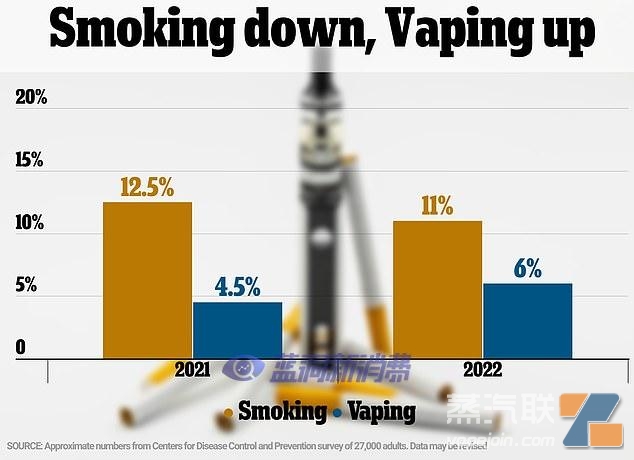
According to the latest preliminary data from the National Health Interview Survey, about 11% of adults reported to the CDC that they are currently smokers, based on responses from 27,000 individuals aged 18 and older. In 2020 and 2021, about 12.5% of adults indicated they had smoked cigarettes.
This marks a significant decline compared to the beginning of such surveys. Surveys conducted in the 1940s found that about half of adults in the U.S. reported smoking. The smoking rate began to decline in the 1960s, and recently, in 2016, 15.5% of adults reported smoking.
Recent studies indicate that some groups remain at higher risk. Although the latest CDC survey did not capture this level of detail, the 2023 Tobacco Control Status Report indicates that smoking rates in certain communities—including Native Americans, Alaska Natives, and members of the LGBTQ community—remain alarmingly high.
The overall decline in adult smoking rates should have a positive impact on public health.
In the U.S., smoking remains a leading cause of preventable death and disability. The CDC found that the number of deaths caused by smoking is so high that the number of American citizens who die prematurely from smoking is more than ten times the number of deaths in all wars the U.S. has participated in.
In the U.S., smokers account for 90% of lung cancer cases, but smoking can also lead to strokes, coronary heart disease, chronic obstructive pulmonary disease, and other cancers, including bladder, colon, kidney, liver, stomach, and other cancers. Due to secondhand smoke, those living with smokers also face a greater risk of death.
The latest survey did not specify why the number of smokers is decreasing, but since the 1960s, when the U.S. Surgeon General released the first report linking smoking to health issues, the number of smokers has been declining.
Experts attribute the decline in smoking rates to various efforts—anti-smoking campaigns, programs educating children about the dangers of smoking, strict regulations on where people can smoke and how tobacco companies can advertise, as well as smoking cessation programs that make cigarettes more expensive through higher taxes.
However, Congress has not raised the federal tobacco tax in 14 years. The federal cigarette tax remains at $1.01 per pack, with varying tax rates for other tobacco products. No state raised cigarette taxes in 2022.
The pandemic may also have had an impact. Volunteer Dr. Panagis Galiatsatos stated that smokers are more susceptible to severe consequences from Covid-19, which provided some with the extra motivation to quit—and possibly gave doctors the additional impetus to help them. To some extent, the pandemic also made healthcare access easier.
"I think this pandemic has indeed given doctors time to conduct these telehealth visits, which are solely focused on smoking cessation strategies, helping them assist patients in quitting and staying quit," Galiatsatos said, who is a pulmonologist and the director of the Tobacco Treatment Clinic at Johns Hopkins School of Medicine.
Galiatsatos pointed to a report from the U.S. Surgeon General released just before the pandemic began. The report detailed that among their current smoking patients, the remaining few would be the most resistant to quitting. The then-Surgeon General Jerome Adams encouraged more doctors to help their patients quit smoking. The report found that 40% of smokers are typically not advised by their doctors to quit.
The Rise of E-Cigarettes
Nevertheless, culture has changed. In certain cultures in the U.S., smoking is far less socially acceptable.
However, the use of e-cigarettes seems to be more socially accepted, with studies indicating that especially among young people, this may explain why these numbers are rising.
The current survey found that last year, the usage rate of e-cigarettes rose to nearly 6%, up from about 4.9% the previous year.
Some believe e-cigarettes are a good alternative to traditional cigarettes, and in some countries, they are even marketed as smoking cessation devices, but the CDC states that e-cigarettes are unsafe for teenagers, young adults, pregnant women, and adults who currently do not use tobacco products.
A study published in the British Medical Journal in February found that those using e-cigarettes to quit smoking found them less effective than traditional smoking cessation aids.
The U.S. Food and Drug Administration (FDA) states that there is not enough evidence to support the claim that these products are effective tools for helping people quit smoking. None have been approved for this purpose.
The FDA states that there are no safe tobacco products, including e-cigarettes, vape pens, and other electronic nicotine delivery systems.
Galiatsatos said: "When someone wants to smoke traditional cigarettes or use e-cigarettes, I never hold any bias or judgment, but as a pulmonologist, I will always promote air entering the lungs. From my perspective, I think we should still maintain a public health mindset regarding e-cigarette use because for some people, these products can impact their health.
He said that people may choose e-cigarettes over smoking, but if they truly want to quit, clinicians should be ready to help them.
However, e-cigarettes produce many chemicals harmful to human health, including acrolein, acetaldehyde, and formaldehyde. According to the American Lung Association, studies show that these chemicals, known as aldehydes, can lead to lung disease and heart disease.
According to the U.S. Surgeon General, exposure to nicotine can harm the developing brain in teenagers.
E-cigarettes are more popular among teenagers than cigarettes, so the number of adult e-cigarette users may continue to grow.
According to separate data from the CDC, about 14% of high school students reported using e-cigarettes last year, while 2% of high school students had smoked cigarettes.
The American Academy of Pediatrics states that the proportion of children using e-cigarettes is very high.
Specifically, according to early survey data from the CDC, by 2022, nearly 5% of middle school students and about 17% of high school students reported currently using some form of tobacco. In 2021, about 11% of middle school students and 34% of high school students reported having ever tried tobacco.
According to the CDC, these trial rates are significant because most adult smokers started smoking at a young age.
The AAP continues to encourage pediatricians to include tobacco use screening as part of regular check-ups for children. The report states that discussions about tobacco should not be delayed beyond ages 11 or 12.