
Tobacco Sheet Market, Devices, and Distribution Channels: The Future of the Entire HNB Heated Tobacc
In recent years, global tobacco giants have accelerated their transition to smoke-free products, adjusting their business strategies as the shipment volume of traditional cigarettes gradually declines. For instance, Jacek Olczak, CEO of Philip Morris International (PMI), stated in July 2021 that PMI plans to stop selling traditional cigarettes in the UK within ten years, focusing on the development and commercialization of smoke-free products.
Given the vast development space and market potential for new tobacco products, the production and research and development of related consumables also play a crucial role, in addition to the advantages and patented technologies of these products themselves.This report will analyze the future growth of HNB heated tobacco sheets, flavorings, and devices across three aspects.
1Market for Sheets: HNB High-Frequency Consumables, Increased Usage and StatusLow-temperature herbal capsules, plant slices, plant flavor extracts, and related finished products have characteristics of fast-moving consumer goods, with high consumption and usage frequency. The core materials of HNB tobacco sticks are tobacco sheets and flavorings.
Tobacco sheets: Tobacco sheets are products processed from tobacco waste, serving as carriers for nicotine, smoke agents, flavorings, and concentrates in HNB tobacco sticks. HNB relies on sheets to generate aerosols at high temperatures, carrying tobacco concentrates, nicotine, and other components, thus the usage of sheets is substantial, with the amount of tobacco sheets used in HNB being about nine times that of traditional cigarettes.
Tobacco flavorings: The unique manufacturing process of HNB and its non-combustible nature result in fewer aromatic components compared to traditional tobacco. Flavorings are the primary source of its aroma, hence the original spraying method cannot meet the demand; instead, flavorings are integrated into the sheet production process as one of the raw materials. In terms of usage, the flavoring addition in HNB tobacco sheets can reach about 2.5%, which is several times that of traditional cigarettes.
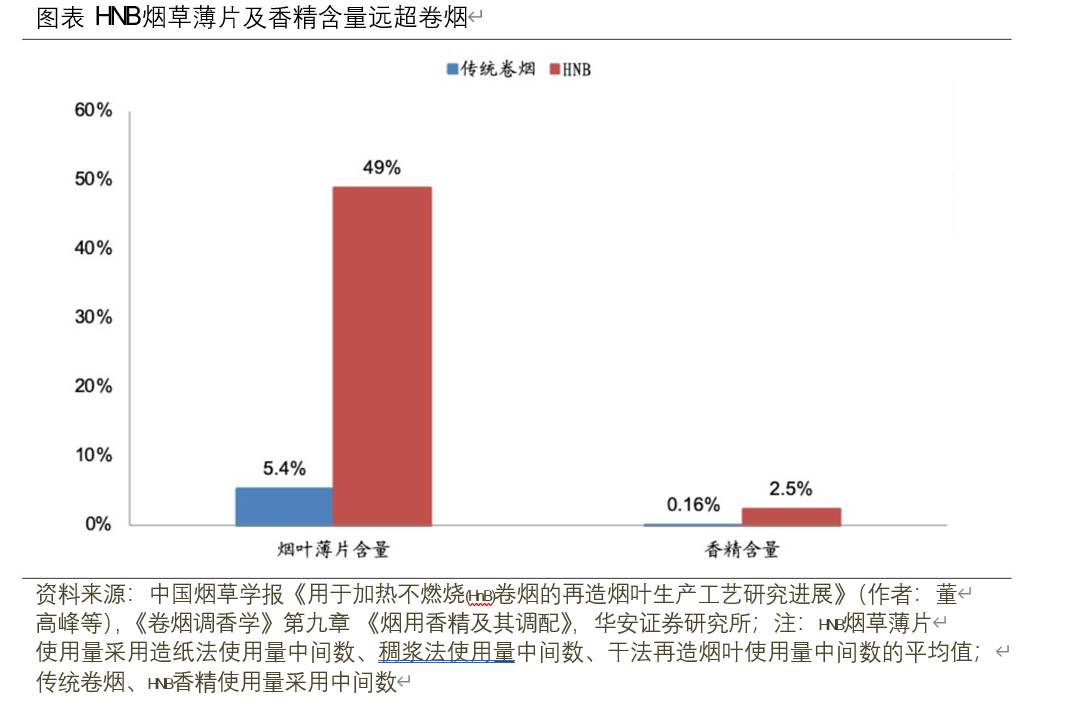 HNB, due to its taste and form being closer to traditional cigarettes than vaping devices, and by heating reprocessed tobacco sheets, the experience of inhaling nicotine and tobacco aroma is also more similar to that of traditional cigarettes. Therefore, HNB's audience is primarily former smokers transitioning away from traditional cigarettes.Huazhong Securities has estimated the market size of tobacco sheets used in cigarettes and HNB in the global and Chinese markets from 2021 to 2025.In the global market, as leading tobacco companies begin to adjust their business strategies towards smoke-free products, and with the main HNB products currently being PMI's IQOS and British American Tobacco's Glo, which had shipment volumes of 76.1 billion and 11 billion sticks respectively in 2020, their market shares reached 9.5% and 1.4%. Based on this data, Huazhong Securities estimates that the global tobacco sheet market size is expected to exceed 54 billion yuan by 2025, with HNB accounting for 27.1 billion yuan, a growth of 42.4% compared to 2020.#p#分页标题#e#
In the Chinese market, HNB products are classified as tobacco products and are managed under the Tobacco Monopoly Law, prohibiting the import of HNB products, with only a small number of HNB products currently in trial sales. Based on previous estimates of the HNB market size, Huazhong Securities believes that the tobacco sheet market is expected to exceed 36 billion yuan by 2025, with HNB accounting for 9.6 billion yuan.
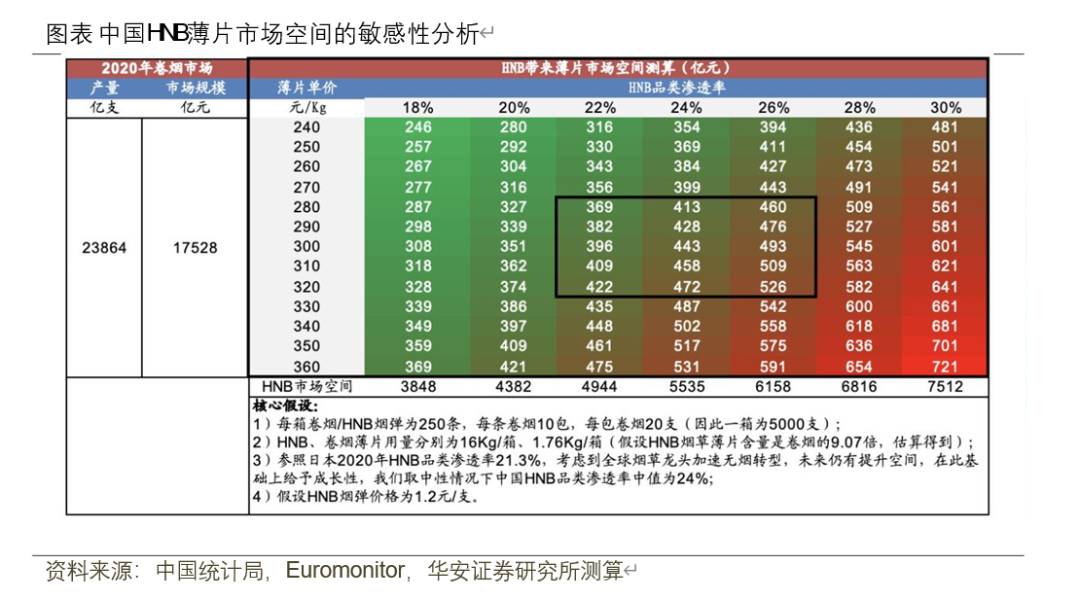
Considering the accelerated transition of global tobacco giants to smoke-free products, there is still growth potential. By calculating the market space for tobacco sheets brought by HNB based on category penetration rates, Huazhong Securities estimates that if the HNB category penetration rate is 24% and the sheet price is 300 yuan/kg, the market space for tobacco sheets brought by HNB (excluding traditional cigarettes) is expected to exceed 44 billion yuan.
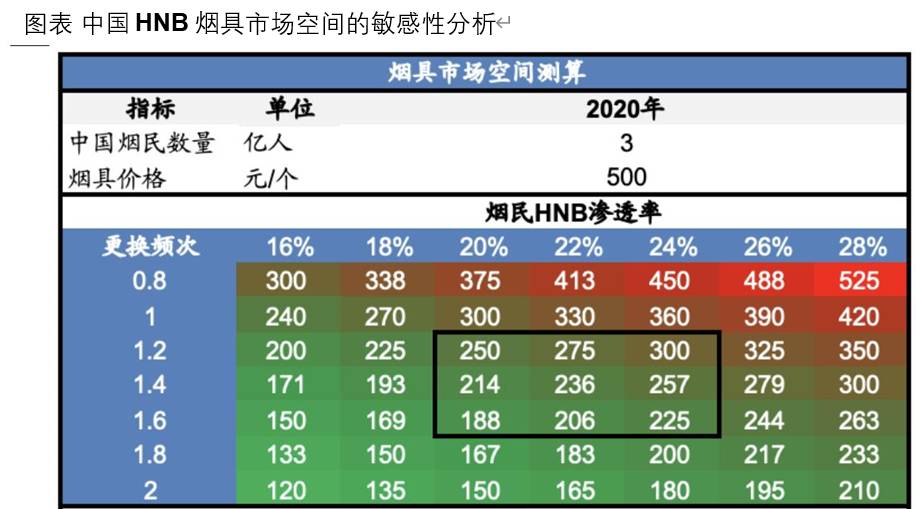
 2Device Market: Long-Term Space for HNB Devices May Exceed 23 Billion YuanBased on Huazhong Securities' assumptions, if the average price of HNB is 500 yuan, with replacement frequency of 0.8 to 2 times, and HNB user penetration rate of 16% to 28%, the market space for HNB devices in China is estimated to be between 18.8 billion and 30 billion yuan.
 Source: National Health Commission, Huazhong Securities Research Institute estimates3Pattern Evolution: Channel Value Highlighted, Collaborative Development of the Entire Industry Chain
The industry is becoming integrated, and leading brands are willing to deeply bind with manufacturers
The main reasons are: first, the scarcity of core technologies; currently, the market still shows that a few manufacturers hold patented technologies, and whether the technology is up to standard is closely related to the subsequent product experience for users. Therefore, high-quality manufacturers are very valuable to brands. Second, brand owners face fierce competition and a highly homogeneous industry survival state, requiring quality and stable manufacturers to help share uncertainties and assist in market expansion.
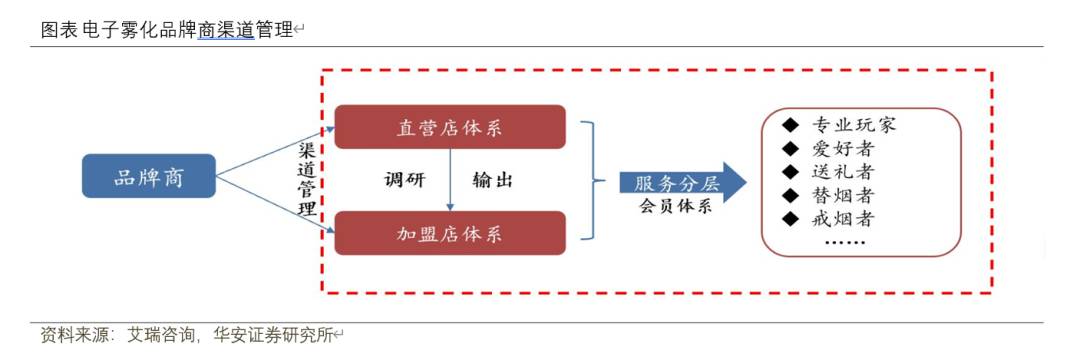
Policy implementation has impacted channel development, making resource management keyWith the implementation of a series of regulatory policies in the electronic vaping market, the development of channels will face challenges. In the face of slightly saturated channel expansion in the early stages, how to improve direct stores and distributors, grasp market pain points and channel needs through research and investigation, and then upgrade or improve management models to establish multi-channel advantages is necessary for future stable development.At the same time, maintaining existing customer resources, building a complete system, meeting diverse consumer needs, and reducing churn are currently the top priorities for brands in maintaining channels.
 #p#分页标题#e#

