
122 Compounds on the New National Standard “Whitelist” for Vaping: Scientists Explain Future R&D Dir
On November 30, 2021, the draft for comments on the e-cigarette national standard was released. The opinion draft lists a "white list" of aerosol additives, which contains a total of 122 different compounds. In the future, brands can only develop flavors according to the ingredients and limited quantities in the "white list".
What is the focus of the "white list"? What impact does it have on existing products and future flavor development? The Xiwu scientific research team led by Dr. Xing Chenyue interpreted this part of the new national standard opinion draft one by one.
Expand the "white list" and clarify the amount used
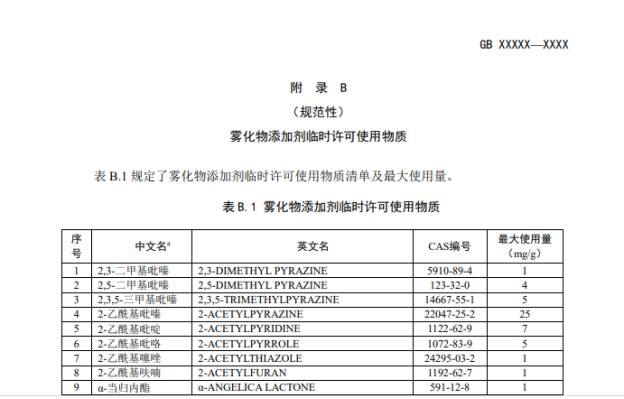
Compared with the draft version list circulated in 2019, this new national standard version list has added some compounds, and the total number has increased from about 90 to 122.
The new version also clearly stipulates the characteristics of most of these compoundsmaximum usage, this is the biggest change and enhancement to the old list.
At present, many overseas countries and regions are still using the "blacklist"(i.e., the "list of substances that cannot be added") as the e-cigarette management standard, while my country is the first to use the "white list" to restrict the use of aerosol additives. This is a more strict and prudent management method and a more responsible management attitude to consumers.
Ingredient categories in the "white list"These 122 substances can be roughly divided into three categories according to their functions:
- Used for acid and alkali adjustmentorganic acid;
- Used as an organic solventalcohol compound;
- For flavorFlavor compounds, sweeteners and natural flavor extracts。
1. 10 organic acids: large dosage space and does not affect existing formulas
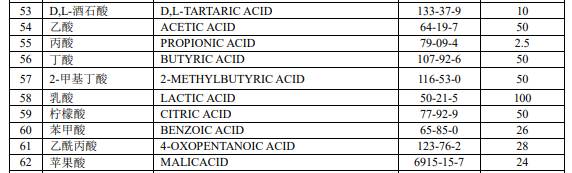
We all know that nicotine salt tobacco oil contains organic acids to fix the nicotine free base in it.# p#pagination title #e#
Items 53-62 of the list have a total of 10 organic acids, including benzoic acid, tartaric acid, lactic acid, citric acid, etc., which are most commonly used in mainstream nicotine salt tobacco oil formulations, as well as acetic acid, propionic acid, butyric acid, etc., which are commonly found in natural tobacco.
The maximum amounts specified by the new national standard for these 10 organic acids are related to their own physical and chemical properties, toxic irritation, and the commonly used amounts in natural tobacco or cigarettes.
Judging from the maximum amount of individual acids among them, the new national standard gives the product a lot of freedom.
Taking benzoic acid as an example, the amount of nicotine and benzoic acid in conventional nicodin benzoate tobacco oil is generally 1:1 molar ratio. Based on the maximum amount of nicotine specified in the new national standard of 2%, the amount of benzoic acid is 1.5%. The maximum amount of benzoic acid on the white list is set at 2.6%, which is 70% higher than the commonly used amount of products.Therefore, it will not affect the existing formulation of nicudin benzoate tobacco oil products。
2. 13 alcohol compounds: abundant dosage space and many options to choose from
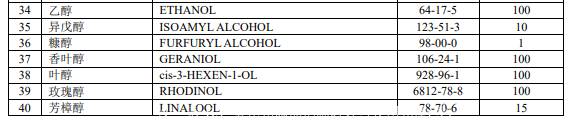
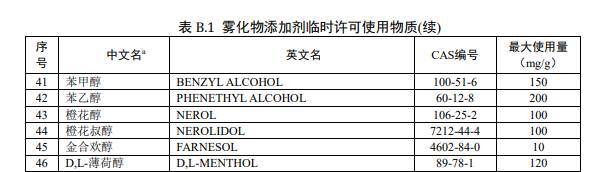
Most flavor compounds and natural flavor extracts are soluble in organic solvents. Appropriate licensing of several safer solvents will help the preparation of tobacco oil.
Items 34-46 of the list have 13 alcohol compounds. About half of them are common organic solvents (such as ethanol, benzyl alcohol, and phenethyl alcohol), and their maximum amounts are also set to be relatively high (such as ethanol 10%, benzyl alcohol 15%, and phenethyl alcohol 20%).
The other part of alcohols are mainly herbal aroma compounds (such as linalool, peppercorn alcohol, etc.). They are common in natural tobacco and herbs, and are often used in cigarettes or fragrant mist products. The maximum amount of these alcohols is between 1% and 12%. As an herbal aroma additive, this amount range is also very generous (for example, the menthol in mint tobacco oil products will hardly exceed 5%).
In summary, the alcohol "white list" limitWill not have a major impact on mint herbal products, a variety of alcoholic organic compounds also provide sufficient auxiliary solvent options for the preparation of tobacco oil.
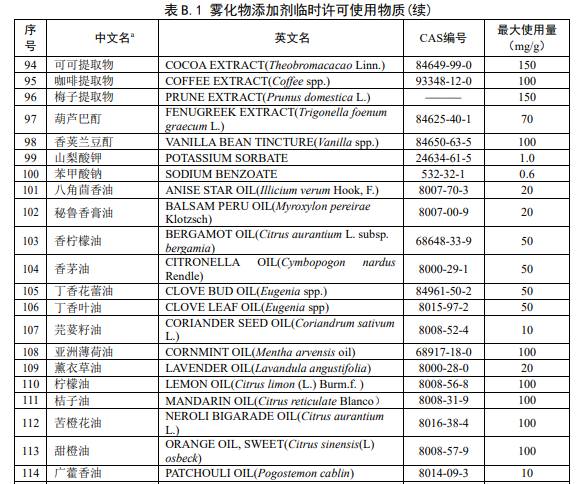
3. Flavoring agents: There are many restrictions on sweetness and fruity flavors, and there is more room for herbal ingredients
 #p#Pagination Title #e#
In addition to the above two categories of compounds, the main function of the other substances on the list is seasoning and flavoring. Among them, a large part are extracts and essential oils of natural substances, and most of them come from herbal plants such as cocoa, coffee, fennel, mint, etc.
These ingredients have low sweetness and are preferred by adults. At the same time, it comes from natural crops and has complex compositions, so the maximum permitted amount is relatively higher.
Among the other compounds on the list used for flavoring,Only very small amounts are clear sweeteners(such as maltol and ethyl maltol), the maximum amount shall not exceed 6%.The amount of various lactones commonly used to prepare fruit flavors is even stricter。The restrictions on the use of these two types of flavoring compounds reflect the new national standard's further desire to prevent products from appearing attractive and inducing to minors.
Outlook for future taste research and development direction: tobacco, low sweetness
It is worth mentioning that tobacco extract is not included in the "white list", but is listed alongside nicotine and mentioned separately as an aerosol raw material.
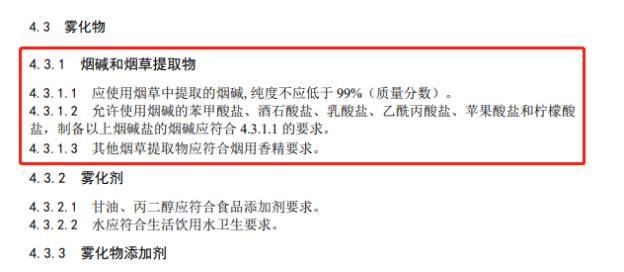
This is because tobacco extract originates from natural tobacco and may contain residual nicotine, and it has been used in cigarettes and other products for a long time. The State Tobacco Monopoly Administration has a specific tobacco flavor standard for it, so it is no longer used as an aerosol additive. The list is consistent with the practice of e-cigarettes being officially included in the management of tobacco products.
When fruity/sweet tobacco oil preparation is restricted by the "white list",The rich number of fruity, sweet and casual drink products on the market will be greatly reduced.The development of tobacco oil flavors will follow the general trend: to develop different tobacco flavors to serve adult smokers; beverage flavors should also be more concentrated in the direction of low-sweetness mature drinks such as coffee and tea.
The new national standard "white list" regulates the composition and amount of tobacco oil, providing a yardstick for creating an orderly market. In the future, under the guidance of the new national standard, Xiwu will comply with the general trend of reducing focus, reducing harm, and removing taste, and continue to bring better products to consumers through technological research and development.# p#pagination title #e#


