
How to Choose the Right Vape Atomizer?
Most vaping content is shared through articles, whether illustrated or text-based, and through video. Some people love reading, while others prefer not to. But the real goal of useful content should be to help you take fewer detours and make better choice
When it comes to sharing information about e-cigarettes, the mediums are usually articles (text and images) or videos. Some friends naturally prefer reading, while others find it overwhelming. Some are only concerned about whether there are any benefits mentioned, which isn't ideal. It's important to understand what you hope to gain from the tedious writing. The goal is to take shortcuts and avoid detours.
Those who know me understand that I also find reading a bit overwhelming, but I enjoy writing my thoughts for sharing and particularly like watching videos that candidly discuss the pros and cons of products.
For those who enjoy reading and are naturally inclined towards e-cigarettes, I hope this article can be of help.
**Topic: Discussing How to Choose an Atomizer**
As a vapor, what do you usually busy yourself with? I think it mainly involves checking out the latest product reviews, and the rest is about e-liquids and atomizers, right? As the soul of e-cigarettes, e-liquids and atomizers hold a high status in the entire vaping process. Why do I say that?
I believe everyone knows that a good e-liquid requires a suitable atomizer and data to interpret it; otherwise, you might as well just vape glycerin.
Conversely, a good atomizer without understanding its pulse, paired with the wrong characteristics of e-liquid and data, means you might as well just vape glycerin.
Atomizers can be divided into two main categories: pre-filled and DIY.
**Pre-filled:**
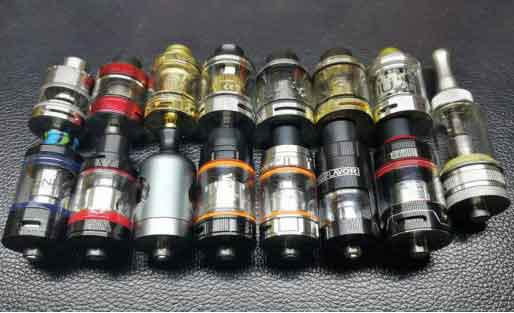 First, let's talk about pre-filled atomizers.
**Advantages:** Ready to use, decent flavor.
**Disadvantages:** Too ready to be rebuilt, high cost.
In today's fast-paced life, where everything is busy and orderly, many people have been stuck in a routine for years. Having a hobby is not easy, but you need to carve out time to play with it. For those who can't spare too much time, pre-filled atomizers are your best choice.
They are convenient, have long battery life, and stable flavor. Just change the coil before bed, fill it with your favorite e-liquid, and the next day you can grab it and go. If you have a dual-battery device, it can last you two days without a hitch. When the flavor turns bitter, just swap in a new coil, and you can enjoy a week of hassle-free vaping.
Manufacturers test the "atomizer core" multiple times during the development process to determine its oil delivery mode and data before mass production, ensuring that the flavor of each atomizer is guaranteed.
For those who fit the above criteria, when choosing an atomizer, you can simply divide it into two situations:
1. For small clouds, if you enjoy a delicate vaping experience and prefer a low-key approach, a flavor-focused small cloud pre-filled atomizer with e-liquid containing 6mg nicotine and less than 60% VG is suitable for you.
2. If you enjoy the "throat hit" sensation, dense clouds, and occasionally showing off with some tricks, then a large cloud pre-filled atomizer with e-liquid containing less than 3mg nicotine and over 70% VG is right for you.
The high cost mentioned comes from the atomizer core.
The model of pre-filled atomizers is: replaceable consumables. Once the core is burnt out due to its non-rebuildable nature (though experts can do it), it must be replaced, and cores are sold separately.
Of course, among pre-filled atomizers, there are a few that have excellent flavor interpretation capabilities, with some flavors even richer and fuller than DIY options.
Today, I mainly want to discuss DIY atomizers.
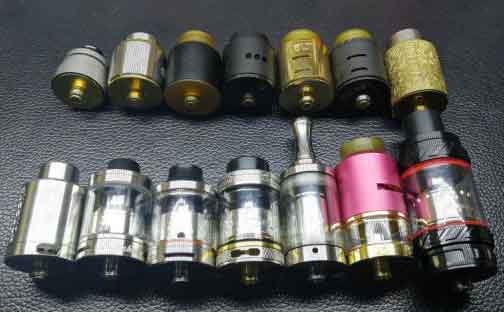 DIY atomizers can be divided into two categories: tank and dripping, which can be understood directly from the terms. They can further be subdivided into flavor-focused and cloud-focused types. With the advancement of technology, atomizers that combine flavor and cloud production with high playability have gradually emerged.
The heating wire can be single, dual, multi-coil, or mesh, among others.
How do you determine whether a DIY atomizer focuses on flavor or playability? It's actually easy to judge by observation. When browsing information about related atomizers, I primarily look at the airflow structure, which is the soul of a DIY atomizer.
The structure includes: airflow method, evaporation chamber airflow layout, chimney compression structure, and drip tip structure.
The perfect airflow structure I envision should maximize the cooling around the base, with direct airflow hitting the heating wire to fully blend air and vapor, making the vapor fuller. The golden ratio of the dome and compressed airflow should make the vapor as dense as possible, with a drip tip that has a reliable design to prevent condensation and is comfortable to use, along with an easy-to-use coil building platform.
There are various ways to build coils, but they all follow the same principles.
**Choosing Method**
You can judge your needs based on the following points:
1. I recommend using Phillips or flat screws; compared to Allen screws, they are much more convenient and reliable when tightening. Especially when you're fiddling with oily hands, those tiny Allen screws are a big hassle. When building coils, a small Allen wrench can be very troublesome, as Allen screws are generally small and precise, making them easy to lose during cleaning. If the material's hardness isn't sufficient, using brute force can easily strip the screw or break the corners, which is quite frustrating.
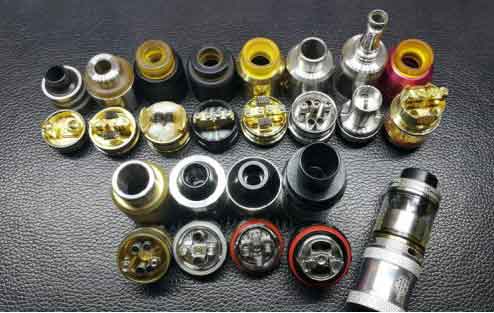 After acquiring multiple atomizers, your collection of Allen wrenches will grow, and you'll have to find them each time.
A Phillips or flat screw is straightforward—it's either a Phillips or a flat.
2. Try to choose an electrode post layout that doesn't require bending the wire, as this can significantly reduce the chances of short circuits, asymmetry, and uneven heating. Generally, once you build the coil, it should be good to go.
This can be observed; most of the current atomizers have electrode posts that are suitable for beginners or can be easily adjusted.
3. Choose a wider wire slot that can accommodate both regular and larger wires, laying the groundwork for advanced use and saving costs. A good wire can be very durable.
4. The oil delivery method directly affects the oil delivery efficiency, excluding cotton quantity and technique. Parallel oil delivery is always faster than bottom oil wells, so beginners are advised not to choose bottom oil wells. However, parallel wrapped oil wells also have drawbacks; keeping e-liquid at high temperatures for extended periods can affect the flavor, so it's important to control wattage and draw density, allowing the atomizer to cool down occasionally.
5. Shorter airflow paths result in higher vapor temperatures, making it easier to inhale heated oil, but some people prefer a warm sensation. Longer paths provide a more suitable temperature. Narrow airflow paths yield rich and full flavors, suitable for single-flavor e-liquids, while wider atomizers mix flavors well, suitable for multi-flavor blends.
6. Even if a cylindrical drip tip is perfectly chamfered, it can still cause discomfort. A drip tip that lacks a slope or duckbill shape provides a better experience, evoking a sense of maternal love. I have always held a disdainful attitude towards drip tips that lack internal grooves to prevent condensation and will decisively purchase a new drip tip or replacement.
At this point, the main points have been covered; the remaining aspects such as materials, colors, oil filling methods, and airflow adjustment methods are less important.
**Advertisement Time**
As I often say:
When experiencing e-liquids, use familiar atomizers, familiar data, and your favorite device.
When experiencing atomizers, use familiar e-liquids, familiar data, and your favorite device.
**Data**
It’s clear that data is also crucial. Regularly reading e-liquid reviews and sharing articles about various flashy devices is really unnecessary; what matters is stable output and comprehensive protection design. As for limited editions, materials, brands, prices, and touch, those are not the focus.
I often see questions in groups asking for recommendations on certain atomizer data; this data refers to the wire gauge, diameter, and number of wraps. In fact, there’s no fixed answer. By observing the spacing between electrode posts and the size of the oil delivery holes, you can determine the appropriate wire gauge and number of wraps for dual coils. If it’s too large, it won’t fit; if it’s too small, it will be loose, and the cotton quantity will be insufficient to block the oil delivery holes. Common sizes are 2.5 or 3.0, with 5-8 wraps, and resistance controlled at 0.3-0.6 (for flavor) and below 0.3 (for vapor). Of course, this is just to illustrate the point. You should know that extreme data boxes either can’t handle it or take forever to produce a few puffs of vapor.
Finally, pairing it with a cost-effective cotton and box, as long as it doesn’t look too out of place when screwed in, is considered a success.
Those who know me understand that I also find reading a bit overwhelming, but I enjoy writing my thoughts for sharing and particularly like watching videos that candidly discuss the pros and cons of products.
For those who enjoy reading and are naturally inclined towards e-cigarettes, I hope this article can be of help.
**Topic: Discussing How to Choose an Atomizer**
As a vapor, what do you usually busy yourself with? I think it mainly involves checking out the latest product reviews, and the rest is about e-liquids and atomizers, right? As the soul of e-cigarettes, e-liquids and atomizers hold a high status in the entire vaping process. Why do I say that?
I believe everyone knows that a good e-liquid requires a suitable atomizer and data to interpret it; otherwise, you might as well just vape glycerin.
Conversely, a good atomizer without understanding its pulse, paired with the wrong characteristics of e-liquid and data, means you might as well just vape glycerin.
Atomizers can be divided into two main categories: pre-filled and DIY.
**Pre-filled:**
First, let's talk about pre-filled atomizers.**Advantages:** Ready to use, decent flavor.
**Disadvantages:** Too ready to be rebuilt, high cost.
In today's fast-paced life, where everything is busy and orderly, many people have been stuck in a routine for years. Having a hobby is not easy, but you need to carve out time to play with it. For those who can't spare too much time, pre-filled atomizers are your best choice.
They are convenient, have long battery life, and stable flavor. Just change the coil before bed, fill it with your favorite e-liquid, and the next day you can grab it and go. If you have a dual-battery device, it can last you two days without a hitch. When the flavor turns bitter, just swap in a new coil, and you can enjoy a week of hassle-free vaping.
Manufacturers test the "atomizer core" multiple times during the development process to determine its oil delivery mode and data before mass production, ensuring that the flavor of each atomizer is guaranteed.
For those who fit the above criteria, when choosing an atomizer, you can simply divide it into two situations:
1. For small clouds, if you enjoy a delicate vaping experience and prefer a low-key approach, a flavor-focused small cloud pre-filled atomizer with e-liquid containing 6mg nicotine and less than 60% VG is suitable for you.
2. If you enjoy the "throat hit" sensation, dense clouds, and occasionally showing off with some tricks, then a large cloud pre-filled atomizer with e-liquid containing less than 3mg nicotine and over 70% VG is right for you.
The high cost mentioned comes from the atomizer core.
The model of pre-filled atomizers is: replaceable consumables. Once the core is burnt out due to its non-rebuildable nature (though experts can do it), it must be replaced, and cores are sold separately.
Of course, among pre-filled atomizers, there are a few that have excellent flavor interpretation capabilities, with some flavors even richer and fuller than DIY options.
Today, I mainly want to discuss DIY atomizers.
DIY atomizers can be divided into two categories: tank and dripping, which can be understood directly from the terms. They can further be subdivided into flavor-focused and cloud-focused types. With the advancement of technology, atomizers that combine flavor and cloud production with high playability have gradually emerged.The heating wire can be single, dual, multi-coil, or mesh, among others.
How do you determine whether a DIY atomizer focuses on flavor or playability? It's actually easy to judge by observation. When browsing information about related atomizers, I primarily look at the airflow structure, which is the soul of a DIY atomizer.
The structure includes: airflow method, evaporation chamber airflow layout, chimney compression structure, and drip tip structure.
The perfect airflow structure I envision should maximize the cooling around the base, with direct airflow hitting the heating wire to fully blend air and vapor, making the vapor fuller. The golden ratio of the dome and compressed airflow should make the vapor as dense as possible, with a drip tip that has a reliable design to prevent condensation and is comfortable to use, along with an easy-to-use coil building platform.
There are various ways to build coils, but they all follow the same principles.
**Choosing Method**
You can judge your needs based on the following points:
1. I recommend using Phillips or flat screws; compared to Allen screws, they are much more convenient and reliable when tightening. Especially when you're fiddling with oily hands, those tiny Allen screws are a big hassle. When building coils, a small Allen wrench can be very troublesome, as Allen screws are generally small and precise, making them easy to lose during cleaning. If the material's hardness isn't sufficient, using brute force can easily strip the screw or break the corners, which is quite frustrating.
After acquiring multiple atomizers, your collection of Allen wrenches will grow, and you'll have to find them each time.A Phillips or flat screw is straightforward—it's either a Phillips or a flat.
2. Try to choose an electrode post layout that doesn't require bending the wire, as this can significantly reduce the chances of short circuits, asymmetry, and uneven heating. Generally, once you build the coil, it should be good to go.
This can be observed; most of the current atomizers have electrode posts that are suitable for beginners or can be easily adjusted.
3. Choose a wider wire slot that can accommodate both regular and larger wires, laying the groundwork for advanced use and saving costs. A good wire can be very durable.
4. The oil delivery method directly affects the oil delivery efficiency, excluding cotton quantity and technique. Parallel oil delivery is always faster than bottom oil wells, so beginners are advised not to choose bottom oil wells. However, parallel wrapped oil wells also have drawbacks; keeping e-liquid at high temperatures for extended periods can affect the flavor, so it's important to control wattage and draw density, allowing the atomizer to cool down occasionally.
5. Shorter airflow paths result in higher vapor temperatures, making it easier to inhale heated oil, but some people prefer a warm sensation. Longer paths provide a more suitable temperature. Narrow airflow paths yield rich and full flavors, suitable for single-flavor e-liquids, while wider atomizers mix flavors well, suitable for multi-flavor blends.
6. Even if a cylindrical drip tip is perfectly chamfered, it can still cause discomfort. A drip tip that lacks a slope or duckbill shape provides a better experience, evoking a sense of maternal love. I have always held a disdainful attitude towards drip tips that lack internal grooves to prevent condensation and will decisively purchase a new drip tip or replacement.
At this point, the main points have been covered; the remaining aspects such as materials, colors, oil filling methods, and airflow adjustment methods are less important.
**Advertisement Time**
As I often say:
When experiencing e-liquids, use familiar atomizers, familiar data, and your favorite device.
When experiencing atomizers, use familiar e-liquids, familiar data, and your favorite device.
**Data**
It’s clear that data is also crucial. Regularly reading e-liquid reviews and sharing articles about various flashy devices is really unnecessary; what matters is stable output and comprehensive protection design. As for limited editions, materials, brands, prices, and touch, those are not the focus.
I often see questions in groups asking for recommendations on certain atomizer data; this data refers to the wire gauge, diameter, and number of wraps. In fact, there’s no fixed answer. By observing the spacing between electrode posts and the size of the oil delivery holes, you can determine the appropriate wire gauge and number of wraps for dual coils. If it’s too large, it won’t fit; if it’s too small, it will be loose, and the cotton quantity will be insufficient to block the oil delivery holes. Common sizes are 2.5 or 3.0, with 5-8 wraps, and resistance controlled at 0.3-0.6 (for flavor) and below 0.3 (for vapor). Of course, this is just to illustrate the point. You should know that extreme data boxes either can’t handle it or take forever to produce a few puffs of vapor.
Finally, pairing it with a cost-effective cotton and box, as long as it doesn’t look too out of place when screwed in, is considered a success.


