
Half of binge-drinking students in Utah also use e-cigarettes (photo)
Salt Lake City - If you are a kid these days, cigarettes have never been so unpopular.
“You can almost ask any kid: it’s very, very cool,” said Carson Robb, a student at Davis High School, who described the idea of an ashtray and the smell of cigarette smoke as "disgusting."
However, when it comes to e-cigarettes—battery-powered devices that deliver nicotine and flavor through vapor clouds—they have never seemed more appealing, Robb said, who created a club called SAEV aimed at students who vape.
New data from the Utah Department of Health and Human Services adds to public health officials' concerns that young people are increasingly turning to e-cigarettes.
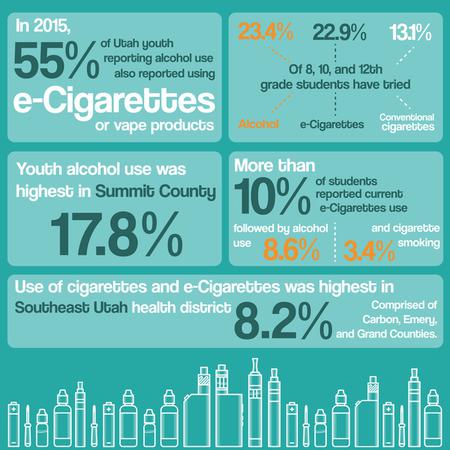
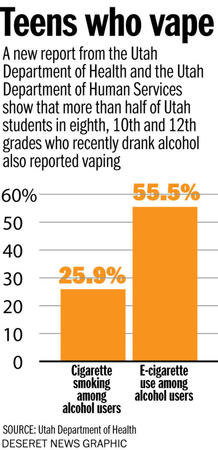
Results from the state's biennial student health and risk prevention survey show that 56% of Utah youth who reported drinking recently also reported using e-cigarettes or vape products.
Only 26% of those same students reported using traditional cigarettes.
“That’s a huge number,” said Brittany Karzen, a spokesperson for the health department's tobacco prevention and control program.
Karzen said health officials believe the allure of e-cigarettes is particularly strong among those kids who are at high risk and on the lower end of the teenage spectrum.
“Because these products have been talked about and seen as a safe choice, or safer, these kids might think, 'Hey, this isn’t so bad. My friends have it. I want to try it,'” Karzen said.
Adult use of e-cigarettes has sparked intense debate in the medical community. In the UK, a prominent medical group released a report encouraging their use as a healthier alternative to traditional cigarettes.
In the US, however, many doctors remain cautious about the potential normalization of smoking among children.
“For us adults, if someone has switched from smoking to vaping, that might be a good thing,” said John Ryan, a cardiologist at the University of Utah.
Ryan's concern, he said, is the device's appeal to young people.
“How will this translate to an older population? Are we creating another generation that is dependent and addicted to nicotine?” he said.
Compared to traditional cigarettes, e-cigarettes are not considered a tobacco product.
Instead, these devices heat "e-juice," which is why doctors at the Royal College in the UK recommend it as a smoking cessation tool that delivers nicotine through vapor.
Supporters of e-cigarettes have long said they do not support selling to kids. In Utah, it is illegal to sell e-cigarettes to anyone under 19.
“We have people who are minors and who are users coming together to pay attention,” said Allen Fraser, executive director of the Utah Tobacco-Free Association. “This shouldn’t be happening.”
Fraser said Utah is doing more to prevent youth access to e-cigarettes than other states, including banning online sales of vaping-related products.
He expressed concern that teenagers who use e-cigarettes will graduate to traditional cigarettes.
He pointed out that researchers who looked at national survey data found that three-quarters of high school seniors who used e-cigarettes had previously smoked traditional cigarettes. Researchers noted that non-smoking high school students are "highly unlikely to use e-cigarettes."
“This suggests that the whole gateway theory is false,” Fraser said. “It doesn’t exist.”
According to the health department, Utah students also reported relatively low levels of experimentation with alcohol and e-cigarettes (23%) and traditional cigarette experimentation (13%), according to Healthy Utah.
Only 3% of Utah students reported currently smoking, 9% reported current alcohol use, and 11% reported current e-cigarette use.
Karzen said e-cigarettes present a challenge for public health officials who have overseen a historic decline in traditional cigarette use, now facing a "different animal" to tackle.
“Our youth smoking rate is 3.4%, so it’s clear we’ve talked about this issue in a way that has worked,” she said. “The question now is: can we talk about e-cigarettes in the same way? Or do we need to find different ways to address this issue?”


