
In-Depth 2021 Comparison: Which Is More Harmful, Vaping or Cigarettes?
Which is more harmful, vaping or cigarettes? This question has likely been on the minds of many smokers who want to try the new generation of upgraded e-cigarette products but are also afraid, as inhaling anything into the body requires caution. This article compiles data and my personal experiences with this product over the years. Let's delve into the comparison of the harms of e-cigarettes versus cigarettes.
Before we understand, let's take a look at the comparison of the components of e-cigarettes and cigarettes:
E-cigarettes: atomizer device (machine atomization), functional devices, etc., e-liquid (main vaporizing component) containing flavoring, food-grade propylene glycol, food-grade glycerin, and nicotine.
Cigarettes: tobacco, cigarette paper, flavoring agents, nicotine, humectants, filters, and rolling paper.
Both contain nicotine, which is the primary route to addiction. Non-smokers should choose carefully; regardless of whether one chooses the former or the latter, there is a possibility of addiction. Therefore, e-cigarettes are not a product for quitting smoking; they can at most be considered a smoking cessation aid, simulating smoke to address psychological cravings.
?

What about the harmful components produced by the vapor of both?
E-cigarettes: As mentioned above, the vaporizing components are flavoring, food-grade propylene glycol, food-grade glycerin, and nicotine, which are heated without an open flame to evaporate the vapor, many of which are food-grade and generally safe for consumption. Here are some of the chemicals found in the vapor: nicotine, propylene glycol, acetaldehyde, nitrosamines. Any other chemicals found are mostly related to the flavoring process, and these flavoring agents are strictly used for food rather than inhalation products, so toxicological studies focus on demonstrating that flavoring agents can be safely consumed.
?

Cigarettes: Cigarettes are burned with an open flame, and the smoking process involves burning tobacco that contains thousands of chemicals, over 20 of which are strongly linked to carcinogenicity. We can refer to these 20+ chemicals collectively as "carcinogens". Listing the names of these 20+ chemicals would take a long time. However, here are some of the chemicals we can consider carcinogenic: nicotine, tar, hydrogen cyanide, formaldehyde, lead, arsenic, ammonia, benzene, carbon monoxide, nitrosamines, etc. Many of these chemicals are strongly associated with major health conditions, including cancer, heart disease, and lung diseases. These chemical elements are not found in the process of making cigarettes; rather, it is the burning of tobacco that initiates the chemical reactions, producing smoke filled with the aforementioned carcinogens.
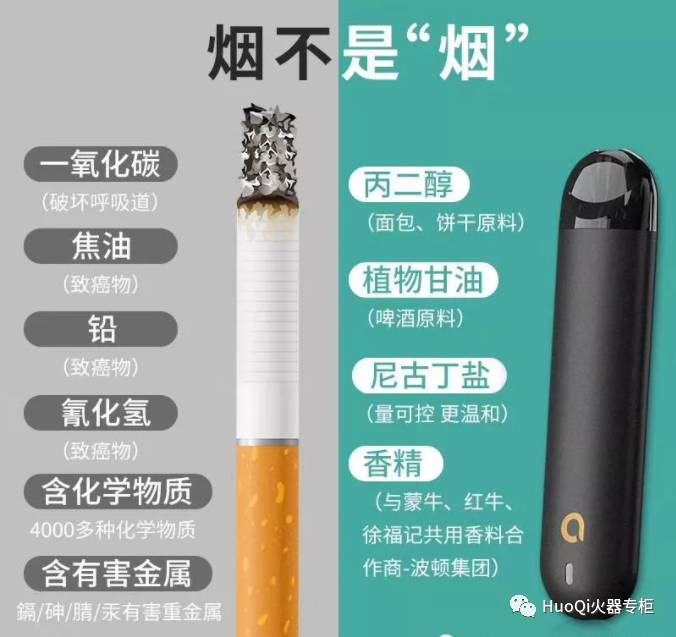
Based on the above comparison, some scientific conclusions have been drawn stating that "e-cigarettes are 95% less harmful than cigarettes". In February 2018, the American Cancer Society (ACS) also released a position statement: although the long-term effects of using e-cigarettes are not yet clear, it can be estimated that they are less harmful than regular cigarettes. The association clearly encourages people to try using e-cigarettes as a substitute for traditional cigarettes. It also recommends that clinicians suggest e-cigarettes to smokers as a replacement for traditional cigarettes.
In November 2018, the Centers for Disease Control and Prevention (CDC) also expressed its stance to the public. It recommends that those who are already addicted to smoking switch to e-cigarettes and try to quit smoking. However, it also reminds that e-cigarettes are not harmless, and that teenagers, pregnant women, and those who do not smoke should not attempt them just because they are less harmful than cigarettes.
E-cigarettes, what exactly are they? Are they good or bad? Can e-cigarettes really help with quitting smoking? I hope the above content can be of some help to you. If you want to quit smoking completely, it’s best to avoid both; if your addiction is deep and you cannot easily quit, then you can rationally try a healthy "smoking alternative". After all, e-cigarettes are 95% less harmful than cigarettes, and they do not involve the carcinogenic chemicals produced by the open flame combustion of traditional cigarettes. If you do not smoke, it is best to avoid both.


