Can Vaping Help You Quit Smoking? Is It Effective?
When merchants sell e-cigarettes, they often promote that e-cigarettes can help with quitting smoking, and some people choose e-cigarettes for this reason; however, many others argue that e-cigarettes cannot help with quitting smoking and that one should not pay this 'intelligence tax.' Is it possible that they end up paying tobacco taxes without actually quitting?
At first glance, e-cigarettes and nicotine replacement products seem similar.

Can e-cigarettes help with quitting smoking? Are e-cigarettes effective for quitting?
Nicotine replacement products are a general term for items used to help quit smoking, primarily used in nicotine replacement therapy (NRT). The nicotine in cigarettes is an addictive substance, and when quitting smoking, people experience withdrawal symptoms, making it difficult to quit.
Nicotine patches are a proven effective tool for quitting smoking. In the show Sherlock, Benedict Cumberbatch used nicotine patches to stay alert, but his usage was, of course, incorrect.
If nicotine patches, nicotine gum, or nicotine sprays are used to deliver nicotine into the bloodstream during the quitting process, they can alleviate withdrawal symptoms and increase the success rate of quitting.
In 1996, the World Health Organization (WHO) officially recommended nicotine replacement therapy to various countries [1]. The FDA has also approved at least four legal nicotine replacement products to assist with quitting.
E-cigarettes also seem to serve this purpose; in fact, the WHO refers to e-cigarettes as "electronic nicotine delivery systems" and studies them alongside other nicotine replacement products.
However, although e-cigarettes are similar to nicotine replacement products, their usage behavior is also similar to smoking, so it cannot be simply assumed that e-cigarettes can help with quitting.
Blue pill or red pill?
The discussion on whether e-cigarettes are harmful should be comparative, not ignoring the background factors of cigarette harm. Discussing whether e-cigarettes are "absolutely harmless" without context is highly misleading.
Research results on whether e-cigarettes can help with quitting smoking are inconsistent.
For example, a paper published in JAMA in 2014 indicated that a longitudinal analysis of two online surveys conducted a year apart with 949 smokers showed that the success rate of quitting for e-cigarette users did not increase, nor did their cigarette consumption decrease. However, the authors of the paper also noted that this survey relied on self-reported data, and the understanding of the participants' e-cigarette usage, frequency, and habits was insufficient.
Other studies suggest that e-cigarettes can help smokers quit or reduce their smoking.
Can e-cigarettes help with quitting smoking? Are e-cigarettes effective for quitting?
A meta-analysis study in 2016 showed that those who chose e-cigarettes to quit smoking had a 28% higher probability of successfully quitting compared to those who did not choose e-cigarettes.
A recent study published in the Cochrane Database of Systematic Reviews found that e-cigarettes can help with quitting smoking, and their effectiveness is better than the placebo effect.
In a photo, Sophie Turner and her boyfriend were spotted out, and she was using an e-cigarette called Juul, a popular e-cigarette in the U.S. The popularity of Juul has caused concern for U.S. health authorities, as many middle school students have started trying e-cigarettes.
Another meta-analysis study from 2015 indicated that using nicotine-containing e-liquid is more likely to lead to quitting than using non-nicotine e-liquid; this suggests that e-cigarettes can indeed play a role similar to traditional nicotine replacement therapies. This study even indicated that e-cigarettes are more successful than traditional nicotine replacement therapies in helping people quit smoking (20% success rate vs. 10% success rate).
A study published in the Chinese Journal of Clinical Physicians in 2015 reported that e-cigarettes can help smokers quit or reduce their smoking; 47.1% of smokers reported a reduction in smoking.
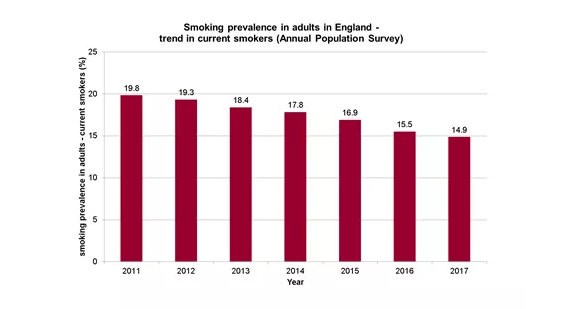
From 2011 to 2017, the overall smoking rate in the UK declined, and the UK Department of Public Health believes that e-cigarettes have played a significant role.
The situation in the UK is relatively optimistic. In a blog released by the UK Department of Public Health in 2018, it stated that at least in the UK, e-cigarettes can help people quit smoking. Among the 2.9 million e-cigarette users in the UK, more than half have completely quit smoking, and e-cigarettes are expected to help 20,000 people quit smoking each year. With the promotion of e-cigarettes, the smoking rate in the UK has been declining year by year, reaching a historic low of 15.5%, only higher than Sweden in all of Europe.
Conservatively speaking, according to the WHO's statement in 2014, existing research is insufficient to prove that using e-cigarettes can help completely quit smoking, and traditional nicotine therapies that have been proven effective are prioritized for recommendation.
The WHO also believes that while many people may not quit completely, they still use both cigarettes and e-cigarettes, but because they tend to smoke less, e-cigarettes can still be recommended to smokers.