
E-Cigarette Regulation Is Finally Coming: MIIT Seeks Public Comment, 200 Billion Giant Plunges
The Ministry of Industry and Information Technology (MIIT) will promote the legalization of e-cigarette regulation.
On the afternoon of March 22, the MIIT announced that to strengthen the regulation of e-cigarettes and other new tobacco products, it, along with the State Tobacco Monopoly Administration, has drafted the "Decision on Amending the Implementation Regulations of the Tobacco Monopoly Law of the People's Republic of China (Draft for Comments)" and is now seeking public feedback until April 22, 2021.
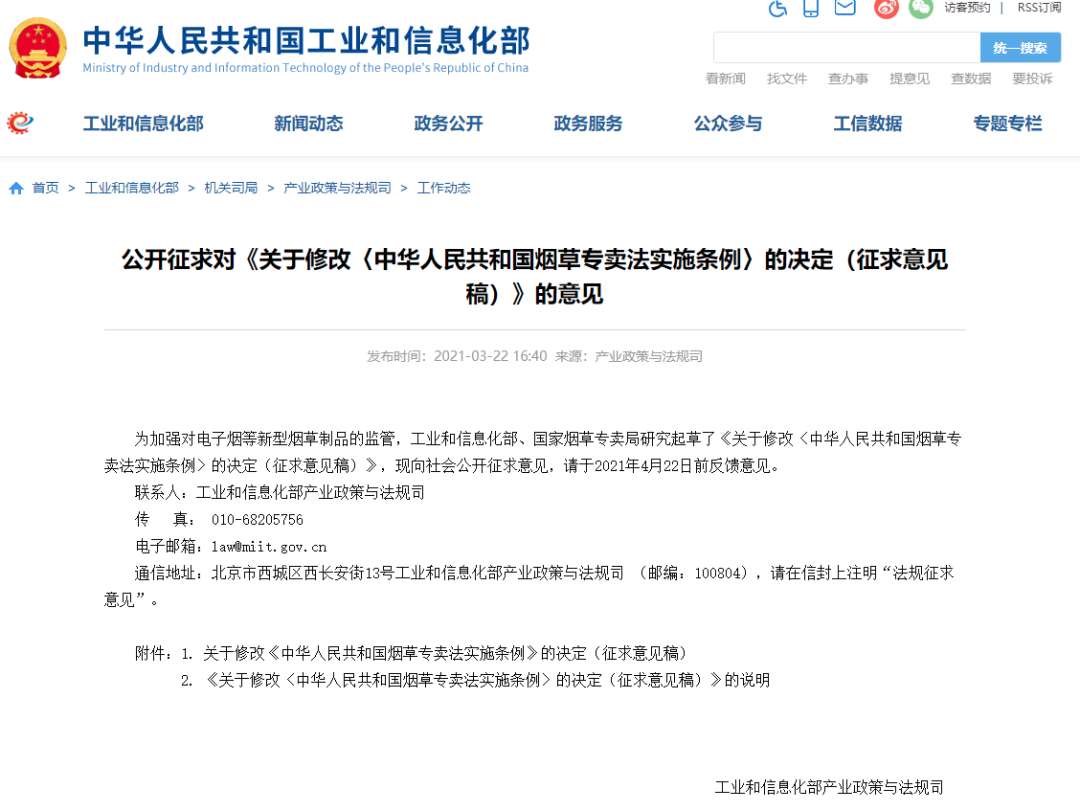
The key points regarding e-cigarettes are as follows:
This amendment to the "Implementation Regulations" will add a clause in the appendix, as Article 65: "E-cigarettes and other new tobacco products shall be implemented in accordance with the relevant provisions regarding cigarettes in this regulation." The main considerations are:
(1) To promote the legalization of e-cigarette regulation. In recent years, new situations and problems have emerged in the market regulation of e-cigarettes and other new tobacco products, attracting significant public attention. This amendment mainly aims to implement the requirements of the Central Committee of the Communist Party of China and the State Council regarding the legalization of e-cigarette regulation, clarify the legal basis for regulating e-cigarettes and other new tobacco products, and ensure alignment with laws and regulations such as the "Law on the Protection of Minors of the People's Republic of China," thereby reinforcing the fundamental role of the rule of law in stabilizing expectations and benefiting long-term development.
(2) To align with the characteristics of e-cigarette products and current international regulatory practices. Given that e-cigarettes and other new tobacco products share similarities with traditional cigarettes in core components, product functions, and consumption methods, they should be regulated in accordance with the relevant provisions regarding cigarettes in the "Implementation Regulations." This is consistent with the regulatory approaches of major countries and regions internationally.
(3) To enhance the regulatory effectiveness of e-cigarettes. Regulating e-cigarettes and other new tobacco products in accordance with the relevant provisions regarding cigarettes in the "Implementation Regulations" will significantly improve regulatory effectiveness, effectively standardize the production and operation activities of e-cigarettes, address issues such as product quality safety risks and false advertising, and effectively protect consumers' legitimate rights and interests.
The e-cigarette giant, Smoore Technology, saw its stock price plummet before the market opened.
In response to the news, Smoore Technology, listed on the US stock market, experienced a sudden drop of 30% in its pre-market stock price!
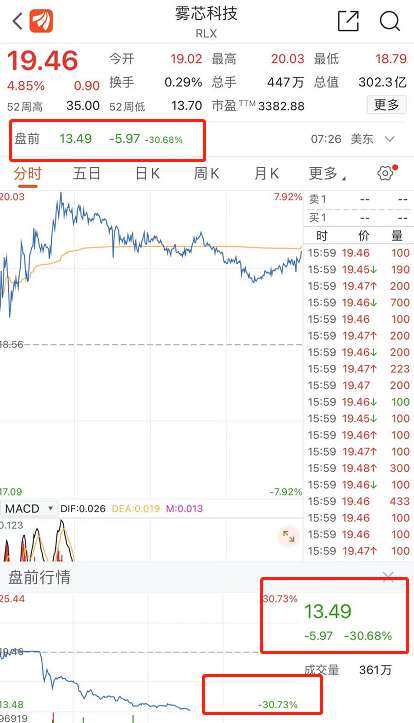
According to its official website, Smoore Technology is a consumer-grade electronic vaporizer brand company founded in China, primarily engaged in the research, design, and sales of the RELX brand electronic vaporizer. The management of Smoore Technology stated that the company is the largest e-cigarette manufacturer in China, holding a 62.6% market share in the retail market as of September 30, 2020.
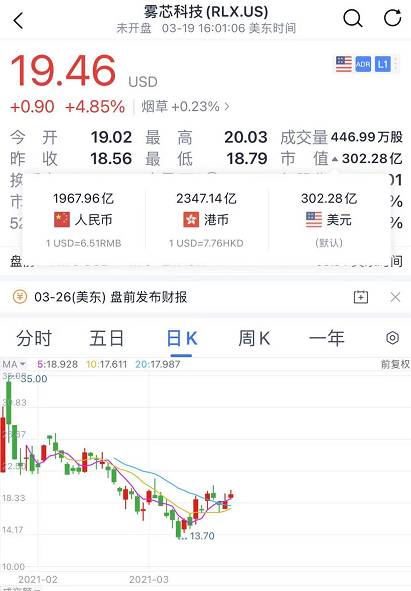
On January 22, the e-cigarette company Smoore Technology (RELX) officially listed on the New York Stock Exchange under the ticker symbol "RLX," with an issue price of $12 per ADS. On its first day of trading, Smoore Technology was highly sought after by investors, and by the end of that day, RELX's stock price surged by 145.92%, closing at $29.54, with a market capitalization of $45.8 billion, approximately 300 billion RMB.
As of the latest closing, Smoore Technology's stock price was reported at $19.46 per share, with a market capitalization of nearly 200 billion RMB.
At the end of 2019, the State Tobacco Monopoly Administration and the State Administration for Market Regulation issued an online ban on e-cigarettes, leading to widespread despair in the e-cigarette industry. At that time, the media widely discussed the topic of "How long can e-cigarettes survive?"
However, now, why have e-cigarettes not only survived but also become a hot investment trend?
Due to regulatory requirements, RELX's e-cigarettes primarily rely on offline sales channels, and last year's pandemic did not significantly negatively impact its performance. According to its prospectus, Smoore Technology's revenue for 2018, 2019, and the first three quarters of 2020 was 133 million, 1.549 billion, and 2.201 billion RMB, respectively; net profits were approximately -287,000, 47.748 million, and 109 million RMB. As of September 2020, Smoore Technology collaborated with 110 authorized distributors, owning over 5,000 specialty stores and more than 100,000 retail stores.
The founder, born in the 1980s, Wang Ying, saw her net worth soar to 58 billion RMB overnight, entering the ranks of China's top billionaires. This was only three years after she founded Smoore Technology.
How profitable is the e-cigarette business?
According to a CIC report, the global smoking cessation market reached $63.1 billion in 2019, with a compound annual growth rate (CAGR) of 26.3% from 2016 to 2019, and is expected to reach $124 billion by 2023, with a CAGR of 18.4% from 2019 to 2023. Among this, the scale of electronic vaporization devices (including closed and open electronic vaporization devices) will reach $82 billion, with a CAGR of 23.5% from 2019 to 2023, exceeding the industry growth rate.
According to research and analysis by consulting and intelligence firm Arizton, the global e-cigarette market revenue will exceed $60 billion from 2020 to 2025, growing at a compound annual growth rate of about 15%. With technological advancements and changing lifestyle concepts, the market potential for new tobacco products is immense.
CITIC Securities pointed out that the global trend of tobacco harm reduction is evident, with vaporized e-cigarettes growing rapidly, becoming a major alternative for tobacco harm reduction. In 2019, vaporized e-cigarette products accounted for 55.8% of the global harm reduction alternative market, with a scale of approximately $35.2 billion; it is expected to increase to $82 billion by 2023, with a CAGR of 23.5%. Currently, China is the main producer of e-cigarettes, but the user penetration rate is far lower than that of Europe and the United States. In 2019, the number of smokers in China reached 286.7 million, accounting for nearly one-third of the global total, but the penetration rate of e-cigarette users was only 1.2%, indicating significant potential for development. The domestic vaporized e-cigarette market is expected to grow rapidly, primarily dominated by closed products. In 2019, the market size of vaporized e-cigarettes in China was $1.5 billion, accounting for 0.6% of the overall domestic tobacco market; it is expected to reach $11.3 billion by 2023, with a share of 4.0%, and a CAGR of 65.9% from 2019 to 2023.
Everbright Securities' research report states that due to health concerns and the market education driven by leading brands, the Chinese e-cigarette market is developing rapidly, with a CAGR of 35.7% from 2016 to 2019. Given the high number of smokers in China, and referencing the over 30% penetration rate of e-cigarettes in the United States, it is believed that the future market space for e-cigarettes in China could reach 112.8 billion RMB.
Additionally, in 2019, China had 286.7 million smokers. Assuming a 30% penetration rate, with a device replacement every two years (250 RMB per device) and three pods per month (average price of 99 RMB for three pods), the potential market size for the industry would be 1.129 trillion RMB, representing a 12-fold growth compared to the 2019 market size of $1.5 billion, with growth potential comparable to that of new energy vehicles.
E-cigarettes are not only profitable but also have a vast market space. China is the largest tobacco market globally, with over 300 million smokers, maintaining the highest number of smokers worldwide. According to China Insights Consultancy (CIC), the penetration rate of e-cigarettes in China was only 1.2% in 2019, while the penetration rate among smokers in Europe and the United States has already reached double digits.
In summary, e-cigarettes represent a good business opportunity, offering a fresh experience, extremely high repurchase rates, and a potentially large consumer base.
Policy regulation is the "Sword of Damocles" hanging over the e-cigarette industry.
The Chinese e-cigarette market still faces significant uncertainty regarding policies.
In Europe and the United States, the attitudes are starkly contrasting. The United States defines e-cigarettes as tobacco, with strict PMTA review mechanisms, flavor restrictions, and considerations for taxation; the United Kingdom, however, defines them as medical/consumer products, imposing certain restrictions on content and marketing but maintaining an overall open attitude, believing that e-cigarettes are an important tool for reducing the national smoking rate. In summary, the differences in policy approaches between the UK and the US mainly depend on three factors: (1) the degree of harm posed by e-cigarettes compared to traditional cigarettes; (2) the appeal of e-cigarettes to teenagers; (3) whether e-cigarettes can achieve smoking cessation effects.
United States: Policy measures focus on reducing youth smoking rates. The youth smoking rate in the US has gradually increased since 2014, driven by brands like VUSE, BLU, and JUUL, with over 5 million youth e-cigarette users in 2019, making it a pressing social issue. Consequently, in addition to PMTA, the US has mainly adopted measures such as flavor restrictions, raising the age limit, and taxation to reduce the appeal of e-cigarettes to youth or to increase the threshold and cost for youth to purchase e-cigarettes.
United Kingdom: E-cigarettes are seen as an important tool for reducing smoking rates, with a relatively open government attitude. A 2015 study by the UK Department of Health found that e-cigarettes are 95% less harmful than traditional cigarettes, setting the tone for subsequent UK policy formulation. According to the UK Department of Health, there is currently no evidence that e-cigarettes will become a gateway for youth smoking, and every year, 20,000 people in the UK quit smoking through e-cigarettes. Based on this, UK policy focuses on restrictions on content and marketing while maintaining an overall open attitude.
Focusing on China: The impact of flavor bans and taxation is worth noting. Calculations indicate that current e-cigarette users in China are primarily adults, with a lower proportion of youth compared to the US. Additionally, considering the vast market potential in China and the extremely low penetration rate among female smokers, the "smoking cessation" function will become increasingly important in Chinese e-cigarette consumption. The impact of domestic flavor bans may be less severe than in the US; furthermore, if e-cigarettes are subjected to a 20% retail tax and a 50% wholesale tax, the terminal prices will rise by 3.5 RMB and 10.5 RMB, respectively, after certain concessions. However, the imposition of a 50% wholesale tax will undoubtedly disrupt the high growth trend of e-cigarettes, warranting close attention in the future.
Currently, the comprehensive tax rate on ordinary tobacco is around 60%, while e-cigarettes are still regarded as ordinary consumer goods, with a comprehensive tax rate of less than 20%. However, if e-cigarettes are classified as tobacco in the future, they will be subject to heavy taxation, which could be a significant negative factor that may arise. Moreover, tobacco tax is an important component of China's fiscal revenue, with the tobacco industry generating a total tax revenue of 1.2056 trillion RMB in 2019, accounting for 6.3% of the country's total fiscal revenue.


