
Does Vaping Cause Osteoporosis? Expert Responds: Rumor!
A recent report titled “Vaping May Cause Osteoporosis” has attracted widespread attention. However, we noted that this U.S.-based study has already been challenged by the American Council on Science and Health (ACSH), which stated: “The study is confusing
Recently, a report titled "Does Vaping Cause Osteoporosis?" has attracted widespread attention. However, we note that this study from the United States has been debunked by the American Council on Science and Health (ACSH), which stated: "The study is confusing, and any conclusions drawn from it are incorrect." "Does Vaping Cause Bone Damage? Yes or No, a Confusing Study," published on the ACSH website
It turns out that the problem lies in the definitions. The study defines e-cigarette users as "those who have used e-cigarettes at least once in the past 30 days." This means that both heavy users who vape daily and those who have only tried e-cigarettes once in the past 30 days are classified as e-cigarette users. Does this include someone who smoked cigarettes for the first 29 days and only started using e-cigarettes on the last day? Should their fractures be attributed to cigarettes or e-cigarettes?
"If the definitions that form the premise of the study are invalid, the conclusions are naturally meaningless," said Cameron English, head of the life sciences section at ACSH and author of the article.
Now, let's look at the specifics of the study. The study published in the American Journal of Medicine claims that a survey of over 5,500 adult e-cigarette users found a high correlation between e-cigarette use and the incidence of brittle fractures. The conclusion seems alarming, but the logic is riddled with holes: e-cigarette users have a higher incidence of brittle fractures = e-cigarette users are more prone to fractures = e-cigarette users have osteoporosis = e-cigarettes cause osteoporosis in users — a typical slippery slope fallacy.
Is the high incidence of fractures due to users engaging in dangerous work? Do fracture patients have other common habits besides using e-cigarettes? Did users have a history of fractures before using e-cigarettes? Every equation in the study's logic can be questioned.
More critically, some conclusions of the study contradict internationally recognized authoritative scientific conclusions.
Cameron English noted that he became aware of this study because it claimed that "dual users of cigarettes and e-cigarettes have a higher incidence than smokers." The UK Department of Health confirmed back in 2015 that e-cigarettes can reduce 95% of the harm of smoking; how can the incidence be higher for those who abandon the more harmful cigarettes?
He studied the research and found it to be completely self-contradictory. The data shows that the incidence of brittle fractures among former e-cigarette users is higher than that of current users; according to the study's conclusion (that e-cigarettes are a causative factor), stopping e-cigarette use should lead to fewer fractures.
"Does Vaping Cause Bone Damage? Yes or No, a Confusing Study," published on the ACSH website
It turns out that the problem lies in the definitions. The study defines e-cigarette users as "those who have used e-cigarettes at least once in the past 30 days." This means that both heavy users who vape daily and those who have only tried e-cigarettes once in the past 30 days are classified as e-cigarette users. Does this include someone who smoked cigarettes for the first 29 days and only started using e-cigarettes on the last day? Should their fractures be attributed to cigarettes or e-cigarettes?
"If the definitions that form the premise of the study are invalid, the conclusions are naturally meaningless," said Cameron English, head of the life sciences section at ACSH and author of the article.
Now, let's look at the specifics of the study. The study published in the American Journal of Medicine claims that a survey of over 5,500 adult e-cigarette users found a high correlation between e-cigarette use and the incidence of brittle fractures. The conclusion seems alarming, but the logic is riddled with holes: e-cigarette users have a higher incidence of brittle fractures = e-cigarette users are more prone to fractures = e-cigarette users have osteoporosis = e-cigarettes cause osteoporosis in users — a typical slippery slope fallacy.
Is the high incidence of fractures due to users engaging in dangerous work? Do fracture patients have other common habits besides using e-cigarettes? Did users have a history of fractures before using e-cigarettes? Every equation in the study's logic can be questioned.
More critically, some conclusions of the study contradict internationally recognized authoritative scientific conclusions.
Cameron English noted that he became aware of this study because it claimed that "dual users of cigarettes and e-cigarettes have a higher incidence than smokers." The UK Department of Health confirmed back in 2015 that e-cigarettes can reduce 95% of the harm of smoking; how can the incidence be higher for those who abandon the more harmful cigarettes?
He studied the research and found it to be completely self-contradictory. The data shows that the incidence of brittle fractures among former e-cigarette users is higher than that of current users; according to the study's conclusion (that e-cigarettes are a causative factor), stopping e-cigarette use should lead to fewer fractures.
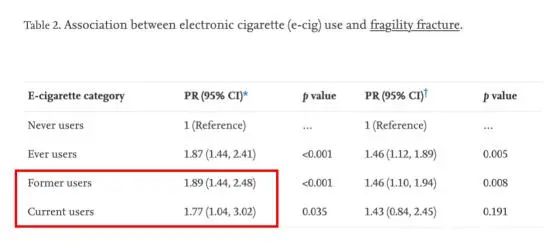 Research data shows that the incidence among former e-cigarette users is higher than that of current e-cigarette users.
In fact, the authors of the study have already stated the limitations of their conclusions, including not distinguishing between the brands of e-cigarettes used by the subjects, the duration of use, and conducting more specific comparative analyses. However, both domestic and foreign media have focused solely on spreading the sensational conclusion that "e-cigarettes cause osteoporosis."
"The researchers have stated that 'our findings have significant potential implications for public health.' Frankly, drawing any conclusions from this study is erroneous. Even if e-cigarettes do cause osteoporosis, we need more scientific research to prove it, if such a situation exists," Cameron English said.
Research data shows that the incidence among former e-cigarette users is higher than that of current e-cigarette users.
In fact, the authors of the study have already stated the limitations of their conclusions, including not distinguishing between the brands of e-cigarettes used by the subjects, the duration of use, and conducting more specific comparative analyses. However, both domestic and foreign media have focused solely on spreading the sensational conclusion that "e-cigarettes cause osteoporosis."
"The researchers have stated that 'our findings have significant potential implications for public health.' Frankly, drawing any conclusions from this study is erroneous. Even if e-cigarettes do cause osteoporosis, we need more scientific research to prove it, if such a situation exists," Cameron English said.
"Does Vaping Cause Bone Damage? Yes or No, a Confusing Study," published on the ACSH website
It turns out that the problem lies in the definitions. The study defines e-cigarette users as "those who have used e-cigarettes at least once in the past 30 days." This means that both heavy users who vape daily and those who have only tried e-cigarettes once in the past 30 days are classified as e-cigarette users. Does this include someone who smoked cigarettes for the first 29 days and only started using e-cigarettes on the last day? Should their fractures be attributed to cigarettes or e-cigarettes?
"If the definitions that form the premise of the study are invalid, the conclusions are naturally meaningless," said Cameron English, head of the life sciences section at ACSH and author of the article.
Now, let's look at the specifics of the study. The study published in the American Journal of Medicine claims that a survey of over 5,500 adult e-cigarette users found a high correlation between e-cigarette use and the incidence of brittle fractures. The conclusion seems alarming, but the logic is riddled with holes: e-cigarette users have a higher incidence of brittle fractures = e-cigarette users are more prone to fractures = e-cigarette users have osteoporosis = e-cigarettes cause osteoporosis in users — a typical slippery slope fallacy.
Is the high incidence of fractures due to users engaging in dangerous work? Do fracture patients have other common habits besides using e-cigarettes? Did users have a history of fractures before using e-cigarettes? Every equation in the study's logic can be questioned.
More critically, some conclusions of the study contradict internationally recognized authoritative scientific conclusions.
Cameron English noted that he became aware of this study because it claimed that "dual users of cigarettes and e-cigarettes have a higher incidence than smokers." The UK Department of Health confirmed back in 2015 that e-cigarettes can reduce 95% of the harm of smoking; how can the incidence be higher for those who abandon the more harmful cigarettes?
He studied the research and found it to be completely self-contradictory. The data shows that the incidence of brittle fractures among former e-cigarette users is higher than that of current users; according to the study's conclusion (that e-cigarettes are a causative factor), stopping e-cigarette use should lead to fewer fractures.
Research data shows that the incidence among former e-cigarette users is higher than that of current e-cigarette users.
In fact, the authors of the study have already stated the limitations of their conclusions, including not distinguishing between the brands of e-cigarettes used by the subjects, the duration of use, and conducting more specific comparative analyses. However, both domestic and foreign media have focused solely on spreading the sensational conclusion that "e-cigarettes cause osteoporosis."
"The researchers have stated that 'our findings have significant potential implications for public health.' Frankly, drawing any conclusions from this study is erroneous. Even if e-cigarettes do cause osteoporosis, we need more scientific research to prove it, if such a situation exists," Cameron English said.

