2015: A Turning Point for the Four Major Multinational Tobacco Companies
In reviewing the development of the international tobacco market in 2014, we must connect many points to see the "weather map" of the international tobacco industry: the four major multinational tobacco companies have continuously issued statements about declining sales; the tobacco crops in major tobacco-producing countries have seen significant increases; the oversupply of tobacco leaves has led to a sharp decline in profits for major international tobacco merchants, with a drop of up to 30% compared to the previous year; affected by policies, the domestic currency of the world's second-largest cigarette market, Russia, is on the verge of collapse. In addition, the legal cigarette market in the EU continues to shrink, and the illegal cigarette market has already accounted for 1/10 of the share, while the "Arab Spring" has also affected the supply and sales channels of cigarettes.<\/p>
In such a situation, the development of the four major multinational tobacco companies seems to be at a watershed. This will cause all stakeholders attached to this value chain to begin to change their positions and strategic choices—all must revolve around survival.<\/p>
Demand-side Economics<\/strong><\/p>
To predict the future performance of the international tobacco industry, it is necessary to analyze customer demand, as this will have a significant impact on all other aspects of the industry. In 2014, the overall consumption of the global tobacco industry was estimated at 5.8 trillion cigarettes (1 trillion equals 10 to the 12th power—translator's note). In recent years, global tobacco consumption has decreased by 1-2 percentage points annually, with the Japanese market declining the fastest, while the EU, the US, and Eastern Europe (including Russia) are experiencing a slow decline.<\/p>
The four major multinational tobacco companies—Philip Morris International, British American Tobacco, Japan Tobacco, and Imperial Brands—have continuously released reports of single-digit percentage declines in sales. Philip Morris International reported a 2.4% decline in cigarette sales from January to September 2014; Japan Tobacco reported a 4.9% decline in the same period; Imperial Brands reported a 7% decline in cigarette sales for the entire year of 2014, while British American Tobacco and Imperial Brands had similar declines. If we estimate based on annual sales levels, these four major multinational tobacco companies collectively reduced cigarette sales by about 70 billion cigarettes in 2014.<\/p>
Some attribute this situation to the rise of the e-cigarette market. However, this statement does not reveal the true reason for the overall slowdown in industry development. On a global scale, the market size of e-cigarettes is still very small.<\/p>
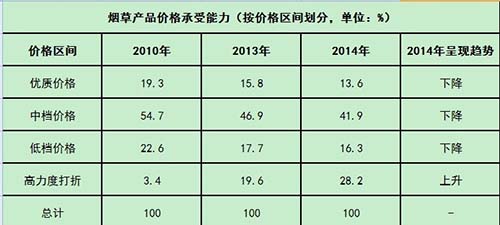
I believe that the fundamental reason for the decline in total cigarette sales is the so-called "premiumization" strategy adopted by the international tobacco industry. The essence of this strategy is to transfer cigarette consumption taxes to consumers by maintaining sufficiently high retail prices to ensure final profits in the face of declining total sales. It is noteworthy that a price demand analysis conducted on the global market reflects a new development trend (as shown in the table below).<\/p>
The rapid growth of heavily discounted cigarette brands indicates that customers want to purchase cigarettes at prices they can accept, rather than paying the extra costs. The four major multinational tobacco companies are trying every means to control retail prices. For example, in some markets, they suggest setting minimum consumption tax standards to ensure minimum retail prices. Subsequently, they produce some high-end brands to compete with regular brands. However, such strategies have only been effective for a short period. Today, the prices of cigarette brands produced by the four major multinational tobacco companies have exceeded what customers can bear. Operational strategy errors have forced the four major multinational tobacco companies to raise cigarette prices, which in turn has led to further declines in overall cigarette sales. This has allowed many small and medium-sized enterprises to take the opportunity to enter the tobacco market and capture market share through more reasonable prices.<\/p>
The significant decline in the market share of the four major multinational tobacco companies in Europe has triggered intense restructuring in the cigarette market. Over the past two years, the dramatic changes in the Western European supply market have fully demonstrated this: Philip Morris International announced the closure of its factory in Bergen op Zoom, Netherlands; Japan Tobacco announced the closure of its factories in Northern Ireland and Belgium; Imperial Brands announced the closure of its factories in Nottingham, UK, and Nantes, France. The closure of these five factories has resulted in the unemployment of 3,000 workers. Outside of Europe, other factories have also been closed in the past year and a half, including Philip Morris International's hand-rolled clove cigarette factories in Indonesia and Lumajang, its factory in Murrabin, Australia, and Japan Tobacco's four factories in its home country. The closure of these factories has led to the loss of 7,000 jobs. A total of 10,000 jobs have disappeared in the production bases of the four major multinational tobacco companies. They have not established new factories, which means that consumer demand has further weakened.<\/p>
In fact, comparing the historical development of cigarettes and recent data indicates that the signs of difficulty for the four major multinational tobacco companies are becoming increasingly evident. According to data from 2010, the four major multinational tobacco companies held 45% of the global market share, while by 2014, this figure had dropped to around 38%. This means that compared to 2010, the four major multinational tobacco companies saw a decrease of 200 billion cigarettes in sales in 2014.<\/p>
The significant growth in sales of heavily discounted cigarette brands and the gradual expansion of the low-priced cigarette market indicate that competition in the international tobacco industry will become more intense. Some details reveal the difficulties they will face—the four major multinational tobacco companies will have to compete with their own brands, i.e., their newly launched products, to make a profit. This contradicts the "brand rationalization and streamlining" strategy implemented by the four major multinational tobacco companies in recent years to ensure growth in cigarette sales. Not competing with their own brands means that strategic adjustments are imperative—finding new opportunities in the current market to ensure that they can compensate for the losses caused by declining sales while effectively preventing future market downturns.<\/p>
The current political turmoil exacerbates this difficult situation. For example, trade sanctions against Russia have dealt a huge blow to the market, causing the value of the ruble to plummet. Previously, the consumption of cigarettes in the Russian market could reach 380 billion cigarettes, with 95% of the market controlled by the four major multinational tobacco companies. It is also worth noting that Japan Tobacco relies heavily on the Russian market—over 40% of its profits come from there. Perhaps in the past two years, entering the water pipe market in Egypt and the hand-rolled cigarette market in Belgium can be seen as a prelude to the company reducing its dependence on the cigarette and Russian markets, but these measures may not have the desired effect.<\/p>
The Indonesian market continues to grow and has become the third-largest cigarette-consuming country in the world. However, only two of the four major multinational tobacco companies are active in that market. The cigarette market in Africa (mainly in the Middle East) has enormous growth potential. One can boldly speculate that for the four major multinational tobacco companies, if they do not adjust their strategies in a timely manner, the future will be quite bleak.<\/p>
Supply-side Economics<\/strong><\/p>
In 2014, Brazil, the United States, Zimbabwe, and India had bumper tobacco crops, yet there was no usual large-scale purchase. The four major multinational tobacco companies chose to consume their tobacco leaf inventories as a response strategy.<\/p>
Given the presence of a large amount of unregistered tobacco leaves and the fact that newly harvested tobacco leaves will be available in the first quarter of 2015, the tobacco leaf market has shown signs of oversupply. Major tobacco merchants have issued statements to lower income expectations, reflecting the current reality of the tobacco leaf market. However, with the expected decline in tobacco leaf demand in the first six to nine months of 2015, many tobacco merchants will face additional pressure to deal with the problems arising from insufficient sales in 2015. Russia will play an important role in obtaining foreign exchange resources in this market, which will also put greater pressure on tobacco leaf sales in 2015. Many industry insiders even predict that it will take until at least 2016 for the tobacco leaf market to return to its previous normal sales levels. In fact, some have even suggested that major tobacco merchants should unite to weather the crisis together.<\/p>
The above situation clearly indicates that the future tobacco market will be a buyer's market. This will certainly lead to questions about whether the "vertical integration" approach of the four major multinational tobacco companies directly intervening in the operations of the Brazilian, American, and African tobacco leaf markets is a form of monopolistic logic. At the same time, the seemingly solid giant alliance has shown small cracks, and there are signs that this alliance will not last long. Philip Morris International recently announced that it has abandoned its involvement in the US tobacco leaf market and has instead adopted a more traditional procurement method, purchasing local tobacco leaves through American tobacco merchants. So, will we soon see changes in the Brazilian and African tobacco leaf markets? <\/p>
In the forefront of non-tobacco products, some manufacturers have shifted their focus to the continuously rising demand in Asia. However, under the trend of mergers and closures, the issue of production surplus of non-tobacco products in Europe and the United States still needs to be closely monitored in the coming years. In terms of tobacco equipment, based on the principle of "capacity replacement" rather than "capacity expansion," equipment sales have generally slowed down.<\/p>
Through the above analysis, I believe that in 2015, the four major multinational tobacco companies will face a tsunami year.<\/p>
High-end cigarettes are not popular in this small tobacco shop on the corner of a street in France, while such retail stores are very common in many countries. If merely relying on price increases to compensate for the losses caused by declining sales, it is clear that this will not adapt to the future development of the cigarette market.<\/font><\/p>
 <\/p>
<\/p>