Osaka, Japan E-Cigarette Expo and Analysis of the Japanese E-Cigarette Market
This was a high-quality exhibition, and I can say that because there were no micro-businesses, no internet celebrities, it was clean and not superficial, with a clear purpose—selection and cooperation. In my view, these two words summarize this exhibition. For Japanese businesses, I have channels to seek product selection and cooperation, brand selection and cooperation, factory selection and cooperation for technical support, and strong logistics that can provide long-term guarantees. This is important for our manufacturers because you not only gain profits but also quality supervision, style of conduct, design philosophy, and a series of tests and influences in management and operation. This rigor, in my opinion, is unparalleled except for the Germans, and merchants who inherit this quality are like those who have practiced internal martial arts; even without techniques, they can use every blade of grass and tree to defeat the enemy.
The above is a general summary. My personal suggestions on concepts may be somewhat exaggerated and vague, but they are indeed what I want to express, and I hope everyone can deeply understand.
Below, I will briefly share some thoughts and summaries based on conversations between a domestic investor and the Biso owner, discussions among Japanese wholesalers, and my exchanges with domestic businesses.
Key Insights
Understanding the Japanese e-cigarette market
If we do not clarify the relationship between the e-cigarette industry and the cigarette industry, our scale has reached its limit of 30 billion yen in the past five years (excluding HB). If nicotine is legalized, the market could multiply tenfold. If we consider other aspects such as flavor, stress relief, and health, I can estimate the scale.
The channels for Japanese e-cigarettes are online, department stores, and specialized promotional chain e-cigarette companies, with 80% of profits and sales generated online (Rakuten, Amazon, Yahoo, various telecom platforms), while professional channels account for only 20%.
Brand building is more adept in specialized stores, but the brands of specialty stores are exploited by online and department store food services to gain short-term profits.
In Japan, e-cigarettes are considered a miscellaneous item, with no regulations. There are no legal restrictions, and industry self-regulation ensures quality, which will continue well due to the Japanese character.
The pure e-cigarette market in 2017 was declining and struggling, but the development and popularity of HB (heat-not-burn) are well-known, occupying a large part of the market.

Reasons for HB becoming a hotspot
Iqos is perfectly operated by the state, with flawless promotion, funding, and channels, allowing it to be rapidly popularized in airports, Shinkansen, and every convenience store in cities, as well as on television.
Currently, Iqos tobacco sticks have no tax, allowing corporate profits to expand by 50%;
The profits from Iqos tobacco sticks far exceed those from the devices;
With 20 million smokers in Japan, a 2% vape conversion rate, the proportion of e-cigarette users who are non-smokers is estimated to be 30%-40%. Heat-not-burn e-cigarettes have not restricted the e-cigarette market but have catalyzed it, increasing awareness of e-cigarettes.
Japan's official stance on the health of e-cigarettes
Japan's official medical institutions are also in the research phase regarding the health effects of e-cigarettes, similar to many countries worldwide, with no relevant laws, but related papers are increasing year by year. Biso submitted an academic paper last year with Yokohama National University and Tokai University, stating that e-cigarettes are harmless, and such formal academic research is gradually increasing.
Nicotine sales are prohibited in Japan, but overseas direct mail is feasible.
Japanese consumers' choices for e-liquids
In physical stores, taste is more important for first-time purchases, but the likelihood of purchasing online for the second time is increasing.
There is a special case where regular customers in Japan treat stores as places to relax and chat, not caring about prices, and are loyal to purchasing in-store, even ridiculing customers who do not consume in-store. This can be seen in fans sleeping on the street on the last day of the exhibition.
Online sales focus on image design and price as the main factors.
Channel merchants and department stores pay more attention to branding.
The current market is dominated by heat-not-burn products, small devices, and disposable products. A suitable product can capture over 60% of the market share, and the next era will be one of OEM and self-designed products.
The Japanese e-cigarette exhibition is a landmark event
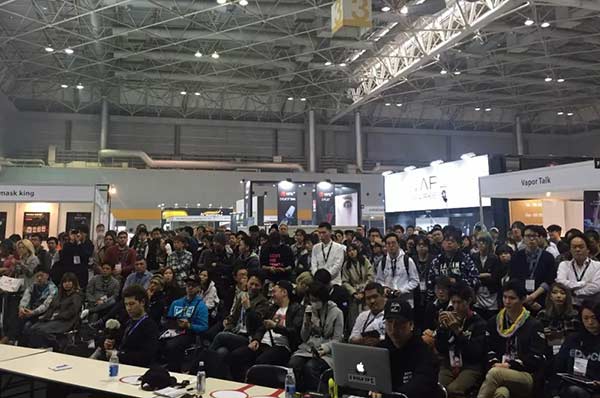
The Japan International E-Cigarette Exhibition held from March 29-31, 2018, was the first professional e-cigarette exhibition in Japan. The successful hosting and conclusion of this exhibition is an unprecedented landmark event for the Japanese e-cigarette industry.
Consul Sun from the Chinese Consulate in Osaka attended to provide guidance.
As Japan's first e-cigarette exhibition, this event has a profound impact on the Japanese e-cigarette industry. Japan is already in a critical period of building a "smoke-free society," and the e-cigarette industry is rapidly developing. The holding of this exhibition undoubtedly provides strong development information for the industry and instills credible consumer confidence among the public. It is believed that after this exhibition, the Japanese e-cigarette industry will enter a stage of explosive growth!
Japan, as a billion-level e-cigarette consumption market, is also a blue ocean market that global e-cigarette companies are eager to enter. "E-Cigarette Online," as the Chinese organizer, has built a bridge for Chinese e-cigarette companies to enter Japan ahead of time. At this exhibition, major Japanese retail giants, including Rakuten, attended to seek partners and connect with large channel merchants, undoubtedly giving Chinese companies the key to unlocking the Japanese e-cigarette market. Furthermore, as the first e-cigarette exhibition in Japanese history, it has a strong influence, and the brands of participating companies will surely become well-known to Japanese consumers through the exhibition's promotion. This influential and credible brand building is something that no other advertising form can achieve! After this exhibition, with the help of partners and brand awareness, Chinese companies in the Japanese e-cigarette market will develop rapidly and unimpeded!
Finally, I wish the Chinese e-cigarette industry to lead the way in emerging overseas markets!