China Tobacco plans a Hong Kong listing — is it because of e-cigarettes?
The China National Tobacco Corporation has surpassed 1 trillion yuan in tax revenue every year for the past three years, making it the richest company in China. At the same time, China Tobacco has never gone public or advertised, making it the most low-profile company in China.
However, on December 31, 2018, China Tobacco's subsidiary, China Tobacco International (Hong Kong), mysteriously submitted IPO materials to the Hong Kong Stock Exchange, revealing a glimpse of China Tobacco to the public. According to relevant statistics, in 2017, cigarette sales reached 47.378 million boxes, generating a total tax revenue of 1.11451 trillion yuan. By November 2018, China had sold 47.5 million boxes of cigarettes, equivalent to 6.1 billion cigarettes. From 2015 to 2017, China Tobacco International's net profits were 391 million HKD, 339 million HKD, and 348 million HKD, with revenues of 7.619 billion HKD, 6.31 billion HKD, and 7.807 billion HKD respectively. In 2017, the total tax revenue of China Tobacco was 1.11451 trillion yuan. By the first nine months of 2018, China Tobacco International's total revenue reached 651 million USD. What does this mean? If you are unclear, we can take a look at the following charts:
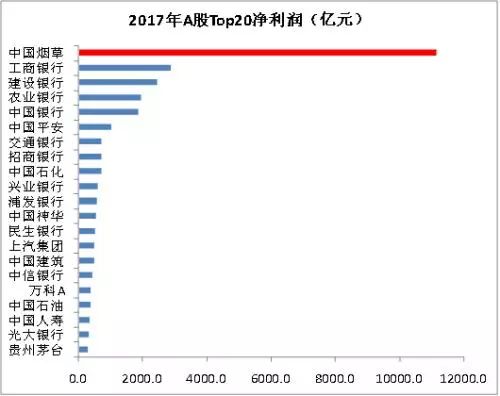
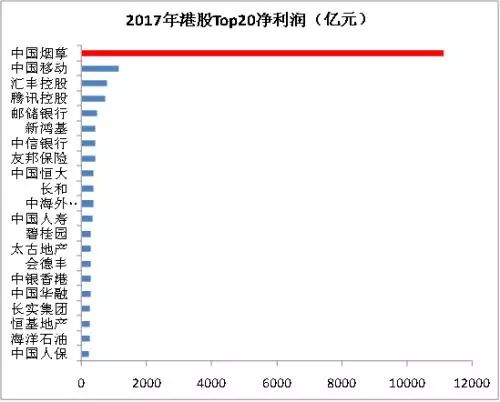
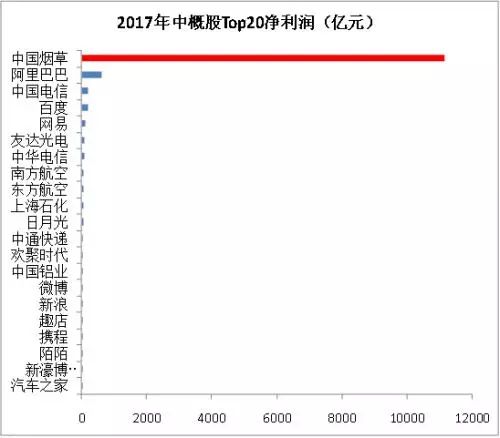
China Tobacco's net profit is equivalent to 9.7 times that of China Mobile, 15.4 times that of Tencent, 18.1 times that of Alibaba, 30.1 times that of Evergrande, 38.8 times that of Country Garden, 48.3 times that of China Life Insurance, 60.9 times that of Baidu, 486.8 times that of Weibo, and 515.8 times that of Ctrip.
That's right, a subsidiary of such a wealthy company is about to go public.
Since it is not short of money, why go public? In fact, although China Tobacco is said to be particularly profitable, there is still a considerable gap compared to international tobacco companies.
Relevant statistics show that in 2017, the total revenues of Japan Tobacco, Imperial Brands, British American Tobacco, and Philip Morris International were 64.97 billion USD, 38.32 billion USD, 73.57 billion USD, and 78.1 billion USD respectively, monopolizing 70% of the cigarette market outside of China.
The listing of China Tobacco International is naturally to open up foreign channels and share a piece of the market. From a business perspective, China Tobacco International has a "golden key" background, enjoying exclusive rights to export and import. However, since China Tobacco is only sending its subsidiary to go public, does this imply that the China National Tobacco Corporation has secrets that cannot be disclosed to outsiders?
Data shows that China Tobacco International (Hong Kong) is a wholly-owned subsidiary of the China National Tobacco Corporation, established in 2004, responsible for capital operations and international business expansion for China Tobacco International.
According to the statement from the China National Tobacco Corporation, China Tobacco International (Hong Kong) exclusively operates four types of businesses:
1. Import business of tobacco leaf products needed by the Chinese tobacco industry (excluding Zimbabwe); 2. Export business of tobacco leaf products sold by all domestic and foreign entities (excluding non-controlling enterprises) to Southeast Asia and Hong Kong, Macau, and Taiwan; 3. Sales of cigarette products by all domestic and foreign entities to Hong Kong, Macau, and duty-free shops in mainland China, Thailand, and Singapore; 4. Sales of new tobacco products (only including heated non-combustion tobacco products) by all domestic and foreign entities to the global market (excluding mainland China).
It is worth noting that the main business of this IPO includes not only the import and export of tobacco leaf products and cigarettes but also specifically includes the export of new tobacco products.
Why is traditional tobacco, which has always competed with e-cigarettes, now joining the other camp?
Since 1950, when the Journal of the American Medical Association published Morton L. Levin's groundbreaking research, the discovery of the harms of cigarettes has long sounded the alarm for the tobacco industry. Levin's research found a statistical correlation between lung cancer cases and heavy smoking. The British Medical Journal also published similar research findings, and since then, many studies have proven that smoking is harmful to health. In fact, people have long suspected that certain smoking processes have negative effects on health, and the deep inhalation of smoke by smokers has been proven to have the worst impact on health. According to research by the UK Department of Health, the carcinogens produced by burning cigarettes amount to thousands.
 The World Health Organization classifies tobacco as a Group 1 carcinogen and recognizes it as the leading preventable cause of death. Since the implementation of the Framework Convention on Tobacco Control in 2005, countries have continuously increased their control over tobacco through measures such as increased taxation, bans, and packaging restrictions. At the same time, as people's health awareness gradually increases, the market for traditional cigarettes is shrinking. For example, in Japan, the smoking rate was as high as 83.7% in 1966, but the recent 2018 national smoking rate survey showed that the smoking rate among residents is now 17.9%.
This has prompted traditional cigarette companies to conduct more research to further reduce the impact of tobacco inhalation on the human body. In the past decade, new tobacco products have begun to emerge in front of consumers.
In 2003, e-cigarettes were introduced. However, it is worth mentioning that the inventor of e-cigarettes was not a traditional tobacco company, but a Chinese pharmacist named Han Li. He was once a heavy smoker, and after his father died of lung cancer caused by smoking, he became determined to find an effective way to quit smoking. Therefore, he worked hard to become a medical researcher, trying to find a solution. In 2003, he invented the first nicotine-based e-cigarette product. The following year, Han Li was the first to mass-produce and sell this device internationally. In 2004, Han Li renamed Jinlong Holdings to Ruyan Technology. By 2005, Ruyan Technology's e-cigarette products began to be exported overseas and obtained the first international patent in 2007. Because e-cigarettes do not contain tobacco and do not produce tar and carbon monoxide, they are highly anticipated—likely to be a revolutionary product in the cigarette industry. The UK Department of Health employed about 5,000 scientists, researchers, and public health professionals, spending years to ultimately conclude through independent research that "e-cigarettes are 95% less harmful than traditional cigarettes and reduce about 7,000 harmful substances."
In the first half of 2017, Japan's national cigarette sales reached 46.8 billion sticks, while the same period in 2016 was 52.7 billion sticks, a year-on-year decline of 11.2%. Japan Tobacco stated that the decline in cigarette sales is directly related to the popularity of e-cigarettes. The emergence of e-cigarettes has led to more and more smokers abandoning traditional tobacco. While traditional tobacco sales are plummeting, e-cigarettes are selling out. For example, Japanese smokers are very concerned about others when smoking, worried that the cigarette butt might burn someone nearby, and that the smoke might drift into children's eyes. E-cigarettes, being lightweight, do not burn and produce no ashes, and have no secondhand smoke, satisfying the Japanese people's psychological need to avoid causing trouble to those around them; the fact that they only contain nicotine and do not contain carcinogenic tar also makes them more appealing to health-conscious Japanese consumers, with many wives even proactively buying e-cigarettes for their husbands as a substitute for traditional cigarettes. For smokers, both physiological and psychological health improvements are enough to make them accept new tobacco products.
Nowadays, in many restaurants and cafes in Japan, it is not uncommon to see signs that only allow the use of e-cigarettes, indicating that e-cigarettes have gained social acceptance and have become part of regulating public smoking etiquette and promoting public health. Japanese variety show Ame Talk even dedicated an episode to e-cigarettes.
New tobacco products have become a hot topic in developed countries such as Europe, America, and Japan. Recently, Altria, one of the four major tobacco groups, acquired a 35% stake in an American e-cigarette company, valuing the company at over 38 billion USD. According to Forbes, this deal made the two co-founders of the e-cigarette company billionaires. This startup company has matched the market value of listed companies like Ford and Delta Airlines in just three years.
To join the new tobacco battle and address the challenges posed by e-cigarettes, the China National Tobacco Corporation has taken the step of having its wholly-owned subsidiary, China Tobacco International (Hong Kong), go public.
In the opening section of the IPO application report, China Tobacco International (Hong Kong) extensively describes the current status and trends of global heated new tobacco products and fully hints at the historical opportunities faced by the China National Tobacco Corporation, which can be summarized as follows:
1. The export market for Chinese e-cigarette products is vast;
2. The China National Tobacco Corporation has invested significant resources in the R&D and manufacturing of e-cigarettes; 3. The China National Tobacco Corporation needs to increase efforts and resources to enhance the market visibility of e-cigarettes and diversify sales channels; 4. China Tobacco International (Hong Kong) is the exclusive operating entity for all entities under the China National Tobacco Corporation to export and sell new tobacco products globally; 5. China Tobacco International (Hong Kong) will acquire or strategically cooperate to timely grasp the relevant strategic development resources for new tobacco business.
It is not difficult to see that China Tobacco International (Hong Kong) is the "vanguard" of the China National Tobacco Corporation's full-scale efforts in new tobacco. The logic behind this IPO initiative is self-evident:
The traditional tobacco business of the China National Tobacco Corporation is ultimately a domestic market business, while new tobacco represents a global war, with its industrial chain distributed across major global markets.
To participate in this new global industrial chain war, a platform company that complies with international corporate governance and transparency is needed to allocate resources, and the IPO of China Tobacco International (Hong Kong) is set to play this role.
However, whether this leap from traditional tobacco trade to a new tobacco integration platform will generate a significant increase in investment value remains to be closely observed and evaluated as more pieces of this grand chess game fall into place in the future.