E-Liquid Formula Testing and Analysis
With smoking bans being introduced and implemented in major cities across China, e-cigarettes have gradually become familiar to many ordinary smokers and are widely used as smoking cessation products or alternatives to traditional cigarettes. Traditional
With smoking bans being introduced and enforced in major cities across China, e-cigarettes have gradually become familiar to many ordinary smokers and are widely used as smoking cessation products or substitutes for traditional cigarettes. Traditional cigarettes produce smoke through the high-temperature combustion of tobacco, while e-cigarettes use a power supply to heat a coil, which then heats the e-liquid and atomizes it into fine particles containing nicotine and flavorings. When inhaled, this creates simulated smoke. The atomization temperature of e-cigarettes is far lower than the combustion temperature of tobacco in traditional cigarettes. E-cigarette aerosol does not contain tar, CO, or other toxic and harmful substances, and it also does not produce secondhand smoke. As a result, e-cigarettes are becoming increasingly favored in the market.
E-liquid is the most important component in an e-cigarette, determining its taste, flavor, and the overall user experience. It is generally composed of five main categories of ingredients:
Propylene glycol (PG), a common pharmaceutical and food additive. It is hygroscopic, slightly sweet, colorless, odorless, transparent, and highly fluid. PG is one of the base ingredients of e-liquid. Its main role is to act as a carrier for flavorings, enhance taste, produce a small amount of vapor when heated, and provide some throat hit. It also helps dilute glycerin, reduce e-liquid viscosity, and improve wicking performance.
Glycerin (VG). VG is highly hygroscopic, very viscous, and has relatively poor fluidity. Its main function is to produce vapor.
Flavorings. Flavorings play a very important role in e-liquid, and the proportions and combinations of different flavors determine the final flavor profile.
Nicotine. Its main function is to relieve cravings, provide throat hit, and to some extent improve the taste of the e-liquid.
Additives: including sweeteners, acidulants, throat-soothing agents, deionized water, etc. Their main function is to improve the taste of the e-liquid and make up for shortcomings in the flavorings. Because of the variety and customizability of e-liquids and vaping devices, e-cigarettes have rapidly developed into a youth subculture, with many people evolving from “users” into “enthusiasts.” Some prefer the taste of e-cigarettes and enjoy the wide range of e-liquid flavors and the impact of vapor in the mouth; others are drawn to their cool image, preferring large vapor production and socializing through “blowing smoke rings.”
The significance of viscosity measurement and rheological study
Viscosity is an important factor affecting the flowability of e-liquid and the wicking performance of e-cigarette atomizers. Increasing the amount of glycerin in e-liquid can significantly boost vapor density during use, but because glycerin has high viscosity, it can easily cause poor wicking in some tank atomizers, making it necessary to add deionized water or propylene glycol to improve flowability. Increasing the amount of propylene glycol can enhance flavor and throat hit, but it may cause the viscosity of the e-liquid to become too low. In that case, glycerin or food-grade thickeners need to be added so the e-liquid can remain stably inside the pod without leaking.
E-liquid viscosity measurement
Because e-liquid products generally have relatively high value, Ametek-Brookfield recommends using a Small Sample Adapter (SSA) + TC series circulating water bath system (as shown in Figure 1) for e-liquid viscosity testing.
The Small Sample Adapter is specially designed for viscosity testing when samples are difficult to obtain or highly valuable. The required sample volume is only 2-16 mL (the specific volume depends on the spindle model used), which can effectively reduce testing costs. The SSA uses a coaxial cylindrical spindle and matching sample chamber, allowing calculation of shear rate and shear stress to obtain absolute viscosity. The sample chamber is installed in a water bath jacket and connected to an external circulating water bath for convenient temperature control during testing. The TC series circulating water bath system offers temperature control accuracy of up to 0.01°C, providing precise and stable temperature conditions for viscosity testing.
Using a DV3TLV + SSA + TC650-SD bath, the viscosity of three e-liquids was tested at 22°C. The TC650-SD circulating bath system was used to control sample temperature, and Rheocalc T software was used for program setup and data acquisition. The test results are shown in Figure 2.
Data were collected using “Multi Point” mode to observe instrument stability and data fluctuation during the test. The continuous sensing system unique to Brookfield digital viscometers ensures real-time and accurate data output. The “Test Averaging” function was used to obtain average test values, and the viscosities of the three e-liquids were 55 cP, 1147 cP, and 239 cP, respectively.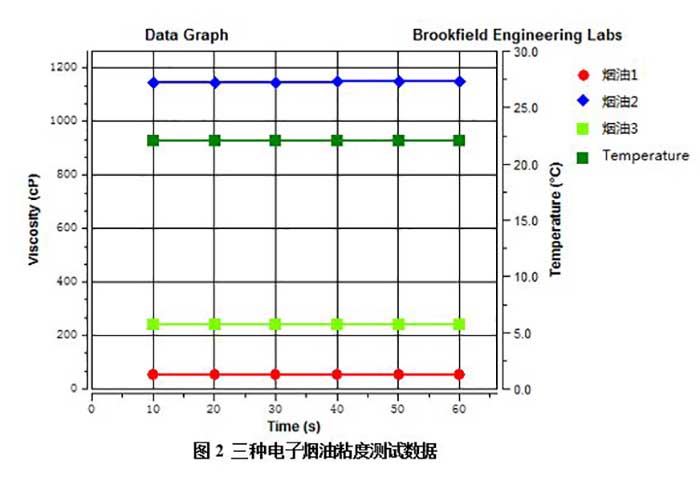 Application overview#p#Page Break Title#e#
As one of the world’s best-known manufacturers of viscometers and rheometers, Ametek-Brookfield has always been committed to providing users with products that offer stable and reliable quality, high measurement accuracy, and excellent repeatability. Brookfield viscometers can achieve measurement accuracy of ±1% of full scale and repeatability of ±0.2%. To meet viscosity testing needs across different industries, the company provides personalized solutions that are perfectly suited to a wide range of analytical applications.
The RST rheometer can perform comprehensive rheological testing and deliver excellent rheological analysis for both quality control and R&D. The RST series rheometers offer both controlled shear rate and controlled shear stress modes, making them especially suitable for measuring the viscosity, flow curves, and other properties of non-Newtonian fluids under steady-state flow. In addition, they can measure rheological properties such as viscoelasticity, yield stress, and thixotropy under transient shear flow and creep conditions.
E-liquid is the most important component in an e-cigarette, determining its taste, flavor, and the overall user experience. It is generally composed of five main categories of ingredients:
Propylene glycol (PG), a common pharmaceutical and food additive. It is hygroscopic, slightly sweet, colorless, odorless, transparent, and highly fluid. PG is one of the base ingredients of e-liquid. Its main role is to act as a carrier for flavorings, enhance taste, produce a small amount of vapor when heated, and provide some throat hit. It also helps dilute glycerin, reduce e-liquid viscosity, and improve wicking performance.
Glycerin (VG). VG is highly hygroscopic, very viscous, and has relatively poor fluidity. Its main function is to produce vapor.
Flavorings. Flavorings play a very important role in e-liquid, and the proportions and combinations of different flavors determine the final flavor profile.
Nicotine. Its main function is to relieve cravings, provide throat hit, and to some extent improve the taste of the e-liquid.
Additives: including sweeteners, acidulants, throat-soothing agents, deionized water, etc. Their main function is to improve the taste of the e-liquid and make up for shortcomings in the flavorings.
Because of the variety and customizability of e-liquids and vaping devices, e-cigarettes have rapidly developed into a youth subculture, with many people evolving from “users” into “enthusiasts.” Some prefer the taste of e-cigarettes and enjoy the wide range of e-liquid flavors and the impact of vapor in the mouth; others are drawn to their cool image, preferring large vapor production and socializing through “blowing smoke rings.”The significance of viscosity measurement and rheological study
Viscosity is an important factor affecting the flowability of e-liquid and the wicking performance of e-cigarette atomizers. Increasing the amount of glycerin in e-liquid can significantly boost vapor density during use, but because glycerin has high viscosity, it can easily cause poor wicking in some tank atomizers, making it necessary to add deionized water or propylene glycol to improve flowability. Increasing the amount of propylene glycol can enhance flavor and throat hit, but it may cause the viscosity of the e-liquid to become too low. In that case, glycerin or food-grade thickeners need to be added so the e-liquid can remain stably inside the pod without leaking.
E-liquid viscosity measurement
Because e-liquid products generally have relatively high value, Ametek-Brookfield recommends using a Small Sample Adapter (SSA) + TC series circulating water bath system (as shown in Figure 1) for e-liquid viscosity testing.
The Small Sample Adapter is specially designed for viscosity testing when samples are difficult to obtain or highly valuable. The required sample volume is only 2-16 mL (the specific volume depends on the spindle model used), which can effectively reduce testing costs. The SSA uses a coaxial cylindrical spindle and matching sample chamber, allowing calculation of shear rate and shear stress to obtain absolute viscosity. The sample chamber is installed in a water bath jacket and connected to an external circulating water bath for convenient temperature control during testing. The TC series circulating water bath system offers temperature control accuracy of up to 0.01°C, providing precise and stable temperature conditions for viscosity testing.
Using a DV3TLV + SSA + TC650-SD bath, the viscosity of three e-liquids was tested at 22°C. The TC650-SD circulating bath system was used to control sample temperature, and Rheocalc T software was used for program setup and data acquisition. The test results are shown in Figure 2.
Data were collected using “Multi Point” mode to observe instrument stability and data fluctuation during the test. The continuous sensing system unique to Brookfield digital viscometers ensures real-time and accurate data output. The “Test Averaging” function was used to obtain average test values, and the viscosities of the three e-liquids were 55 cP, 1147 cP, and 239 cP, respectively.
Application overview#p#Page Break Title#e#As one of the world’s best-known manufacturers of viscometers and rheometers, Ametek-Brookfield has always been committed to providing users with products that offer stable and reliable quality, high measurement accuracy, and excellent repeatability. Brookfield viscometers can achieve measurement accuracy of ±1% of full scale and repeatability of ±0.2%. To meet viscosity testing needs across different industries, the company provides personalized solutions that are perfectly suited to a wide range of analytical applications.
The RST rheometer can perform comprehensive rheological testing and deliver excellent rheological analysis for both quality control and R&D. The RST series rheometers offer both controlled shear rate and controlled shear stress modes, making them especially suitable for measuring the viscosity, flow curves, and other properties of non-Newtonian fluids under steady-state flow. In addition, they can measure rheological properties such as viscoelasticity, yield stress, and thixotropy under transient shear flow and creep conditions.