
Mobile supply chains accelerate their move into e-cigarettes, with new processes driving upgrades
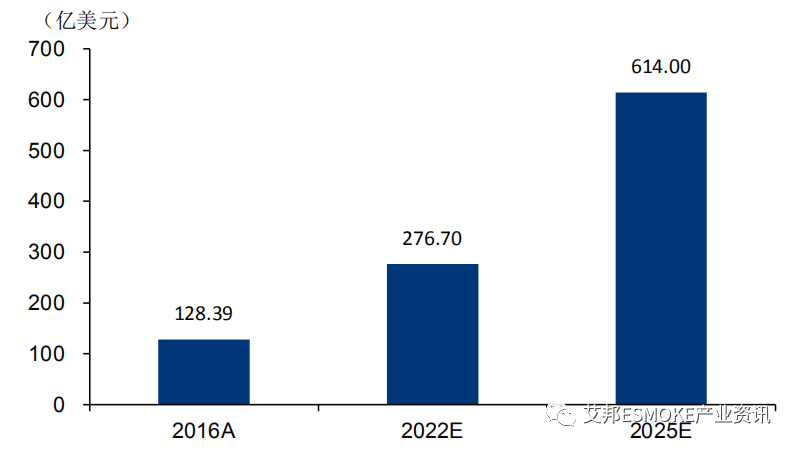
As an emerging electronic product, e-cigarettes have been gaining market share overseas year by year, while domestic attention continues to rise. The global e-cigarette market is expected to reach USD 61.4 billion by 2025. Chart: Estimated global e-cigare
As an emerging electronic device, e-cigarettes have been gaining market share abroad year by year, and domestic attention is increasing. The global e-cigarette market is expected to reach a scale of $61.4 billion by 2025.
 As a product that accompanies smokers daily, the appearance characteristics are an important indicator of stimulating purchasing desire and showcasing personal taste. Below, I have compiled several mobile industry technologies that are expected to enhance the aesthetics of e-cigarette devices.
The penetration and resource layout of the mobile industry into the e-cigarette industry have been quietly progressing. The demand for personnel, funds, and equipment in the e-cigarette industry is far less than that of mobile phones, and the communication between the two industries can activate the idle capacity of the mobile industry chain while bringing new vitality to the e-cigarette industry chain:
1) Currently, engineers from the mobile industry, such as CMF, ID, and structural engineers from brands like Coolpad and Gionee, are flowing into major e-cigarette companies;
2) The mobile industry is accelerating its layout in e-cigarettes. Recently, Coolpad signed a strategic cooperation agreement with Yuan Green, a subsidiary of the Borton Group, to enter the e-cigarette market. The collaboration will launch the COOL series of e-cigarette products, which is sure to create a storm in the Chinese e-cigarette market! The COOL e-cigarette adopts internationally leading heating tobacco technology, and its design is also very attractive;
3) Mobile industry supply chains are increasingly investing in the e-cigarette industry, with metal processing, IMD, MIM, injection molding ceramics, CNC, die-casting, polishing equipment, sintering furnaces, injection molding machines, and other equipment shifting towards e-cigarettes.
In the current era of e-cigarettes, it can be said that many brands are competing, just like the era of counterfeit and branded smartphones, where quality varies greatly and homogenization is severe. Differentiated technological upgrades in e-cigarette device functions and appearances will be the key to winning in the future!
1. 2.5D/3D Glass
2.5D glass can be used as a front cover or back cover decorative panel on mobile phones, while 3D glass is more commonly used as a back cover decorative panel. 2.5/3D glass, after film lamination, can present various dazzling optical coating effects and is widely used across multiple models in major terminals.
On e-cigarettes, 2.5/3D glass can be used on large e-cigarettes as a decorative panel or display screen panel, significantly enhancing the product's quality compared to traditional plastic lenses.
2. Aluminum Metal Processing
The middle frame and back cover of mobile phones widely use aluminum alloy CNC + anodizing technology, which includes ordinary sandblasting + anodizing, micro-arc oxidation, high-gloss polishing oxidation, and gradient color oxidation. In low-power e-cigarettes, ordinary sandblasting + anodizing is widely applied to aluminum extruded tubes, such as the smoking tube used by the American star brand JUUL, which employs sandblasting + anodizing.
3. 3D Optical Texture Composite Panels
3D optical texture composite panels are a recently popular decorative technology that mimics 2.5D/3D glass. This PMMA/PC composite material combines the hardness of PMMA and the impact resistance of PC, achieving a surface hardness of 3-4H, suitable for use as display screen lenses or decorative pieces on e-cigarettes, and can exhibit various dynamic optical textures through optical coating processes.
4. Two-color Injection Molding
Two-color injection molding technology has been widely used in traditional plastic shell mobile phones, achieving various effects such as waterproofing, dustproofing, enhancing drop resistance, and creating personalized shapes.
E-cigarettes can also utilize two-color injection molding, with two feasible application routes:
1) Small e-cigarettes: Enhanced modified plastic two-color, replacing aluminum alloy extruded tubes;
2) Large e-cigarettes: Two-color injection molding based on three-proof considerations.
5. LSR Injection Molding
LSR is liquid silicone rubber injection technology, commonly used in mobile phones for waterproof card slots, waterproof interfaces, and waterproof shells. The USB interface of e-cigarettes can also use LSR for waterproofing and dustproofing. If it is an injection-molded shell, LSR secondary injection molding can be applied to achieve an overall waterproof design.
6. LDS Antenna
LDS technology is commonly used in 4G mobile phones to achieve antenna functions. The usual practice is to develop an antenna bracket on which the LDS antenna circuit is made, and then assemble it into the phone, relying on a spring pin to connect to the wireless signal.
In some high-end e-cigarettes, communication functions have been added, and LDS technology can be utilized.
7. MIM Injection Molding
MIM injection molding is widely used in automotive, mobile, and medical fields. Currently, it is mainly applied in mobile phones for card slots, camera brackets, etc. In e-cigarettes, MIM parts can be used in atomizer bases and supports.
8. IMD/IML/IMT Molding
IMD is a traditional plastic in-mold decoration technology. Well-known IMD companies in the industry have also received excellent supplier awards from well-known e-cigarette companies like MIKVE.
IMT is an evolved version of IML technology. Since IMT removes the outer film of IML, the appearance effect is clearer and brighter, closely mimicking the appearance of glass. This is a highly promising application technology in the mobile industry. The e-cigarette industry can gradually transition from traditional IML technology to IMT technology. I have learned that e-cigarette manufacturers like MIKVE, Heyuan, Kang'er, and Zhuoyue have resources and technical reserves in this area.
As a product that accompanies smokers daily, the appearance characteristics are an important indicator of stimulating purchasing desire and showcasing personal taste. Below, I have compiled several mobile industry technologies that are expected to enhance the aesthetics of e-cigarette devices.The penetration and resource layout of the mobile industry into the e-cigarette industry have been quietly progressing. The demand for personnel, funds, and equipment in the e-cigarette industry is far less than that of mobile phones, and the communication between the two industries can activate the idle capacity of the mobile industry chain while bringing new vitality to the e-cigarette industry chain:
1) Currently, engineers from the mobile industry, such as CMF, ID, and structural engineers from brands like Coolpad and Gionee, are flowing into major e-cigarette companies;
2) The mobile industry is accelerating its layout in e-cigarettes. Recently, Coolpad signed a strategic cooperation agreement with Yuan Green, a subsidiary of the Borton Group, to enter the e-cigarette market. The collaboration will launch the COOL series of e-cigarette products, which is sure to create a storm in the Chinese e-cigarette market! The COOL e-cigarette adopts internationally leading heating tobacco technology, and its design is also very attractive;
3) Mobile industry supply chains are increasingly investing in the e-cigarette industry, with metal processing, IMD, MIM, injection molding ceramics, CNC, die-casting, polishing equipment, sintering furnaces, injection molding machines, and other equipment shifting towards e-cigarettes.
In the current era of e-cigarettes, it can be said that many brands are competing, just like the era of counterfeit and branded smartphones, where quality varies greatly and homogenization is severe. Differentiated technological upgrades in e-cigarette device functions and appearances will be the key to winning in the future!
1. 2.5D/3D Glass
2.5D glass can be used as a front cover or back cover decorative panel on mobile phones, while 3D glass is more commonly used as a back cover decorative panel. 2.5/3D glass, after film lamination, can present various dazzling optical coating effects and is widely used across multiple models in major terminals.
On e-cigarettes, 2.5/3D glass can be used on large e-cigarettes as a decorative panel or display screen panel, significantly enhancing the product's quality compared to traditional plastic lenses.
2. Aluminum Metal Processing
The middle frame and back cover of mobile phones widely use aluminum alloy CNC + anodizing technology, which includes ordinary sandblasting + anodizing, micro-arc oxidation, high-gloss polishing oxidation, and gradient color oxidation. In low-power e-cigarettes, ordinary sandblasting + anodizing is widely applied to aluminum extruded tubes, such as the smoking tube used by the American star brand JUUL, which employs sandblasting + anodizing.
3. 3D Optical Texture Composite Panels
3D optical texture composite panels are a recently popular decorative technology that mimics 2.5D/3D glass. This PMMA/PC composite material combines the hardness of PMMA and the impact resistance of PC, achieving a surface hardness of 3-4H, suitable for use as display screen lenses or decorative pieces on e-cigarettes, and can exhibit various dynamic optical textures through optical coating processes.
4. Two-color Injection Molding
Two-color injection molding technology has been widely used in traditional plastic shell mobile phones, achieving various effects such as waterproofing, dustproofing, enhancing drop resistance, and creating personalized shapes.
E-cigarettes can also utilize two-color injection molding, with two feasible application routes:
1) Small e-cigarettes: Enhanced modified plastic two-color, replacing aluminum alloy extruded tubes;
2) Large e-cigarettes: Two-color injection molding based on three-proof considerations.
5. LSR Injection Molding
LSR is liquid silicone rubber injection technology, commonly used in mobile phones for waterproof card slots, waterproof interfaces, and waterproof shells. The USB interface of e-cigarettes can also use LSR for waterproofing and dustproofing. If it is an injection-molded shell, LSR secondary injection molding can be applied to achieve an overall waterproof design.
6. LDS Antenna
LDS technology is commonly used in 4G mobile phones to achieve antenna functions. The usual practice is to develop an antenna bracket on which the LDS antenna circuit is made, and then assemble it into the phone, relying on a spring pin to connect to the wireless signal.
In some high-end e-cigarettes, communication functions have been added, and LDS technology can be utilized.
7. MIM Injection Molding
MIM injection molding is widely used in automotive, mobile, and medical fields. Currently, it is mainly applied in mobile phones for card slots, camera brackets, etc. In e-cigarettes, MIM parts can be used in atomizer bases and supports.
8. IMD/IML/IMT Molding
IMD is a traditional plastic in-mold decoration technology. Well-known IMD companies in the industry have also received excellent supplier awards from well-known e-cigarette companies like MIKVE.
IMT is an evolved version of IML technology. Since IMT removes the outer film of IML, the appearance effect is clearer and brighter, closely mimicking the appearance of glass. This is a highly promising application technology in the mobile industry. The e-cigarette industry can gradually transition from traditional IML technology to IMT technology. I have learned that e-cigarette manufacturers like MIKVE, Heyuan, Kang'er, and Zhuoyue have resources and technical reserves in this area.


