
Petri Atomizer Wicking Tips: No Leaks, No Burnt Hits
Do you know the right way to wick the Petri? Since the Petri RTA was released in August 2016, it has won over many users with its standout looks, dense vapor, and refined flavor. But lately, many users have been asking how to wick the Petri properly. Poor
Do you know how to wick cotton for the Petri atomizer? Since its release in August 2016, the Petri RTA has won the favor of many players with its stunning appearance, rich vapor, and delicate flavor. However, recently, I've seen many players asking how to properly wick cotton for the Petri. Whether it's oil flow issues leading to burnt cotton or leaking e-liquid, let's take a look at the tips for wicking cotton for the Petri to avoid leaks and burnt hits!
First, let's clarify the materials used by players, which is the most common Muji cotton, without using any high-end products like bacon, cloud cotton, or cotton candy. Unfortunately, we're on a budget! The biggest characteristic of wicking cotton for the Petri is: it can't be too much or too little. Some may say this is obvious, but the Petri has higher requirements in this regard. Too much will cause oil flow issues, while too little will not block the oil inlet, leading to leaks. In this aspect, the Petri is not friendly to players. This time, the player is using Clapton wire with a 3.0mm diameter and 5 tight wraps. First, let's talk about how much cotton to cut. So how much cotton is appropriate? Right! About 10mm in width. Many players hesitate to cut too much cotton when wicking. In fact, a little extra is fine; cotton is layered, and having a bit more allows for slight adjustments, while having too little wastes an entire strip of cotton. When the cotton is inserted into the heating wire, it will pull and create significant resistance, but it can also be pulled easily. This "significant resistance" is quite difficult to master and requires multiple practices to truly understand its meaning. Unfortunately, the path that needs to be taken cannot be skipped. After inserting the cotton, it's time to cut off the excess cotton. The trick to cutting is to hold the scissors close to the outer side of the base and then snip. Both sides should be the same. This way, the cut cotton will be just the right length. Don't worry about having too little cotton; you'll see soon enough.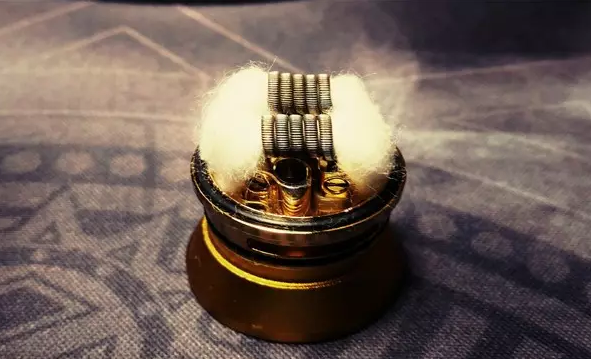 Can you see it clearly?
Next, verify the amount of cotton by inserting it into the groove of the base, ensuring it fits snugly—neither too much nor too little.
At this point, the cotton amount is roughly determined, and the next step is fine-tuning. Remove the heating base, then cover the atomization chamber; some cotton should still be exposed. This is not acceptable, as it will cause oil flow issues.
You must trim the exposed cotton to achieve the effect shown in the image below; this is the best outcome.
Now, the fine-tuning of the cotton is complete. Moving on to the next topic, cotton shaping. Before that, you need to moisten the cotton with e-liquid. The purpose of this is to facilitate the shaping of the cotton.
What should the moistened cotton look like? Please pay attention to two points: first, the post screws should be exposed.
Second, the cotton should be relatively concentrated to effectively block the oil inlet.
Can you see it clearly?
Next, verify the amount of cotton by inserting it into the groove of the base, ensuring it fits snugly—neither too much nor too little.
At this point, the cotton amount is roughly determined, and the next step is fine-tuning. Remove the heating base, then cover the atomization chamber; some cotton should still be exposed. This is not acceptable, as it will cause oil flow issues.
You must trim the exposed cotton to achieve the effect shown in the image below; this is the best outcome.
Now, the fine-tuning of the cotton is complete. Moving on to the next topic, cotton shaping. Before that, you need to moisten the cotton with e-liquid. The purpose of this is to facilitate the shaping of the cotton.
What should the moistened cotton look like? Please pay attention to two points: first, the post screws should be exposed.
Second, the cotton should be relatively concentrated to effectively block the oil inlet.
 At this point, the cotton is considered ready. Then, step by step, assemble the atomizer and fill it with e-liquid. When filling, please note: first, close the airflow valve; second, do not overfill. After filling, wait about 1 minute before you can start vaping. When you see bubbles rising from the oil inlet, it proves that the cotton you just made is just right—not leaking and not burnt.
Alright, that's it for the Petri cotton wicking tips. Thank you all for reading.
At this point, the cotton is considered ready. Then, step by step, assemble the atomizer and fill it with e-liquid. When filling, please note: first, close the airflow valve; second, do not overfill. After filling, wait about 1 minute before you can start vaping. When you see bubbles rising from the oil inlet, it proves that the cotton you just made is just right—not leaking and not burnt.
Alright, that's it for the Petri cotton wicking tips. Thank you all for reading.

