
What Affects Vaping Flavor and Vapor Production?
What factors affect vaping flavor and vapor production? Yesterday we introduced the difference between fancy coils and standard coils, so today we'll focus on three essential DIY elements: resistance, coil diameter, and number of wraps, because these are
What affects vaping flavor and vapor production? Yesterday we introduced the difference between clapton wire and plain wire, so you probably already have a basic idea of that and we won’t repeat it here. Today, let’s talk about three essential DIY factors: resistance, coil diameter, and number of wraps, because these are the keys to determining flavor performance.
Coil Diameter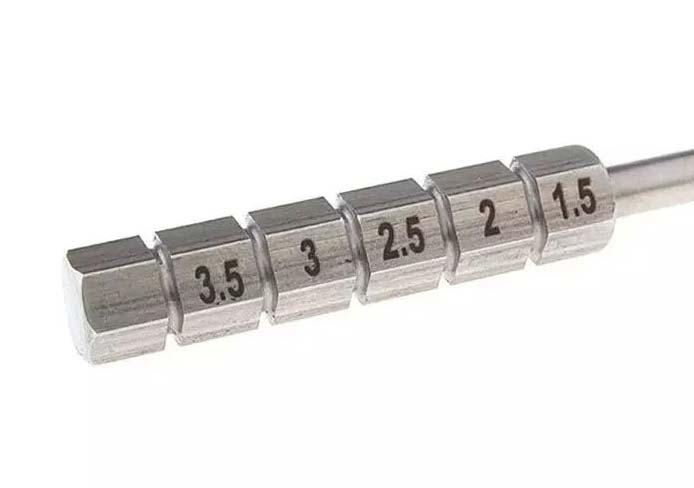 Coil diameter is the inner diameter of the coil. Generally, it increases in 0.5mm steps. Common sizes are 2.0, 2.5, 3.0, and 3.5mm—very familiar numbers for experienced users. Different coil diameters correspond to different resistance values, so naturally they also require different power outputs.
The larger the coil diameter, the higher the resistance for the same wire configuration, and the lower the power required. The smaller the coil diameter, the lower the resistance for the same wire configuration, and the higher the power required. I generally use a 2.5mm coil diameter for RTA tank atomizers, and a 3.0mm diameter for RDA drippers.
If the resistance is 1Ω, then an output of 15–18W is usually appropriate. If the resistance is around 0.15Ω, then around 60W will do, and you can even go higher.
One thing to keep in mind: when the coil gets smaller, output power rises, but the amount of cotton inside the coil also decreases. If wicking can’t keep up, you may get a burnt coil. When installing cotton, don’t pack it too tightly—keep e-liquid flow smooth—but don’t leave it too loose either. In an RTA, loose cotton may fail to block the juice ports properly and cause leaking; in an RDA, it may lead to spitback.
Number of Wraps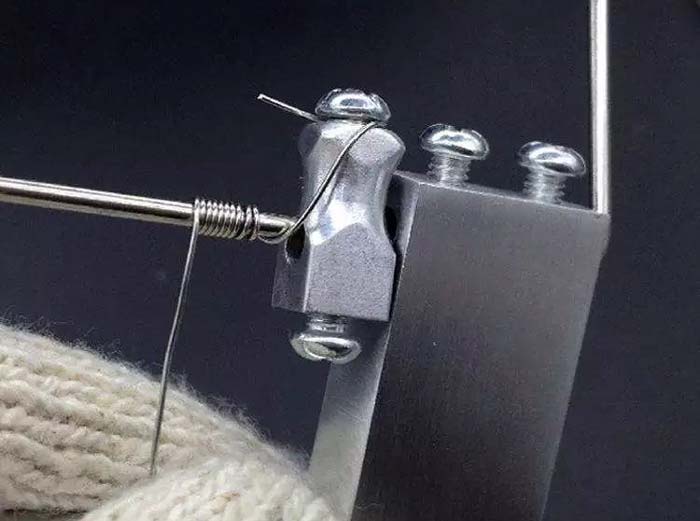 Depending on the deck structure of the atomizer, wrapping resistance wire may involve clockwise or counterclockwise orientation, but we won’t discuss that today. Let’s just focus on the number of wraps. Common builds use 5, 6, 7, or 8 wraps, and there’s also a distinction between spaced coils and contact coils. Spaced coils tend to produce lighter flavor, while contact coils make the vapor denser and richer. If that still doesn’t get the flavor to where you want it, then you can adjust the coil diameter and use it once the resistance is suitable.
With the same coil diameter, increasing the number of wraps also increases resistance. Another feature of more wraps is that the heating surface area becomes larger, e-liquid consumption rises, and vapor density also improves. I usually use a 6-wrap contact coil in an RTA tank atomizer, and 6–8 wrap contact coils in an RDA dripper.
The more wraps there are, the slightly slower the ramp-up compared with a coil with fewer wraps, but the heating is more even and the flavor tends to be smoother and more refined. First of all, you need to decide whether you want high resistance or low resistance. Generally speaking, low resistance is used for large vapor production, while high resistance is for flavor-focused vaping.
For low resistance, you can slightly reduce the coil diameter, use thicker wire, and reduce the number of wraps. For high resistance, you can use a 2.5mm diameter and increase the number of wraps to enlarge the heating area, producing more even vapor and a more comfortable flavor experience.
Resistance
Resistance is the Ω value, determined by the combination of coil diameter, number of wraps, and wire gauge. The higher the resistance, the lower the output power required. The lower the resistance, the higher the output power required, and the faster the battery will drain.
A common question is: how many watts are appropriate for this atomizer or this resistance? Generally speaking, you can just look at the voltage. Keeping it between 3.4V and 4.2V usually avoids burning the coil, and the flavor will also fall within a fairly balanced range.
Finally, here’s a look at how different wire gauges produce slightly different data, for your reference.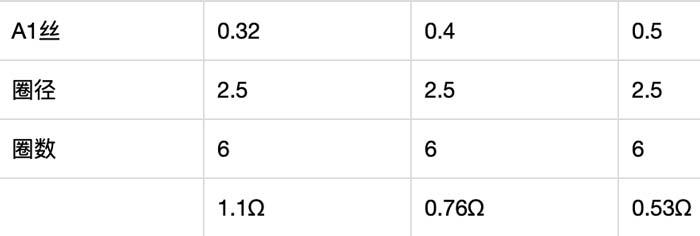 For a dual-coil setup, the value is roughly half. For example, if a single coil is 0.53Ω, then a dual-coil build will be around 0.26Ω.
There are many different setups waiting to be explored. Different e-liquids and different build data will all produce different flavor experiences.
Coil Diameter
Coil diameter is the inner diameter of the coil. Generally, it increases in 0.5mm steps. Common sizes are 2.0, 2.5, 3.0, and 3.5mm—very familiar numbers for experienced users. Different coil diameters correspond to different resistance values, so naturally they also require different power outputs.The larger the coil diameter, the higher the resistance for the same wire configuration, and the lower the power required. The smaller the coil diameter, the lower the resistance for the same wire configuration, and the higher the power required. I generally use a 2.5mm coil diameter for RTA tank atomizers, and a 3.0mm diameter for RDA drippers.
If the resistance is 1Ω, then an output of 15–18W is usually appropriate. If the resistance is around 0.15Ω, then around 60W will do, and you can even go higher.
One thing to keep in mind: when the coil gets smaller, output power rises, but the amount of cotton inside the coil also decreases. If wicking can’t keep up, you may get a burnt coil. When installing cotton, don’t pack it too tightly—keep e-liquid flow smooth—but don’t leave it too loose either. In an RTA, loose cotton may fail to block the juice ports properly and cause leaking; in an RDA, it may lead to spitback.
Number of Wraps
Depending on the deck structure of the atomizer, wrapping resistance wire may involve clockwise or counterclockwise orientation, but we won’t discuss that today. Let’s just focus on the number of wraps. Common builds use 5, 6, 7, or 8 wraps, and there’s also a distinction between spaced coils and contact coils. Spaced coils tend to produce lighter flavor, while contact coils make the vapor denser and richer. If that still doesn’t get the flavor to where you want it, then you can adjust the coil diameter and use it once the resistance is suitable.With the same coil diameter, increasing the number of wraps also increases resistance. Another feature of more wraps is that the heating surface area becomes larger, e-liquid consumption rises, and vapor density also improves. I usually use a 6-wrap contact coil in an RTA tank atomizer, and 6–8 wrap contact coils in an RDA dripper.
The more wraps there are, the slightly slower the ramp-up compared with a coil with fewer wraps, but the heating is more even and the flavor tends to be smoother and more refined. First of all, you need to decide whether you want high resistance or low resistance. Generally speaking, low resistance is used for large vapor production, while high resistance is for flavor-focused vaping.
For low resistance, you can slightly reduce the coil diameter, use thicker wire, and reduce the number of wraps. For high resistance, you can use a 2.5mm diameter and increase the number of wraps to enlarge the heating area, producing more even vapor and a more comfortable flavor experience.
Resistance
Resistance is the Ω value, determined by the combination of coil diameter, number of wraps, and wire gauge. The higher the resistance, the lower the output power required. The lower the resistance, the higher the output power required, and the faster the battery will drain.
A common question is: how many watts are appropriate for this atomizer or this resistance? Generally speaking, you can just look at the voltage. Keeping it between 3.4V and 4.2V usually avoids burning the coil, and the flavor will also fall within a fairly balanced range.
Finally, here’s a look at how different wire gauges produce slightly different data, for your reference.
For a dual-coil setup, the value is roughly half. For example, if a single coil is 0.53Ω, then a dual-coil build will be around 0.26Ω.There are many different setups waiting to be explored. Different e-liquids and different build data will all produce different flavor experiences.
Related Articles

Vaping News
Ahead of a Nationwide Ban, Hundreds of Russian Retailers Voluntarily Stop Selling Vapes
2026-04-16

Vaping News
Illegal Vape Brands Try to Evade FDA Scrutiny by Posing as “Made in the USA”
2026-04-08
Vaping News
Jordan’s New Tobacco Control Rules: Waterpipe Tobacco Market Set for Major Changes
2026-03-17