Do Warning Images on Cigarette Packs Make People Want to Smoke More?
In April of this year, the World Health Organization and the International Tobacco Control Policy Evaluation Program released a new report, "China's Cigarette Box Health Warnings —— Evidence of Effectiveness and Guidance for Action," which points out that Chinese cigarette boxes with the “Smoking is Hazardous to Your Health” slogans barely serve as a warning, and urges China's tobacco industry, which is in the The report points out that Chinese cigarette packs with slogans saying that smoking is bad for your health hardly play a warning role, and urges the Chinese tobacco industry to print graphic warnings on cigarette packs as an effective way to encourage smokers to quit. In fact, it seems to be common sense to use large graphic health warnings on cigarette packs to raise awareness of the dangers of smoking, reduce smoking rates, and thus save lives, but recent studies have shown that scary picture warnings on cigarette packs can actually increase smokers' desire to smoke. Does this make sense?
The world knows that smoking is bad, and there's no need to list the dangers of it, and the warnings about it vary around the world, so let's summarize a few of the versions:The gentle versionJapanese cigarette packs: For the sake of your health, please don't smoke too much.Singapore cigarette case: don't let your family smoke second-hand.
Rational version
US cigarette packs: smoking in pregnant women can cause fatal injuries, premature labor, and low birth weight; smoking can cause blindness; and smoking can cause fatal lung disease.The Thriller Edition
German cigarette case: smoking can kill you.The Scratchy Version
Smoking is bad for your health.
Besides the slogans, the ones that have the most impact on smokers and make them lose their desire to buy belong to the warning pictures:

But some studies are claiming that those scary warnings on cigarette packs may be the trigger that drives people to smoke.
A psychologist conducted an experiment on smoking and psychological dependence among 39 student smokers. These students were divided into two groups with different warnings on their cigarette packs, one with a warning about death and the other with warnings that had nothing to do with death.
The results of the experiment were eye-opening. Those students whose cigarette packs came with a warning about death were more likely to smoke than those in the other group. These smokers can only forget their sorrows and find confidence in the smoke ring. Maybe smoking makes them look cool and they have made it an important part of their lives. The carton with the death warning is an outright mockery to them, and they smoke even more in order to ease themselves out of their frustration.
This can be explained by fear management and failure of will.
We naturally feel fear when we think about illness, death, and the finite nature of human beings. The brain reacts with fear, but of course we don't always realize it, because the anxiety may not have surfaced yet, and it hasn't yet produced a strong sense of discomfort. But even if we don't realize the fear, we still seek protection and anything that comforts us. Smokers subconsciously feel stress and fear about a death warning on a cigarette pack, but this anxiety is likely to lead the smoker to relieve the stress in the most default and comfortable way —— smoking.
It's the same thing with funeral home ads that you often see in shopping carts in the US.
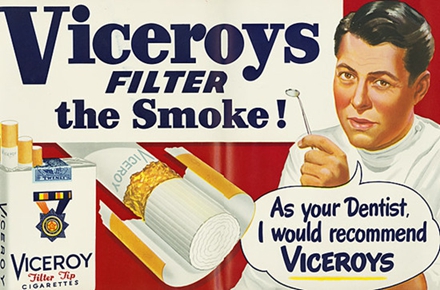
American cigarette ads from the 1950s
Taking the fear of death down a notch, we find a phenomenon that is prevalent in life: stress triggers desire. Stress hormones in the brain cause dopamine neurons to become more excited in the face of temptation, and dopamine is the greatest aid to human desire. It's important to mention here that many people know that dopamine is associated with pleasure, but it doesn't directly cause us to feel happy, rather it plays a role in the brain's reward mechanism, which allows individuals to expect, not to feel pleasure, but of course our instinct is to treat expectation as pleasure. After all, we often “think about it a little excited about it”.The overly dire warnings that induce more smoking behavior may also be motivated by a kind of “stimulus backlash”.
If you have read books on relationship psychology, you are no stranger to the “ Romeo and Juliet effect”. It is a typical phenomenon of misperception under stimulus rebound.
In love, the deeper the outside world's obstruction of both sides, the more violent the opposition, the stronger the desire to be together. We experience the flavor of so-called deep love, it is likely that we just wrongly impose the emotional emotional experience when breaking through the resistance to the definition of love. #p#Page Break #e#
In social psychology, this phenomenon is also known as & ldquo; reverse psychology & rdquo;: the phenomenon of individuals reacting to external persuasion with opposite attitudes and behaviors. There are three kinds of typical reverse psychology:
1, ultra-limit reverse: refers to the collective excessive acceptance of some kind of stimulus after the emergence of the escape reaction. For example, you will be bored with eating mountains and seas of food every day.
2, self-worth protection rebellious: when the persuasion or influence of outsiders threatens people's self-worth, people will intentionally or unintentionally protect their self-worth. This is the reason why teenagers under parental authority are rebellious.
3, forbidden fruit rebellion: inadequate prohibition will stimulate a stronger desire to explore. There is no good reason for a simple ban on the contrary, to produce a greater attraction. The best-selling banned book is typical.For the scary pictures on smoking packages, it may induce the combined effect of three kinds of reverse psychology: firstly, the over-limit reversal triggered by the over-stimulation; secondly, the protective reversal due to the self-protection, or the maintenance of a good self-evaluation to prevent oneself from collapsing (I'm a good person, and even if I smoke, it won't affect that); and then there are insufficient justifications for banning smoking, just presenting the visual stimulus, without the cognitive and psychological impact. There is also the forbidden-fruit backlash because the ban on smoking is not justified by presenting a visual stimulus that does not cognitively convince smokers of the real harms of smoking. If these counter-arguments are valid, warnings may also backfire.
And the subjects in the experiment were student smokers, who are more likely to be thrill-seekers, with scary graphics that give them a thrill of trembling excitement and fearlessness of frustration. After all, some of the warning pictures were indeed too “artistic”.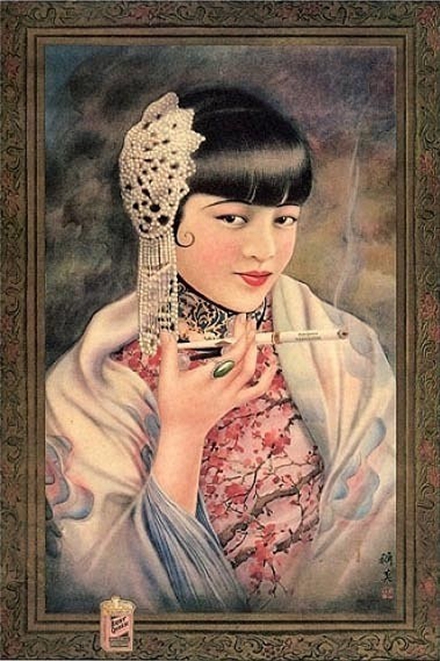
Cigarette advertisements in old Shanghai
Of course the warning signs on cigarette packs may have made smoking more researched, not that we don't need to be vocal about our health, or that warning labels aren't necessary. After all, take the printed skull and death warning cigarettes to give away Ken is embarrassed, for tobacco control, these warning pictures are essential. But for this can only mean that we in the process of product design and concept promotion to pay more attention to psychological considerations, upholding a & ldquo; heart & rdquo; from the professional spirit and responsible attitude, in order to make & ldquo; general common sense & rdquo; more reasonable, more sensible, we can really benefit from.
Related Articles

Ahead of a Nationwide Ban, Hundreds of Russian Retailers Voluntarily Stop Selling Vapes

Illegal Vape Brands Try to Evade FDA Scrutiny by Posing as “Made in the USA”