Snuff Bottles: Tiny Vessels with a World Inside
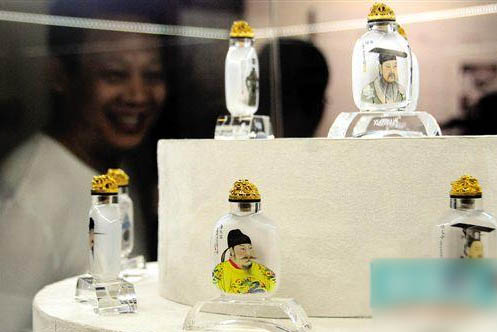
Introduction: It is reported that Christie's will auction a series of exquisite and precious snuff bottles from private collections in October, representing the highest level of this type of miniature art. Industry experts believe that snuff bottle collecting has transitioned from niche to mainstream, gradually attracting the attention of newcomers to the collecting market.
According to Chinese electronic cigarette news: Recently, it was reported that Christie's will auction a series of exquisite and precious snuff bottles from private collections in October, representing the highest level of this type of miniature art. Industry experts believe that snuff bottle collecting has transitioned from niche to mainstream, gradually attracting the attention of newcomers to the collecting market.
Snuff bottles were introduced to China during the late Ming and early Qing dynasties. Although their history is not long, they quickly became an independent and new form of artistic craft through the meticulous work of skilled artisans, encapsulating the long-standing traditional culture of China and being regarded as precious collectibles by many enthusiasts.
Snuff bottles, often referred to as "small vessels," are only small in appearance. In reality, the processing and production of materials such as jade carving, glass, enamel, ceramics, lacquerware, and bamboo are not simpler than other collectibles, making them a culmination of various crafts.
Beautiful legends, with various origins
When it comes to snuff bottles, many people associate them with the inner painting technique, which has various origins. It is said that during the Jiaqing and Daoguang eras, a minor official from another region came to the capital for duty and stayed in a temple. When his snuff ran out, he used a snuff stick to scrape the remaining snuff from the bottle. This scene was seen by a thoughtful monk in the temple, who experimented by bending a bamboo stick to create a pointed tip, dipping it in ink to paint patterns on the inner wall of the transparent snuff bottle, thus developing into today's inner painting technique.
In addition to this legend, there are two other historical accounts: One is that during the Daoguang era of the Qing Dynasty, there was a talented person named Hu Jinlu in Beijing who loved to sniff snuff. Due to his family's financial difficulties, he could not afford snuff and would scratch the residue on the inner wall of the snuff bottle with chopsticks for enjoyment. One day, he accidentally discovered that the stripes made by the chopsticks on the bottle wall looked quite beautiful, so he sharpened the chopsticks and began painting flowers on the inner wall, thus creating the prototype of inner painting snuff bottles.
Another account states that during the Jiaqing era of the Qing Dynasty, a young painter from the south named Gan Huan filled the bottle with small steel balls, quartz sand, and a small amount of water, shaking it back and forth to sand the inner wall, and then painted on the inner wall with a bent bamboo pen. This technique was continuously improved, eventually becoming a craft.
Market observation: Rapid growth of the snuff bottle market
In the auction market, snuff bottles have become the main attraction. In June, a rare Louis XV period gold and enamel snuff bottle was sold for a high price of 1.68 million yuan. In October, Christie's will hold a "American Essence Chinese Snuff Bottle Collection Special Auction," featuring 37 privately collected snuff bottles from the U.S., with the most notable being a glass-bodied yellow-ground enamel snuff bottle made during the Qianlong period, estimated to be worth between 400,000 and 5 million Hong Kong dollars.
The reason snuff bottles can stand out among many collectibles, according to collector Zhang Shixian, is that they combine various techniques such as calligraphy, painting, carving, and inlaying. Using techniques like blue and white, multi-colored, carved porcelain, and inner painting, they draw on the strengths of various crafts from both domestic and foreign sources, making them a miniature art form that embodies the essence of Chinese arts and crafts and a typical object of organic integration of Chinese and foreign cultural arts.
Due to the multiple values of snuff bottles, their compact and unique design, and relatively moderate price, they are increasingly being valued by people. In recent years, major auction companies have opened special sessions for snuff bottles, and prices exceeding one million yuan are no longer uncommon, indicating that the market has entered a phase of healthy growth.
Collecting trends: Collectors prefer inner painting snuff bottles
Zhang Shixian introduced that snuff is a brown powder made from finely processed tobacco mixed with herbs and fragrant flower extracts, which was introduced to China by Italian missionary Matteo Ricci as a tribute during the Wanli period of the Ming Dynasty. At that time, people initially used traditional medicine bottles to hold snuff, and later various materials and production techniques were used to improve the containers for snuff. By the Qing Dynasty, the production of snuff bottles became increasingly refined. Snuff bottles from the Qing Dynasty can be divided into eight categories: metal-bodied enamel snuff bottles, glass snuff bottles, glass-bodied painted enamel snuff bottles, jade snuff bottles, porcelain snuff bottles, bamboo, wood, and ivory snuff bottles, lacquer snuff bottles, and inner painting snuff bottles. Among them, inner painting snuff bottles have become a rising star due to their clever integration of craft techniques and traditional painting art, giving them the characteristics of miniature art pieces, and are highly sought after by collectors.
Inner painting snuff bottles are divided into four major schools: "Beijing, Hebei, Shandong, and Guangdong," with the Hebei school having the highest level, fastest development, and greatest influence. The inner painting tools used by the Hebei school are the metal rod brush invented by the school's founder Wang Xisan, known as the "Xisan bent hook brush," which can be turned in any direction. The inner painting art of the Hebei school is characterized by fine detailing and elegant style, using a combination of traditional Chinese painting colors and oil painting colors to simulate the effects of multiple painting styles, especially excelling in portraiture.
Collector's perspective: Collecting focuses on the old and the rare
When collecting snuff bottles, one should adhere to the principle of focusing on the old and the rare. Specifically, the older the snuff bottle, the greater its potential for appreciation.
Zhang Shixian introduced that snuff bottles from the Kangxi period are primarily made of jade, Hetian mutton fat jade, red and blue sapphires, gold, and silver, with very few surviving, making them extremely precious. Like ceramics, snuff bottles also emphasize the value of official kilns, and snuff bottles from the Qing Dynasty's official kilns are naturally the best choice. Modern snuff bottles have over 90% of their works being inner paintings. Collecting inner painting snuff bottles should start with masterpieces from top domestic inner painting masters from the late Qing and early Republic periods, such as Wang Xisan, Zhou Leyuan, and Ma Shaoyi. Additionally, one can also pay attention to the works of these masters' disciples, such as Zhang Rucai, Chen Runpu, and Wang Guanyu, who are in their creative golden period, and their works have great collection potential. In terms of materials, the first choice is natural crystal snuff bottles, followed by those made of high-transparency agate, then artificial crystal bottles, and finally material bottles (glass bottles). In terms of themes, inner painting snuff bottles should first focus on portrait paintings, followed by animal paintings, then figure paintings, and finally flower and bird paintings.
Expert opinion: Identifying authenticity through bottom inscriptions
In the collecting market, among various snuff bottles, porcelain, ivory, and bone carvings are the three types that are most prone to counterfeiting, so special attention should be paid to identifying fakes and replicas.
Collecting expert Feng Yuguo introduced that to identify porcelain snuff bottles, one should look at the inscriptions on the bottom of the snuff bottle, as it is generally difficult for fakes to replicate beautifully inscribed characters. Secondly, ivory snuff bottles are also prone to counterfeits. Genuine ivory works are milky white, and those that are old will turn yellow, and real ivory will have a network of natural tooth patterns that cannot be replicated by fakes. Finally, for bone carving snuff bottles, many people now use resin or bone powder to synthesize and create snuff bottles, imitating hand-carved designs. This can be identified by the bone patterns; old bones will have fine lines following the natural grain, while bone powder composites will lack these patterns.
Feng Yuguo suggests that if one wants to collect porcelain-bodied snuff bottles, novice collectors can start with blue and white or blue and purple porcelain-bodied snuff bottles, and after gaining a preliminary understanding of the market, gradually move towards higher-end porcelain-bodied snuff bottles like famille rose. If interested in glass-bodied snuff bottles, these varieties are currently more common in the collecting market, mostly with exquisite craftsmanship and a smooth texture. Collectors purchasing such snuff bottles can try lower-priced monochrome glass-bodied snuff bottles. Jade snuff bottles are best represented by finely carved mutton fat jade, and novice collectors can start with ordinary white jade or green jade.
It is important to note that some porcelain works imitating the shapes of late Qing snuff bottles are circulating in the market but are actually medicine bottles used for holding medicine, not porcelain snuff bottles, so special attention should be paid when selecting for collection.
Related Articles

Ahead of a Nationwide Ban, Hundreds of Russian Retailers Voluntarily Stop Selling Vapes

Illegal Vape Brands Try to Evade FDA Scrutiny by Posing as “Made in the USA”