
Which of the Top 10 E-Cigarette Brands Are Better and Publicly Listed?
Which of the top 10 e-cigarette brands are better and publicly listed? In recent years, the e-cigarette market has grown rapidly, with China's market alone reaching RMB 50 billion. However, due to policy factors, entering China's consumer e-cigarette mark
Which of the Top 10 E-Cigarette Brands Are Better and Publicly Listed? <\/strong> In recent years, the e-cigarette market has seen rapid growth, with a market size of 50 billion yuan in China alone. However, due to regulatory reasons, entering the Chinese e-cigarette market carries certain risks. If we change our market entry point and target e-cigarette device supply chain companies, how much opportunity is there for entrepreneurs?
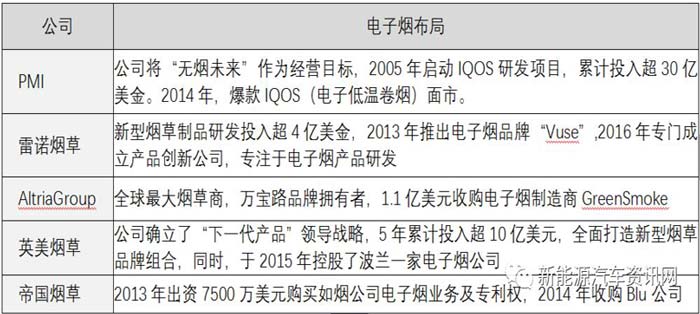
In recent years, global tobacco giants have entered the e-cigarette market, significantly increasing their investment in e-cigarette research and development and capital acquisitions. Among them, the popular e-cigarette IQOS developed by Philip Morris International (PMI) has performed remarkably in the global market, achieving sales of 20 billion yuan within just three years since its launch in 2014, with a growth rate of 390% from 2016 to 2017, accounting for 12.7% of its parent company's net profit, excluding major tobacco markets like China, the United States, and the United Kingdom.
Driven by these industry giants, e-cigarettes are gradually transitioning from niche products to widely recognized hits. With increasing public health awareness and unprecedented breakthroughs in product experience, e-cigarettes are poised to have a significant impact on the traditional tobacco market.
 E-Cigarette Types and Audience Analysis
E-cigarettes are not a new term; they have nearly a decade of history, with recent rapid advancements primarily benefiting from product and technological innovations. To understand e-cigarettes, one must first clarify the two main types currently on the market:
The first type is the vapor-type e-cigarette, also known as e-liquid e-cigarettes, which mainly consist of food-grade or pharmaceutical-grade glycerin, flavoring agents, and tobacco extracts. They present flavors of tobacco, fruit, and beverages. Through the process of atomization, these materials are converted into vapor for users to inhale.
The second type is known as innovative tobacco, specifically heated tobacco (typical of IQOS), where the materials used in the pods are consistent with traditional cigarette tobacco, but they are heated using electronic control at temperatures below 350°C without combustion, releasing (nicotine-containing) vapor for users to inhale, while reducing harmful substances like tar by 90%. This method of heating real tobacco is what defines heated tobacco.
Although both are referred to as e-cigarettes, the differences in materials directly lead to qualitative differences in audience acceptance. E-liquid e-cigarettes cater more to curiosity and new consumer groups, while heated tobacco, being made from real tobacco, closely resembles traditional cigarettes in taste. Users who have tried IQOS generally report that it offers a better taste than vapor e-cigarettes, making it the closest product to real cigarettes.
Data shows that by 2017, IQOS had a penetration rate of 13.9% in Japan, and after entering South Korea at the beginning of 2017, it reached a penetration rate of 5.5% by the end of the year. Therefore, in terms of product experience, heated tobacco is more widely accepted than e-liquid e-cigarettes and is a viable smoking cessation solution, likely to become a leading product in the e-cigarette market.
Products Based on Technology and Big Data
In the competitive e-cigarette market, e-cigarettes, as electronic products, involve multiple technical aspects: such as precise temperature control algorithms, heat insulation materials and thermal design, fast charging technology, and IoT technology. However, these technologies are merely prerequisites for success; the core competitiveness of any consumer product must revolve around "product taste and user experience," with the key factor influencing product taste being the tobacco big data each company possesses. Since heated tobacco uses real tobacco, the characteristics of different brands' tobacco vary, which means they require different roasting methods.
Only when the pods and devices with the "best heating temperature curve" are combined can the perfect taste be achieved. The optimal roasting temperature for tobacco must be based on the tobacco big data tested by each company. For tobacco companies, the temperature curve is a core secret that is never disclosed. Currently, most devices compatible with IQOS do not meet the temperature characteristics of IQOS tobacco, resulting in either burnt flavors from high temperatures or bitter tastes from low temperatures.
Policies on "Survival and Rise"
In the face of such a rapidly developing industry, does this mean we have no opportunity to share in the profits? The author believes that while engaging in e-cigarette entrepreneurship carries certain regulatory risks, the perception of "risk" cannot be one-size-fits-all. More importantly, we must find the right market entry point and clarify our political stance.
It is important to note that while the government understands tobacco, it does not possess the R&D capabilities for electronic technology. After all, Philip Morris International (PMI) has hired over 400 scientists and industry experts, investing more than $3 billion. After more than a decade of exploration, they launched the first heated tobacco product, IQOS, in 2014. Based on the author's market understanding, various tobacco companies are actively collaborating with e-cigarette technology companies to jointly develop products.
 The biggest opportunity in the market is to become a technology component and equipment supplier for the tobacco bureau. Just as selling cigarettes requires packaging and lighters, the tobacco bureau, while knowledgeable about tobacco, does not understand electronic technology. Under the pressure from both internal and external challenges, they will inevitably choose to collaborate with private enterprises for development. It is worth noting that there are several publicly listed companies in China that focus on cigarette packaging.
Benefiting from IQOS's rapid sales growth over the past three years, PMI's procurement from key buyer Venture has increased year by year. Based on this, IQOS contributed the following revenue to Venture: 540 million in 2015, 2.16 billion in 2016, and 7.15 billion in 2017. The growth rates were 298% in 2016 and 231% in 2017. The Shenzhen-based company Yingqu Technology is the main supplier of IQOS plastic components for Venture, and the increase in Venture's e-cigarette production will inevitably lead to more procurement from Yingqu Technology. Yingqu Technology's revenue from e-cigarette components reached 980 million in 2015, 1.648 billion in 2016, and 3.267 billion in 2017, with a compound annual growth rate of 282.3% in the e-cigarette component business, resulting in explosive growth in revenue.
With 350 million smokers in China and a penetration rate of 30%, considering a unit price of 500 yuan for smoking devices, the market size is 50 billion yuan. This does not include exports, but the competition has high entry barriers, creating a large market with few players. This means that if private enterprises can board this ship, they can form a mutually beneficial relationship with the China Tobacco Corporation, continuously innovating and collaborating on technology to provide advanced technical components and smoking devices, ensuring quality traceability and comprehensive after-sales service. The author believes that in the e-cigarette market, several high-quality supply chain companies will emerge as publicly listed entities.
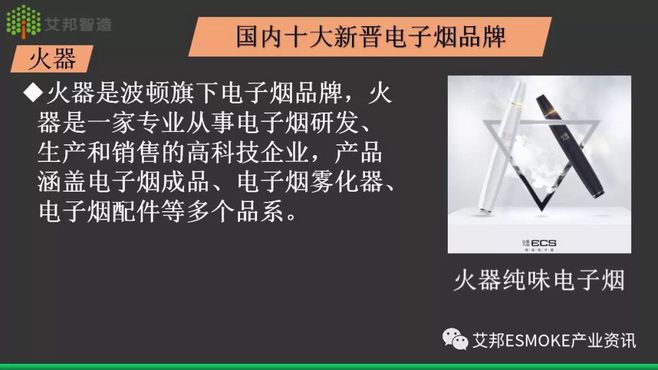 Currently, the main publicly listed companies involved in e-cigarettes in China include:<\/strong>
Yingqu Technology: The company's e-cigarette business mainly involves precision plastic components for IQOS, with its direct client being Venture and the end client being international tobacco giant PMI. The company's revenue from e-cigarette components was approximately 1.5 billion yuan in 2017.
Huabao International: The company mainly engages in the research, production, and sales of flavoring agents, tobacco sheets, new tobacco materials, and new tobacco products, guided by consumer flavor trends and driven by technological innovation, providing flavor system solutions and comprehensive technical services for the Chinese tobacco industry and fast-moving consumer goods companies.
Mackwell: The company is a private technology innovation enterprise engaged in the research, production, and sales of e-cigarettes. Over 99% of the company's revenue comes from disposable e-cigarettes and atomizers. Since listing on the stock transfer system, the company's stock price has increased more than tenfold.
Firearm E-Cigarette: Firearm E-Cigarette is a brand under the Hong Kong-listed company Boton Flavor Group. Leveraging Boton's leading position in the flavoring industry, Firearm E-Cigarette is at the forefront of e-liquid development, holding 5,716 e-cigarette patents and receiving numerous accolades in the industry, reported by various well-known media outlets. Recently launched domestic IQOS—Firearm GS5.0 and disposable small spicy strip e-cigarettes have become popular products.
In recent years, global tobacco giants have entered the e-cigarette market, significantly increasing their investment in e-cigarette research and development and capital acquisitions. Among them, the popular e-cigarette IQOS developed by Philip Morris International (PMI) has performed remarkably in the global market, achieving sales of 20 billion yuan within just three years since its launch in 2014, with a growth rate of 390% from 2016 to 2017, accounting for 12.7% of its parent company's net profit, excluding major tobacco markets like China, the United States, and the United Kingdom.
Driven by these industry giants, e-cigarettes are gradually transitioning from niche products to widely recognized hits. With increasing public health awareness and unprecedented breakthroughs in product experience, e-cigarettes are poised to have a significant impact on the traditional tobacco market.
E-Cigarette Types and Audience AnalysisE-cigarettes are not a new term; they have nearly a decade of history, with recent rapid advancements primarily benefiting from product and technological innovations. To understand e-cigarettes, one must first clarify the two main types currently on the market:
The first type is the vapor-type e-cigarette, also known as e-liquid e-cigarettes, which mainly consist of food-grade or pharmaceutical-grade glycerin, flavoring agents, and tobacco extracts. They present flavors of tobacco, fruit, and beverages. Through the process of atomization, these materials are converted into vapor for users to inhale.
The second type is known as innovative tobacco, specifically heated tobacco (typical of IQOS), where the materials used in the pods are consistent with traditional cigarette tobacco, but they are heated using electronic control at temperatures below 350°C without combustion, releasing (nicotine-containing) vapor for users to inhale, while reducing harmful substances like tar by 90%. This method of heating real tobacco is what defines heated tobacco.
Although both are referred to as e-cigarettes, the differences in materials directly lead to qualitative differences in audience acceptance. E-liquid e-cigarettes cater more to curiosity and new consumer groups, while heated tobacco, being made from real tobacco, closely resembles traditional cigarettes in taste. Users who have tried IQOS generally report that it offers a better taste than vapor e-cigarettes, making it the closest product to real cigarettes.
Data shows that by 2017, IQOS had a penetration rate of 13.9% in Japan, and after entering South Korea at the beginning of 2017, it reached a penetration rate of 5.5% by the end of the year. Therefore, in terms of product experience, heated tobacco is more widely accepted than e-liquid e-cigarettes and is a viable smoking cessation solution, likely to become a leading product in the e-cigarette market.
Products Based on Technology and Big Data
In the competitive e-cigarette market, e-cigarettes, as electronic products, involve multiple technical aspects: such as precise temperature control algorithms, heat insulation materials and thermal design, fast charging technology, and IoT technology. However, these technologies are merely prerequisites for success; the core competitiveness of any consumer product must revolve around "product taste and user experience," with the key factor influencing product taste being the tobacco big data each company possesses. Since heated tobacco uses real tobacco, the characteristics of different brands' tobacco vary, which means they require different roasting methods.
Only when the pods and devices with the "best heating temperature curve" are combined can the perfect taste be achieved. The optimal roasting temperature for tobacco must be based on the tobacco big data tested by each company. For tobacco companies, the temperature curve is a core secret that is never disclosed. Currently, most devices compatible with IQOS do not meet the temperature characteristics of IQOS tobacco, resulting in either burnt flavors from high temperatures or bitter tastes from low temperatures.
Policies on "Survival and Rise"
In the face of such a rapidly developing industry, does this mean we have no opportunity to share in the profits? The author believes that while engaging in e-cigarette entrepreneurship carries certain regulatory risks, the perception of "risk" cannot be one-size-fits-all. More importantly, we must find the right market entry point and clarify our political stance.
It is important to note that while the government understands tobacco, it does not possess the R&D capabilities for electronic technology. After all, Philip Morris International (PMI) has hired over 400 scientists and industry experts, investing more than $3 billion. After more than a decade of exploration, they launched the first heated tobacco product, IQOS, in 2014. Based on the author's market understanding, various tobacco companies are actively collaborating with e-cigarette technology companies to jointly develop products.
The biggest opportunity in the market is to become a technology component and equipment supplier for the tobacco bureau. Just as selling cigarettes requires packaging and lighters, the tobacco bureau, while knowledgeable about tobacco, does not understand electronic technology. Under the pressure from both internal and external challenges, they will inevitably choose to collaborate with private enterprises for development. It is worth noting that there are several publicly listed companies in China that focus on cigarette packaging.Benefiting from IQOS's rapid sales growth over the past three years, PMI's procurement from key buyer Venture has increased year by year. Based on this, IQOS contributed the following revenue to Venture: 540 million in 2015, 2.16 billion in 2016, and 7.15 billion in 2017. The growth rates were 298% in 2016 and 231% in 2017. The Shenzhen-based company Yingqu Technology is the main supplier of IQOS plastic components for Venture, and the increase in Venture's e-cigarette production will inevitably lead to more procurement from Yingqu Technology. Yingqu Technology's revenue from e-cigarette components reached 980 million in 2015, 1.648 billion in 2016, and 3.267 billion in 2017, with a compound annual growth rate of 282.3% in the e-cigarette component business, resulting in explosive growth in revenue.
With 350 million smokers in China and a penetration rate of 30%, considering a unit price of 500 yuan for smoking devices, the market size is 50 billion yuan. This does not include exports, but the competition has high entry barriers, creating a large market with few players. This means that if private enterprises can board this ship, they can form a mutually beneficial relationship with the China Tobacco Corporation, continuously innovating and collaborating on technology to provide advanced technical components and smoking devices, ensuring quality traceability and comprehensive after-sales service. The author believes that in the e-cigarette market, several high-quality supply chain companies will emerge as publicly listed entities.
Currently, the main publicly listed companies involved in e-cigarettes in China include:<\/strong>Yingqu Technology: The company's e-cigarette business mainly involves precision plastic components for IQOS, with its direct client being Venture and the end client being international tobacco giant PMI. The company's revenue from e-cigarette components was approximately 1.5 billion yuan in 2017.
Huabao International: The company mainly engages in the research, production, and sales of flavoring agents, tobacco sheets, new tobacco materials, and new tobacco products, guided by consumer flavor trends and driven by technological innovation, providing flavor system solutions and comprehensive technical services for the Chinese tobacco industry and fast-moving consumer goods companies.
Mackwell: The company is a private technology innovation enterprise engaged in the research, production, and sales of e-cigarettes. Over 99% of the company's revenue comes from disposable e-cigarettes and atomizers. Since listing on the stock transfer system, the company's stock price has increased more than tenfold.
Firearm E-Cigarette: Firearm E-Cigarette is a brand under the Hong Kong-listed company Boton Flavor Group. Leveraging Boton's leading position in the flavoring industry, Firearm E-Cigarette is at the forefront of e-liquid development, holding 5,716 e-cigarette patents and receiving numerous accolades in the industry, reported by various well-known media outlets. Recently launched domestic IQOS—Firearm GS5.0 and disposable small spicy strip e-cigarettes have become popular products.
Related Articles

Vaping News
Ahead of a Nationwide Ban, Hundreds of Russian Retailers Voluntarily Stop Selling Vapes
2026-04-16

Vaping News
Illegal Vape Brands Try to Evade FDA Scrutiny by Posing as “Made in the USA”
2026-04-08

Vaping News
Jordan’s New Tobacco Control Rules: Waterpipe Tobacco Market Set for Major Changes
2026-03-17