
Do E-Cigarettes Produce Secondhand Exposure That Can Harm Others?
Do e-cigarettes create secondhand exposure that can harm other people? Many non-users online ask whether e-cigarettes produce secondhand smoke and whether they can affect family health. In fact, many overseas studies have already looked into this. Researc
Do e-cigarettes produce secondhand exposure that can harm others? Many people who do not smoke electronic cigarettes ask whether e-cigarettes produce secondhand smoke and whether they can harm the health of family members. In fact, there have been many studies on this abroad. Researchers measured particle concentrations indoors after participants used e-cigarettes.
• They found that particles evaporate within seconds after being exhaled from the vapor.
• For traditional cigarettes, it takes 30-45 minutes for air quality to return to normal levels.
A new study compared e-cigarettes with their traditional counterparts to assess their performance in indoor spaces, and it appears that e-cigarettes have a smaller impact on surrounding air quality.
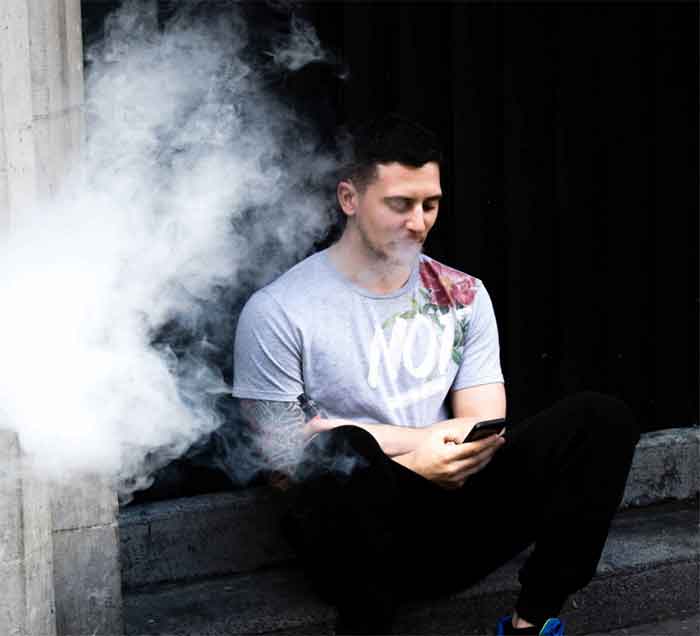 Particles from conventional cigarette smoke linger in the air for over 45 minutes, while researchers found that particles from electronic vapor products evaporate within seconds, even indoors.
Even in the worst-case scenario, with no ventilation, researchers found that particle counts quickly returned to normal levels during the e-cigarette trials.
This new study is part of a collaboration between Kaunas University of Technology in Lithuania, the Swiss Federal Laboratories for Materials Science and Technology, ETH Zurich, and Fontem Ventures.
Participants were regular e-cigarette users, tasked with using their devices under different ventilation conditions. Researchers then measured changes in particle concentrations in the surrounding air.
Seconds later, researchers found that liquid aerosol droplets evaporated, allowing the space to quickly return to normal levels.
Dr. Grant O'Connell, a manager at Fontem Ventures, stated that no particulate matter accumulated in the room after participants exhaled.
"This shows us how to compare the fundamentally different exhaled electronic vapor particles with those released when smoking traditional cigarettes, which linger in the air for a longer time."
After participants exhaled, researchers immediately noted that the particle concentrations from e-cigarettes were on the same order of magnitude as those from traditional cigarettes.
A new study compared e-cigarettes with their traditional counterparts to assess their performance in indoor spaces - and it appears that e-cigarettes have a smaller impact on surrounding air quality.
 However, their decay rates show remarkable differences.
According to researchers, using conventional cigarettes requires 30-45 minutes to restore particle concentrations to background levels, which increases with each puff.
"Exhaled electronic vapor aerosol particles have different chemical compositions than cigarette smoke, and here we show that their physical properties also differ significantly," Dr. O'Connell said.
"These data add to the growing body of evidence that e-cigarettes do not produce harmful secondhand smoke."
• They found that particles evaporate within seconds after being exhaled from the vapor.
• For traditional cigarettes, it takes 30-45 minutes for air quality to return to normal levels.
A new study compared e-cigarettes with their traditional counterparts to assess their performance in indoor spaces, and it appears that e-cigarettes have a smaller impact on surrounding air quality.
Particles from conventional cigarette smoke linger in the air for over 45 minutes, while researchers found that particles from electronic vapor products evaporate within seconds, even indoors.Even in the worst-case scenario, with no ventilation, researchers found that particle counts quickly returned to normal levels during the e-cigarette trials.
This new study is part of a collaboration between Kaunas University of Technology in Lithuania, the Swiss Federal Laboratories for Materials Science and Technology, ETH Zurich, and Fontem Ventures.
Participants were regular e-cigarette users, tasked with using their devices under different ventilation conditions. Researchers then measured changes in particle concentrations in the surrounding air.
Seconds later, researchers found that liquid aerosol droplets evaporated, allowing the space to quickly return to normal levels.
Dr. Grant O'Connell, a manager at Fontem Ventures, stated that no particulate matter accumulated in the room after participants exhaled.
"This shows us how to compare the fundamentally different exhaled electronic vapor particles with those released when smoking traditional cigarettes, which linger in the air for a longer time."
After participants exhaled, researchers immediately noted that the particle concentrations from e-cigarettes were on the same order of magnitude as those from traditional cigarettes.
A new study compared e-cigarettes with their traditional counterparts to assess their performance in indoor spaces - and it appears that e-cigarettes have a smaller impact on surrounding air quality.
However, their decay rates show remarkable differences.According to researchers, using conventional cigarettes requires 30-45 minutes to restore particle concentrations to background levels, which increases with each puff.
"Exhaled electronic vapor aerosol particles have different chemical compositions than cigarette smoke, and here we show that their physical properties also differ significantly," Dr. O'Connell said.
"These data add to the growing body of evidence that e-cigarettes do not produce harmful secondhand smoke."
Related Articles

Vaping News
Ahead of a Nationwide Ban, Hundreds of Russian Retailers Voluntarily Stop Selling Vapes
2026-04-16

Vaping News
Illegal Vape Brands Try to Evade FDA Scrutiny by Posing as “Made in the USA”
2026-04-08

Vaping News
Jordan’s New Tobacco Control Rules: Waterpipe Tobacco Market Set for Major Changes
2026-03-17