
The Dangers of Secondhand Aerosol From E-Cigarettes: E-Cigarette "Vapor" Is Not Harmless
At present, promotional slogans such as harmless vapor, no secondhand smoke, and no impact on others have become standard wording in some e-cigarette advertising. At the same time, these claims have caused considerable confusion: are e-cigarettes really h
Currently, slogans such as "harmless vapor e-cigarettes", "no secondhand smoke", and "does not affect others" are becoming standard in some e-cigarette advertisements. Meanwhile, these advertisements have raised many questions: Is using e-cigarettes harmless? Does e-cigarette vapor affect the health of others?
"Secondhand e-cigarette vapor" contains carcinogens, and there are risks of explosion from poor-quality tobacco sticks, with varying quality of e-liquid... Multiple pieces of evidence indicate that, like traditional cigarettes, e-cigarettes can also impact public health. Experts are calling for regulation of e-cigarette product quality and their use in public spaces to be prioritized.
E-cigarette "vapor" is not harmless
Recently, People's Daily visited several e-cigarette retail stores in Guangzhou and Shenzhen and found that many shops promote "harmless and healthy" as selling points for e-cigarettes. One e-cigarette store near Guangzhou East Station advertised itself as a "healthy smoking cessation experience center" and claimed, "One second to relieve cravings, healthy smoking alternative."
Some shop owners also stated that the main components of e-cigarette liquid are glycerin and propylene glycol. Both substances are edible food additives, and the "vapor" produced by heating does not harm the human body.
In online e-cigarette stores, there are also many advertisements claiming e-cigarettes are harmless. A study by Dr. Xia Yinghua from the Guangdong Provincial Center for Disease Control and Prevention found that among 14 types of advertisements from 12 e-cigarette manufacturers on 18 domestic websites, 89% claimed their products were "beneficial to health".
"Secondhand e-cigarette vapor" is also harmful to health
On a certain e-commerce platform, an e-cigarette manufacturer posted a photo of an adult vaping while holding a baby, claiming, "No more worries about the baby inhaling harmful secondhand smoke."
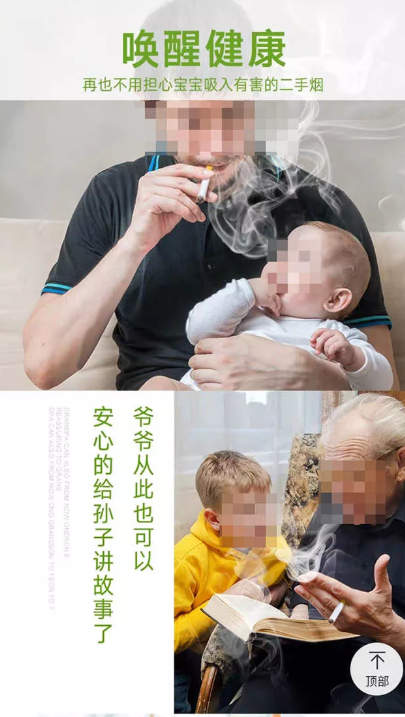
Is the secondhand vapor produced by e-cigarettes really harmless? Experts say this claim is inaccurate.
Wu Yiqun, a researcher at the Chinese Center for Disease Control and Prevention, explained that after heating the e-liquid, e-cigarettes produce aerosols through a vaporizer, which is a colloid formed by solid or liquid particles suspended in the air, with particle sizes ranging from 0.001 to 100 micrometers. This substance contains complex chemical components and is a new source of air pollution.
A smoking control organization mimicked a typical meeting environment and conducted an experiment: in a 25-square-meter enclosed meeting room, after someone took two puffs from an e-cigarette, the indoor PM2.5 level instantly soared from 5 micrograms per cubic meter to 1300 micrograms per cubic meter.
Data from the World Health Organization also shows that secondhand aerosol produced by e-cigarettes can cause PM1.0 levels to be 14 to 40 times higher and PM2.5 levels to be 6 to 86 times higher. The WHO warns that when the concentration of this aerosol reaches a sufficiently high level, it poses a serious threat to human health, especially for patients with respiratory diseases.
Moreover, Wu Yiqun stated that in experiments, carcinogens such as nitrosamines and polycyclic aromatic hydrocarbons were also detected in e-cigarette liquids or secondhand vapor. Additionally, the levels of heavy metals like nickel and chromium released in secondhand e-cigarette vapor are even higher than those found in secondhand smoke from traditional cigarettes.
Furthermore, research from the University of North Carolina in the United States has shown that vaporized e-liquid can inhibit the expression of immune genes.
The harm caused by "secondhand e-cigarette vapor" to public health has begun to attract attention from cities, and e-cigarettes have been included in new smoking control regulations. Recently, cities like Shenzhen and Hangzhou have listed e-cigarettes on the smoking control "blacklist", prohibiting their use in public places.
"Secondhand e-cigarette vapor" contains carcinogens, and there are risks of explosion from poor-quality tobacco sticks, with varying quality of e-liquid... Multiple pieces of evidence indicate that, like traditional cigarettes, e-cigarettes can also impact public health. Experts are calling for regulation of e-cigarette product quality and their use in public spaces to be prioritized.
E-cigarette "vapor" is not harmless
Recently, People's Daily visited several e-cigarette retail stores in Guangzhou and Shenzhen and found that many shops promote "harmless and healthy" as selling points for e-cigarettes. One e-cigarette store near Guangzhou East Station advertised itself as a "healthy smoking cessation experience center" and claimed, "One second to relieve cravings, healthy smoking alternative."
Some shop owners also stated that the main components of e-cigarette liquid are glycerin and propylene glycol. Both substances are edible food additives, and the "vapor" produced by heating does not harm the human body.
In online e-cigarette stores, there are also many advertisements claiming e-cigarettes are harmless. A study by Dr. Xia Yinghua from the Guangdong Provincial Center for Disease Control and Prevention found that among 14 types of advertisements from 12 e-cigarette manufacturers on 18 domestic websites, 89% claimed their products were "beneficial to health".
"Secondhand e-cigarette vapor" is also harmful to health
On a certain e-commerce platform, an e-cigarette manufacturer posted a photo of an adult vaping while holding a baby, claiming, "No more worries about the baby inhaling harmful secondhand smoke."
Is the secondhand vapor produced by e-cigarettes really harmless? Experts say this claim is inaccurate.
Wu Yiqun, a researcher at the Chinese Center for Disease Control and Prevention, explained that after heating the e-liquid, e-cigarettes produce aerosols through a vaporizer, which is a colloid formed by solid or liquid particles suspended in the air, with particle sizes ranging from 0.001 to 100 micrometers. This substance contains complex chemical components and is a new source of air pollution.
A smoking control organization mimicked a typical meeting environment and conducted an experiment: in a 25-square-meter enclosed meeting room, after someone took two puffs from an e-cigarette, the indoor PM2.5 level instantly soared from 5 micrograms per cubic meter to 1300 micrograms per cubic meter.
Data from the World Health Organization also shows that secondhand aerosol produced by e-cigarettes can cause PM1.0 levels to be 14 to 40 times higher and PM2.5 levels to be 6 to 86 times higher. The WHO warns that when the concentration of this aerosol reaches a sufficiently high level, it poses a serious threat to human health, especially for patients with respiratory diseases.
Moreover, Wu Yiqun stated that in experiments, carcinogens such as nitrosamines and polycyclic aromatic hydrocarbons were also detected in e-cigarette liquids or secondhand vapor. Additionally, the levels of heavy metals like nickel and chromium released in secondhand e-cigarette vapor are even higher than those found in secondhand smoke from traditional cigarettes.
Furthermore, research from the University of North Carolina in the United States has shown that vaporized e-liquid can inhibit the expression of immune genes.
The harm caused by "secondhand e-cigarette vapor" to public health has begun to attract attention from cities, and e-cigarettes have been included in new smoking control regulations. Recently, cities like Shenzhen and Hangzhou have listed e-cigarettes on the smoking control "blacklist", prohibiting their use in public places.
Related Articles

Vaping News
Ahead of a Nationwide Ban, Hundreds of Russian Retailers Voluntarily Stop Selling Vapes
2026-04-16

Vaping News
Illegal Vape Brands Try to Evade FDA Scrutiny by Posing as “Made in the USA”
2026-04-08

Vaping News
Jordan’s New Tobacco Control Rules: Waterpipe Tobacco Market Set for Major Changes
2026-03-17