
What Do E-cigarette Atomizer RBA, RDA, RTA, and RDTA Mean?
DIY atomizers have different names. So far, there are four commonly used ones, and each abbreviation starts with the letter R, which stands for Rebuildable. Below, I will expand these four rebuildable abbreviations and explain what they mean: What is RBA?
DIY atomizers have different names. So far, there are four commonly used ones, each abbreviation starting with the letter "R," which stands for "Rebuildable." Below, I will elaborate on the four "rebuildable" abbreviations and what they mean:
What is RBA?
RBA stands for ReBuildable Atomizer, which we usually refer to as a DIY atomizer. It refers to all atomizers that have a heating wire electrode base. Users can install their own coils and cotton on it (referred to as "builds"). Any atomizer with a build kit (including the more detailed subcategories below) can be called an RBA.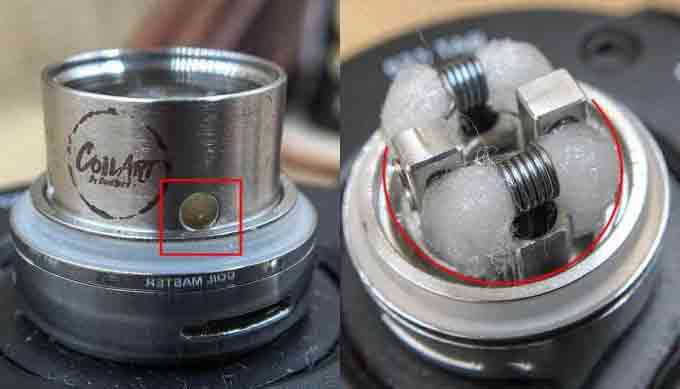 What is RDA?
RDA stands for Rebuildable Dripping Atomizer, which we usually refer to as a "dripper." It is a type of RBA with a base that has an electrode base that can secure the coil and power it to heat the coil. The base has an outer chamber cover that connects to the base via threads or O-rings. RDA does not have a tank to store e-liquid; it is designed to allow e-liquid to be dripped directly onto the coil or cotton from the top (usually requiring the top cap to be removed or dripped directly from the drip tip). RDA relies entirely on cotton to store e-liquid, typically less than 1ml.
In the vaping community, it is widely believed that RDA can produce a purer and more intense flavor than other types of atomizers. Therefore, RDA represents a gold standard against which other atomizers are measured.
RDA can produce massive clouds, especially when equipped with super low resistance (0.05-0.2Ω) coils and powered with high wattage (100+W). A typical example is when used on a mechanical mod without any voltage regulation circuit. In fact, RDA is the star of cloud competitions held worldwide.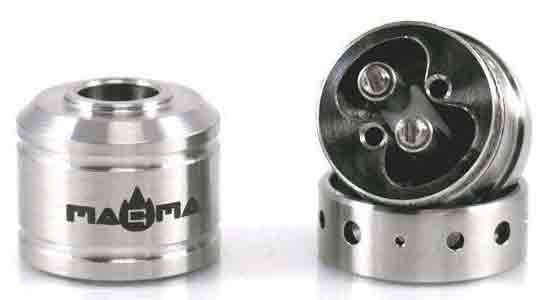 What is RTA?
RTA stands for Rebuildable Tank Atomizer, which we usually refer to as a "tank atomizer." It is a DIY atomizer with an electrode base wrapped in a metal chamber, with an outer ring that holds the e-liquid tank. The top cap connects to the central airflow channel, which leads up to the drip tip. Gravity and pressure force the e-liquid into the oil guide holes below the central metal chamber, and the ends of the guide cotton absorb the e-liquid. When the guide cotton is saturated with e-liquid, it can then heat the coil for vaporization.
The difference between RDA and RTA is the tank; RTA does not require manual dripping.
What is RDTA?
RDTA stands for Rebuildable Dripping Tank Atomizer, which is the most confusing category among several types.
Three years ago, as shown in the image above, RDTA was an RTA (Rebuildable Tank Atomizer) with a base, electrode posts, top cap, and tank, along with an additional component (such as a spring-loaded pump operated by pressing the drip tip) that allowed users to manually control the amount of e-liquid flowing to the guide cotton. Each time the drip tip was pressed, a certain amount of e-liquid would be added to the guide cotton.
These early RDTAs were also referred to as "auto-dripping atomizers." This sounds strange because the spring pump is manually operated, but the "automatic" part refers to not having to stop and open the top cap to drip e-liquid. Dripping is "automatic," which is very convenient, but it is manual automation.
Those early RDTAs were among the rarest types of DIY atomizers for a reason. They were complex in design and often unreliable. Even when they worked properly, regardless of convenience, they were usually overshadowed by their complexity and instability, making them essentially not user-friendly. By 2016, only a few of these "original" RDTAs continued to be produced and sold, most of which are now museum exhibits in vaping history.
However, recently RDTA has been revamped and redefined. The "auto-dripping" manual pump is now a thing of the past. In everyone's view, this is a brand new design that uses wet guide cotton to deliver e-liquid to the coil.
Starting from the second half of 2015, manufacturers began producing new RTA (Rebuildable Tank Atomizer) designs that do not use an "e-liquid channel" to place guide cotton; instead, these new atomizers have cotton holes set on the electrode base, allowing the ends of the cotton to be trimmed and extended into the lower tank, relying on gravity and pressure to saturate the cotton with e-liquid.
Another subjective reason is that manufacturers, to emphasize their so-called performance improvements, have named these redesigned atomizers RDTA. As mentioned earlier, dripping atomizers (RDA) are considered the best atomizers, so manufacturers promote their so-called RDTA as providing better performance than conventional RTA. This muddles the waters, as it is essentially a marketing strategy.
For the previous reason, the redesigned e-liquid delivery system can indeed justify renaming some RTAs as RDTA; the latter reason is clearly unfounded, but it reflects the current market situation.
What is RBA?
RBA stands for ReBuildable Atomizer, which we usually refer to as a DIY atomizer. It refers to all atomizers that have a heating wire electrode base. Users can install their own coils and cotton on it (referred to as "builds"). Any atomizer with a build kit (including the more detailed subcategories below) can be called an RBA.
What is RDA?RDA stands for Rebuildable Dripping Atomizer, which we usually refer to as a "dripper." It is a type of RBA with a base that has an electrode base that can secure the coil and power it to heat the coil. The base has an outer chamber cover that connects to the base via threads or O-rings. RDA does not have a tank to store e-liquid; it is designed to allow e-liquid to be dripped directly onto the coil or cotton from the top (usually requiring the top cap to be removed or dripped directly from the drip tip). RDA relies entirely on cotton to store e-liquid, typically less than 1ml.
In the vaping community, it is widely believed that RDA can produce a purer and more intense flavor than other types of atomizers. Therefore, RDA represents a gold standard against which other atomizers are measured.
RDA can produce massive clouds, especially when equipped with super low resistance (0.05-0.2Ω) coils and powered with high wattage (100+W). A typical example is when used on a mechanical mod without any voltage regulation circuit. In fact, RDA is the star of cloud competitions held worldwide.
What is RTA?RTA stands for Rebuildable Tank Atomizer, which we usually refer to as a "tank atomizer." It is a DIY atomizer with an electrode base wrapped in a metal chamber, with an outer ring that holds the e-liquid tank. The top cap connects to the central airflow channel, which leads up to the drip tip. Gravity and pressure force the e-liquid into the oil guide holes below the central metal chamber, and the ends of the guide cotton absorb the e-liquid. When the guide cotton is saturated with e-liquid, it can then heat the coil for vaporization.
The difference between RDA and RTA is the tank; RTA does not require manual dripping.
What is RDTA?
RDTA stands for Rebuildable Dripping Tank Atomizer, which is the most confusing category among several types.
Three years ago, as shown in the image above, RDTA was an RTA (Rebuildable Tank Atomizer) with a base, electrode posts, top cap, and tank, along with an additional component (such as a spring-loaded pump operated by pressing the drip tip) that allowed users to manually control the amount of e-liquid flowing to the guide cotton. Each time the drip tip was pressed, a certain amount of e-liquid would be added to the guide cotton.
These early RDTAs were also referred to as "auto-dripping atomizers." This sounds strange because the spring pump is manually operated, but the "automatic" part refers to not having to stop and open the top cap to drip e-liquid. Dripping is "automatic," which is very convenient, but it is manual automation.
Those early RDTAs were among the rarest types of DIY atomizers for a reason. They were complex in design and often unreliable. Even when they worked properly, regardless of convenience, they were usually overshadowed by their complexity and instability, making them essentially not user-friendly. By 2016, only a few of these "original" RDTAs continued to be produced and sold, most of which are now museum exhibits in vaping history.
However, recently RDTA has been revamped and redefined. The "auto-dripping" manual pump is now a thing of the past. In everyone's view, this is a brand new design that uses wet guide cotton to deliver e-liquid to the coil.
Starting from the second half of 2015, manufacturers began producing new RTA (Rebuildable Tank Atomizer) designs that do not use an "e-liquid channel" to place guide cotton; instead, these new atomizers have cotton holes set on the electrode base, allowing the ends of the cotton to be trimmed and extended into the lower tank, relying on gravity and pressure to saturate the cotton with e-liquid.
Another subjective reason is that manufacturers, to emphasize their so-called performance improvements, have named these redesigned atomizers RDTA. As mentioned earlier, dripping atomizers (RDA) are considered the best atomizers, so manufacturers promote their so-called RDTA as providing better performance than conventional RTA. This muddles the waters, as it is essentially a marketing strategy.
For the previous reason, the redesigned e-liquid delivery system can indeed justify renaming some RTAs as RDTA; the latter reason is clearly unfounded, but it reflects the current market situation.
Related Articles

Vaping News
Ahead of a Nationwide Ban, Hundreds of Russian Retailers Voluntarily Stop Selling Vapes
2026-04-16

Vaping News
Illegal Vape Brands Try to Evade FDA Scrutiny by Posing as “Made in the USA”
2026-04-08

Vaping News
Jordan’s New Tobacco Control Rules: Waterpipe Tobacco Market Set for Major Changes
2026-03-17