
Do vaping devices contain formaldehyde? Formaldehyde testing for vaping devices
Do vaping devices contain formaldehyde? Has formaldehyde in vaping devices exceeded the limit? Vaping devices are products powered by batteries that heat e-liquid or pods and deliver aerosol for users to inhale. They were originally created for smokers wh
Do vaping devices contain formaldehyde? Formaldehyde testing for vaping devices
Do electronic cigarettes contain formaldehyde, and have formaldehyde levels exceeded standards? Electronic cigarettes are products that use battery power to heat e-liquids or pods to deliver aerosol for users to inhale. Initially, they were designed for smokers looking to quit, but they now seem to have become a trend among teenagers.
On March 15, CCTV's 315 Gala exposed issues with electronic cigarettes, stating that long-term use can produce harmful substances like formaldehyde. This surprised many viewers, as it is commonly said that the harms of electronic cigarettes are less than those of traditional cigarettes. Why then does it produce formaldehyde, a substance that makes people wary?
1. The dangers of formaldehyde
Formaldehyde is a harmful substance to the human body. According to the "Health Standards for Formaldehyde in Indoor Air," the maximum allowable concentration of formaldehyde in indoor air is 0.08 mg/m3. If the concentration exceeds 0.08 mg/m3, it can cause various discomforts, such as loss of appetite, weight loss, weakness, headaches, and insomnia when inhaled for long periods at 20-70 mg/m3. Long-term exposure to 12 mg/m3 can lead to drowsiness, weakness, headaches, finger tremors, and vision impairment. Chronic exposure to low doses of formaldehyde can cause chronic respiratory diseases and increase the risk of nasopharyngeal cancer, colon cancer, brain tumors, and genetic mutations in cell nuclei.
Research shows that some electronic cigarettes do indeed produce formaldehyde, which deepens the resolve of those who are wary of it to quit using e-cigarettes. However, there is also a claim that not all electronic cigarettes produce formaldehyde, as it is generated through molecular breakdown at extremely high temperatures. Only low-quality e-cigarettes that operate at high temperatures will produce formaldehyde, so it cannot be generalized. So, do popular e-cigarettes on the market produce formaldehyde?

2. Formaldehyde testing of electronic cigarettes
To verify this idea, I decided to purchase electronic cigarette products from the market, mainly from platforms like Taobao and JD, including six models: Shanlan, MT, RELX, motto, MOTI, and PHIX.
Generally, manufacturers usually label the contents of nicotine, glycerin, propylene glycol, and food flavorings on the packaging of e-cigarette pods, with nicotine being considered a harmful substance. However, due to testing conditions, we only tested for formaldehyde content to explore whether electronic cigarettes contain formaldehyde.
The testing environment was a sealed box with a side length of 60 cm. The testing tools included an air purifier and an air quality monitor. The testing method involved using the air purifier to normalize the indoor air, then placing the air monitor inside the box, selecting one e-cigarette, and puffing it 10 times without interruption. After that, the box was sealed for one minute, and the air monitor's readings were recorded and compared to the previous normal values.
Additionally, we included data recorded after each 20-second interval, approximately finishing 10 puffs in 3 minutes, and waiting one minute for comparison.
As for the pods, five of the six e-cigarettes used built-in pods, while the Shanlan e-cigarette used a lychee-flavored pod.
This test primarily focused on detecting formaldehyde in the air, with comparisons shown in the chart below.
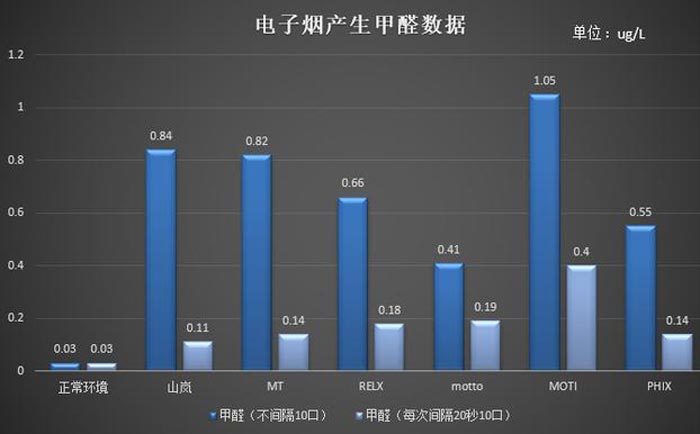 (Non-professional equipment testing, results for reference only)
From the results, it can be seen that during continuous use, each e-cigarette produced formaldehyde levels above 0.5 µg per liter, while the levels decreased to below 0.4 µg per liter during 20-second intervals, mostly maintaining around 0.1 µg.
3. Reasons for formaldehyde production in electronic cigarettes
Why does the formaldehyde content vary significantly with different usage frequencies when using the same e-cigarette? Data shows that this situation is caused by the e-cigarette atomizer, which uses heating principles to vaporize the liquid in the pod for users to inhale. However, the heating process also leads to the thermal decomposition of propylene glycol in the e-liquid, resulting in molecular breakdown and the production of formaldehyde. Nonetheless, propylene glycol itself is safe and is used in everyday products like toothpaste, so the primary reason for formaldehyde production in e-cigarettes lies in the heating of the atomizer.
In simple terms, continuous use of an e-cigarette causes the atomizer to reach high temperatures for extended periods, resulting in more formaldehyde, while using it with 20-second intervals allows the atomizer to cool down, reducing formaldehyde production.
Although my testing data may not be rigorous, overall, e-cigarettes produce formaldehyde regardless of whether they are used continuously or with intervals, which can impact health over time. Moreover, through my practical comparisons, the quality of popular e-cigarettes on the market varies significantly, with some having inherent defects such as oil leakage and high temperatures, which are severely inconsistent with seller descriptions. Some e-cigarettes even promote health benefits and cool features.
The original intention of e-cigarettes was to help smokers quit and reduce other harmful substances, but some sellers design e-cigarettes to be visually appealing and offer various flavors, even claiming that using their e-cigarettes can cleanse the lungs, which is entirely false.
For underage individuals, seeing such cool and "healthy" products may lead them to try them, resulting in nicotine dependence and the development of smoking habits, which is a significant risk.
It is also worth mentioning that both traditional cigarettes and e-cigarettes produce formaldehyde, with the amount produced by traditional cigarettes being higher. Therefore, I want to sound a warning: for users who do not have a smoking habit, for health reasons, no matter how cool e-cigarettes may look, they should absolutely avoid them. I also hope that the government can strengthen regulations on the e-cigarette market to eliminate low-quality products and false advertising.
E-cigarette e-liquids do contain formaldehyde. In conclusion, whether you smoke e-cigarettes or traditional cigarettes, it is undoubtedly harmful to your health. The healthiest way is to stay away from any form of smoking, and underage individuals should absolutely not adopt this habit.
We once failed to stop the popularity of tobacco. Now we may be able to prevent e-cigarettes from becoming a trend. I hope friends without a smoking addiction can stay away from both cigarettes and e-cigarettes.
Do electronic cigarettes contain formaldehyde, and have formaldehyde levels exceeded standards? Electronic cigarettes are products that use battery power to heat e-liquids or pods to deliver aerosol for users to inhale. Initially, they were designed for smokers looking to quit, but they now seem to have become a trend among teenagers.
On March 15, CCTV's 315 Gala exposed issues with electronic cigarettes, stating that long-term use can produce harmful substances like formaldehyde. This surprised many viewers, as it is commonly said that the harms of electronic cigarettes are less than those of traditional cigarettes. Why then does it produce formaldehyde, a substance that makes people wary?
1. The dangers of formaldehyde
Formaldehyde is a harmful substance to the human body. According to the "Health Standards for Formaldehyde in Indoor Air," the maximum allowable concentration of formaldehyde in indoor air is 0.08 mg/m3. If the concentration exceeds 0.08 mg/m3, it can cause various discomforts, such as loss of appetite, weight loss, weakness, headaches, and insomnia when inhaled for long periods at 20-70 mg/m3. Long-term exposure to 12 mg/m3 can lead to drowsiness, weakness, headaches, finger tremors, and vision impairment. Chronic exposure to low doses of formaldehyde can cause chronic respiratory diseases and increase the risk of nasopharyngeal cancer, colon cancer, brain tumors, and genetic mutations in cell nuclei.
Research shows that some electronic cigarettes do indeed produce formaldehyde, which deepens the resolve of those who are wary of it to quit using e-cigarettes. However, there is also a claim that not all electronic cigarettes produce formaldehyde, as it is generated through molecular breakdown at extremely high temperatures. Only low-quality e-cigarettes that operate at high temperatures will produce formaldehyde, so it cannot be generalized. So, do popular e-cigarettes on the market produce formaldehyde?
2. Formaldehyde testing of electronic cigarettes
To verify this idea, I decided to purchase electronic cigarette products from the market, mainly from platforms like Taobao and JD, including six models: Shanlan, MT, RELX, motto, MOTI, and PHIX.
Generally, manufacturers usually label the contents of nicotine, glycerin, propylene glycol, and food flavorings on the packaging of e-cigarette pods, with nicotine being considered a harmful substance. However, due to testing conditions, we only tested for formaldehyde content to explore whether electronic cigarettes contain formaldehyde.
The testing environment was a sealed box with a side length of 60 cm. The testing tools included an air purifier and an air quality monitor. The testing method involved using the air purifier to normalize the indoor air, then placing the air monitor inside the box, selecting one e-cigarette, and puffing it 10 times without interruption. After that, the box was sealed for one minute, and the air monitor's readings were recorded and compared to the previous normal values.
Additionally, we included data recorded after each 20-second interval, approximately finishing 10 puffs in 3 minutes, and waiting one minute for comparison.
As for the pods, five of the six e-cigarettes used built-in pods, while the Shanlan e-cigarette used a lychee-flavored pod.
This test primarily focused on detecting formaldehyde in the air, with comparisons shown in the chart below.
(Non-professional equipment testing, results for reference only)From the results, it can be seen that during continuous use, each e-cigarette produced formaldehyde levels above 0.5 µg per liter, while the levels decreased to below 0.4 µg per liter during 20-second intervals, mostly maintaining around 0.1 µg.
3. Reasons for formaldehyde production in electronic cigarettes
Why does the formaldehyde content vary significantly with different usage frequencies when using the same e-cigarette? Data shows that this situation is caused by the e-cigarette atomizer, which uses heating principles to vaporize the liquid in the pod for users to inhale. However, the heating process also leads to the thermal decomposition of propylene glycol in the e-liquid, resulting in molecular breakdown and the production of formaldehyde. Nonetheless, propylene glycol itself is safe and is used in everyday products like toothpaste, so the primary reason for formaldehyde production in e-cigarettes lies in the heating of the atomizer.
In simple terms, continuous use of an e-cigarette causes the atomizer to reach high temperatures for extended periods, resulting in more formaldehyde, while using it with 20-second intervals allows the atomizer to cool down, reducing formaldehyde production.
Although my testing data may not be rigorous, overall, e-cigarettes produce formaldehyde regardless of whether they are used continuously or with intervals, which can impact health over time. Moreover, through my practical comparisons, the quality of popular e-cigarettes on the market varies significantly, with some having inherent defects such as oil leakage and high temperatures, which are severely inconsistent with seller descriptions. Some e-cigarettes even promote health benefits and cool features.
The original intention of e-cigarettes was to help smokers quit and reduce other harmful substances, but some sellers design e-cigarettes to be visually appealing and offer various flavors, even claiming that using their e-cigarettes can cleanse the lungs, which is entirely false.
For underage individuals, seeing such cool and "healthy" products may lead them to try them, resulting in nicotine dependence and the development of smoking habits, which is a significant risk.
It is also worth mentioning that both traditional cigarettes and e-cigarettes produce formaldehyde, with the amount produced by traditional cigarettes being higher. Therefore, I want to sound a warning: for users who do not have a smoking habit, for health reasons, no matter how cool e-cigarettes may look, they should absolutely avoid them. I also hope that the government can strengthen regulations on the e-cigarette market to eliminate low-quality products and false advertising.
E-cigarette e-liquids do contain formaldehyde. In conclusion, whether you smoke e-cigarettes or traditional cigarettes, it is undoubtedly harmful to your health. The healthiest way is to stay away from any form of smoking, and underage individuals should absolutely not adopt this habit.
We once failed to stop the popularity of tobacco. Now we may be able to prevent e-cigarettes from becoming a trend. I hope friends without a smoking addiction can stay away from both cigarettes and e-cigarettes.
Related Articles

Vaping News
Ahead of a Nationwide Ban, Hundreds of Russian Retailers Voluntarily Stop Selling Vapes
2026-04-16

Vaping News
Illegal Vape Brands Try to Evade FDA Scrutiny by Posing as “Made in the USA”
2026-04-08

Vaping News
Jordan’s New Tobacco Control Rules: Waterpipe Tobacco Market Set for Major Changes
2026-03-17