
What Is in IQOS Tobacco Sticks, and Are the Ingredients Harmful?
What is in IQOS tobacco sticks, and are the ingredients harmful to the human body? IQOS remains popular in China, and many people enjoy using IQOS tobacco sticks. Are there any harmful substances in them? While the device itself produces no combustion, th
What are the harmful ingredients in IQOS tobacco sticks? IQOS electronic cigarettes have been banned repeatedly in China, yet many people enjoy smoking IQOS tobacco sticks. Are there harmful substances in IQOS tobacco sticks? Electronic cigarettes themselves do not contain harmful substances; the tobacco sticks are what we inhale after heating. So, do they contain harmful substances? Let's clarify the concept of non-combustion tobacco, which includes the IQOS Marlboro sticks, HEETS, and the recently released FIIT sticks.
To understand this issue, we first need to grasp the principle of non-combustion tobacco. Traditional tobacco generates nicotine through combustion, which also produces harmful substances like tar and carbon monoxide. When people smoke, they primarily seek to absorb nicotine and the flavors of the tobacco to achieve satisfaction, and the smoke is produced when tobacco burns at temperatures exceeding 600°C, usually containing harmful chemicals. Therefore, secondhand smoke poses health risks to others.
In contrast, non-combustion tobacco uses a heating method to vaporize the tobacco, thus generating nicotine. Although the heating process cannot completely eliminate tar production, the amount of tar generated is very low, almost negligible compared to traditional tobacco combustion.
According to IQOS's official introduction, the principle of IQOS is to heat the tobacco-containing sticks to a temperature below 350°C using a heating blade, without combustion, and thus no burning tobacco taste is produced, but nicotine is released. The lower heating temperature allows the true flavor of the tobacco to be released, providing a throat hit similar to smoking while significantly reducing the chemical substances produced during traditional tobacco combustion.
As a new type of non-combustion tobacco, many people want to know how IQOS/lil tobacco sticks are made. Taking the Marlboro original flavor stick as an example, let's compare its composition before and after heating to see if it affects the body when consumed.
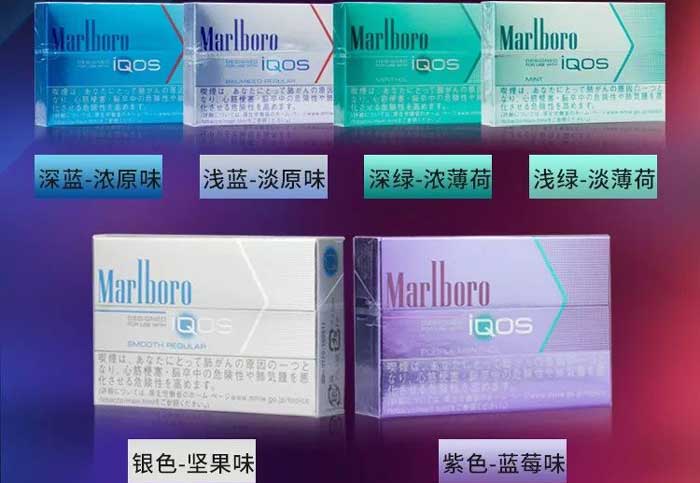 1. Anatomical Structure:
First, I cut open a Marlboro stick... Inside the stick, there are four parts, three of which serve a filtering function. The first part consists of a high-density material, which I will temporarily call primary filter cotton. The second part is a ventilation tube, somewhat similar to a plastic sheet, which I will refer to as the ventilation tube. The third part is also filter cotton, which is directly in contact with the mouth, so it is made of relatively hygienic plant materials, which I will call secondary filter cotton. It is known that IQOS tobacco sticks have applied for international patents, and despite their small size, they are well-crafted. I cannot guarantee that they are completely harmless to the body, but for long-time smokers, they are definitely less harmful than smoking traditional cigarettes. Currently, I believe that products like IQOS/lil are among the healthiest electronic cigarette products available. If you insist on saying that previous vapor cigarettes are the healthiest, then there's nothing I can do about that.
2. Tobacco Analysis:
Next, we analyze the tobacco part of the stick. In the IQOS community, we often refer to it as tobacco fiber, but it is actually "paper soaked in tobacco liquid," primarily made by grinding tobacco leaves into a slurry and combining it with paper pulp. It is a new type of tobacco substitute. Although its shape is long and thin, it is different from traditional tobacco. This tobacco fiber paper turns black when heated, and if heated further, it cannot produce vapor.
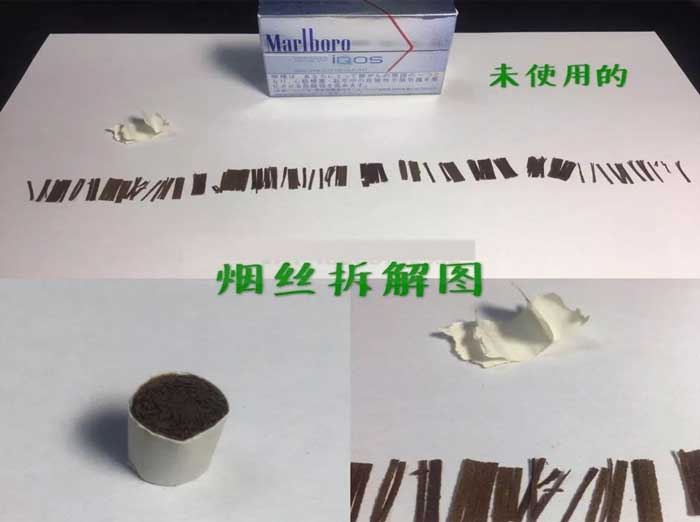 From the images, we can see that the heated tobacco fiber has turned black in the center. Carbonization means that the paper has been heated to a high temperature, causing moisture to evaporate, and is a form of pyrolysis under low or no oxygen conditions. As mentioned earlier, the tobacco fiber uses very little tobacco, and more of it is a mixture of paper and tobacco. If everyone smoked such tobacco, I believe the income of tobacco farmers would significantly decrease.
3. Primary Filter Cotton Analysis:
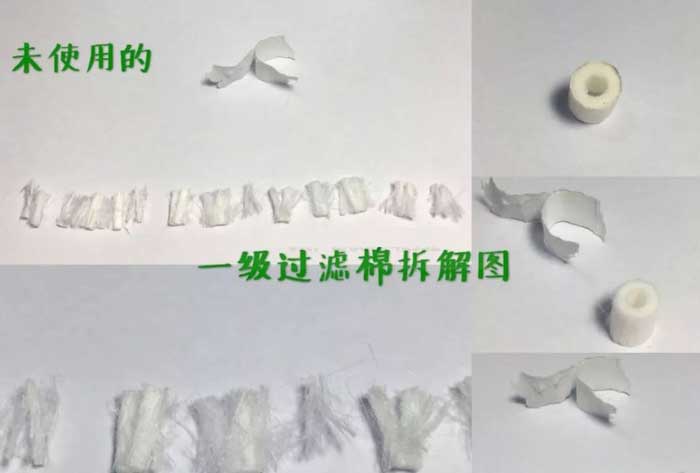 I tore open the primary filter cotton and laid it flat. Inside, it is relatively clean. Another noteworthy point is that the middle of the filter cotton is a hollow ring, which I analyze should be the source of cooling air and flavor, acting as a buffer for the gas while filtering out some substances. From the used primary filter cotton below, we can see yellow substances attached to it, and the yellow color becomes lighter towards the top, perfectly illustrating its filtering function and proving that the primary filter cotton can stabilize the airflow during smoking.
4. Ventilation Tube Analysis:
After analyzing the primary filter cotton, we move on to the ventilation tube. Previously, there has been controversy regarding this ventilation tube, which is made of a material similar to hard plastic, shaped like a tube. This is a special filtering device; although the material resembles hard plastic, it is not made of plastic. The white gel-like part, according to the official statement, is made from corn silk, a natural material that can decompose into non-polluting substances. Its main function is to retain heat, allowing you to draw in warm air when inhaling, and it also filters out some tar. Why do I say this? Please look at the image; the right side of the ventilation tube has yellow oil stains, while the left side does not, and the leftmost regular filter tip is also not stained yellow, indicating that tar has been filtered out. This is quite surprising; we all know that tar is the most harmful part of tobacco. From the tobacco fiber composition, we know that this tobacco stick has almost zero tar content, and with multiple layers of filtration, by the time we inhale it, there is virtually no tar being consumed. This is fantastic.
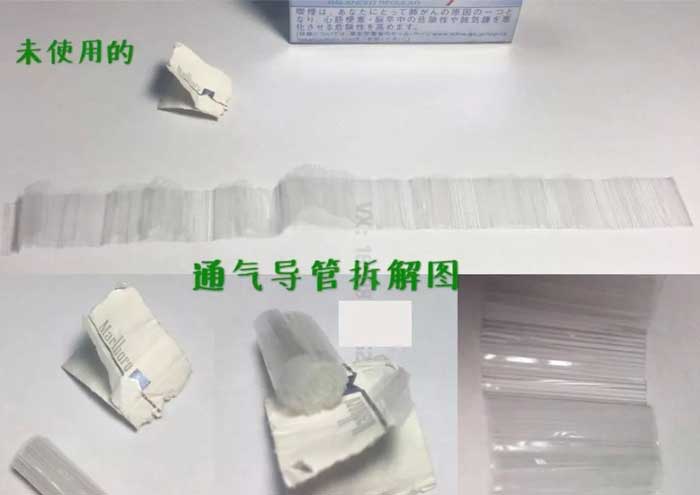 According to official data, this "plastic material" is primarily composed of PLA, which is commonly known as polylactic acid. It is a new type of bio-based and biodegradable material made from renewable plant resources (such as corn). The starch material is converted into glucose through saccharification, which is then fermented with specific strains to produce high-purity lactic acid, which is chemically synthesized into polylactic acid of a certain molecular weight. It has good biodegradability and can be completely decomposed by microorganisms in nature under specific conditions, ultimately generating carbon dioxide and water, thus not polluting the environment. This is very beneficial for environmental protection and is recognized as an environmentally friendly material. Therefore, the high price of tobacco sticks is justified, as it depends not only on the technology but also on the raw materials used.
5. Secondary Filter Cotton Analysis:
Finally, let's take a look at the secondary filter cotton, which is in direct contact with the mouth and is therefore the most effective filter. Similar to traditional cigarettes, this part is used to reduce the smoke, tar, and suspended particles produced during combustion when inhaled, while also reducing the harmfulness of the smoke and tobacco. However, for IQOS electronic cigarettes, the role of the secondary filter cotton is to filter out harmful substances produced during heating, such as nicotine. Since tar has already been filtered out by the previous two parts, if any remains in this part, it would be truly astonishing.
From the information, we can learn that the raw materials used to make the filter tips of regular cigarettes are derived from wood cellulose. Acetylation of cellulose (which is referred to as cellulose acetate or simply "acetate") is dissolved and separated into continuous bundles of synthetic fibers known as tow. The cellulose, based on its chemical and physical processes, is a type of double acetate sodium substitution (actual substitution range 2.35 - 2.55) cellulose. The tow is opened, plasticized, shaped, and cut to the size of the filter.
In summary, the finer the fibers, the higher the filtration efficiency of the cigarette filter. From the images, we can also see that the density of the secondary filter cotton is very high, indicating that its filtration efficiency is also very high.
That's all for today, just for reference. After all, I am just an enthusiast, not a professional. If there are any inaccuracies, I hope the experts will correct me. In any case, I believe that Marlboro tobacco sticks are quite sincere; compared to traditional cigarettes, they manage to minimize harm to the body, which reflects the stature of a large company. Regardless, as a smoker, I will switch to IQOS or lil electronic cigarettes instead of traditional cigarettes, as health is priceless!
To understand this issue, we first need to grasp the principle of non-combustion tobacco. Traditional tobacco generates nicotine through combustion, which also produces harmful substances like tar and carbon monoxide. When people smoke, they primarily seek to absorb nicotine and the flavors of the tobacco to achieve satisfaction, and the smoke is produced when tobacco burns at temperatures exceeding 600°C, usually containing harmful chemicals. Therefore, secondhand smoke poses health risks to others.
In contrast, non-combustion tobacco uses a heating method to vaporize the tobacco, thus generating nicotine. Although the heating process cannot completely eliminate tar production, the amount of tar generated is very low, almost negligible compared to traditional tobacco combustion.
According to IQOS's official introduction, the principle of IQOS is to heat the tobacco-containing sticks to a temperature below 350°C using a heating blade, without combustion, and thus no burning tobacco taste is produced, but nicotine is released. The lower heating temperature allows the true flavor of the tobacco to be released, providing a throat hit similar to smoking while significantly reducing the chemical substances produced during traditional tobacco combustion.
As a new type of non-combustion tobacco, many people want to know how IQOS/lil tobacco sticks are made. Taking the Marlboro original flavor stick as an example, let's compare its composition before and after heating to see if it affects the body when consumed.
1. Anatomical Structure:First, I cut open a Marlboro stick... Inside the stick, there are four parts, three of which serve a filtering function. The first part consists of a high-density material, which I will temporarily call primary filter cotton. The second part is a ventilation tube, somewhat similar to a plastic sheet, which I will refer to as the ventilation tube. The third part is also filter cotton, which is directly in contact with the mouth, so it is made of relatively hygienic plant materials, which I will call secondary filter cotton. It is known that IQOS tobacco sticks have applied for international patents, and despite their small size, they are well-crafted. I cannot guarantee that they are completely harmless to the body, but for long-time smokers, they are definitely less harmful than smoking traditional cigarettes. Currently, I believe that products like IQOS/lil are among the healthiest electronic cigarette products available. If you insist on saying that previous vapor cigarettes are the healthiest, then there's nothing I can do about that.
2. Tobacco Analysis:
Next, we analyze the tobacco part of the stick. In the IQOS community, we often refer to it as tobacco fiber, but it is actually "paper soaked in tobacco liquid," primarily made by grinding tobacco leaves into a slurry and combining it with paper pulp. It is a new type of tobacco substitute. Although its shape is long and thin, it is different from traditional tobacco. This tobacco fiber paper turns black when heated, and if heated further, it cannot produce vapor.
From the images, we can see that the heated tobacco fiber has turned black in the center. Carbonization means that the paper has been heated to a high temperature, causing moisture to evaporate, and is a form of pyrolysis under low or no oxygen conditions. As mentioned earlier, the tobacco fiber uses very little tobacco, and more of it is a mixture of paper and tobacco. If everyone smoked such tobacco, I believe the income of tobacco farmers would significantly decrease.3. Primary Filter Cotton Analysis:
I tore open the primary filter cotton and laid it flat. Inside, it is relatively clean. Another noteworthy point is that the middle of the filter cotton is a hollow ring, which I analyze should be the source of cooling air and flavor, acting as a buffer for the gas while filtering out some substances. From the used primary filter cotton below, we can see yellow substances attached to it, and the yellow color becomes lighter towards the top, perfectly illustrating its filtering function and proving that the primary filter cotton can stabilize the airflow during smoking.4. Ventilation Tube Analysis:
After analyzing the primary filter cotton, we move on to the ventilation tube. Previously, there has been controversy regarding this ventilation tube, which is made of a material similar to hard plastic, shaped like a tube. This is a special filtering device; although the material resembles hard plastic, it is not made of plastic. The white gel-like part, according to the official statement, is made from corn silk, a natural material that can decompose into non-polluting substances. Its main function is to retain heat, allowing you to draw in warm air when inhaling, and it also filters out some tar. Why do I say this? Please look at the image; the right side of the ventilation tube has yellow oil stains, while the left side does not, and the leftmost regular filter tip is also not stained yellow, indicating that tar has been filtered out. This is quite surprising; we all know that tar is the most harmful part of tobacco. From the tobacco fiber composition, we know that this tobacco stick has almost zero tar content, and with multiple layers of filtration, by the time we inhale it, there is virtually no tar being consumed. This is fantastic.
According to official data, this "plastic material" is primarily composed of PLA, which is commonly known as polylactic acid. It is a new type of bio-based and biodegradable material made from renewable plant resources (such as corn). The starch material is converted into glucose through saccharification, which is then fermented with specific strains to produce high-purity lactic acid, which is chemically synthesized into polylactic acid of a certain molecular weight. It has good biodegradability and can be completely decomposed by microorganisms in nature under specific conditions, ultimately generating carbon dioxide and water, thus not polluting the environment. This is very beneficial for environmental protection and is recognized as an environmentally friendly material. Therefore, the high price of tobacco sticks is justified, as it depends not only on the technology but also on the raw materials used.5. Secondary Filter Cotton Analysis:
Finally, let's take a look at the secondary filter cotton, which is in direct contact with the mouth and is therefore the most effective filter. Similar to traditional cigarettes, this part is used to reduce the smoke, tar, and suspended particles produced during combustion when inhaled, while also reducing the harmfulness of the smoke and tobacco. However, for IQOS electronic cigarettes, the role of the secondary filter cotton is to filter out harmful substances produced during heating, such as nicotine. Since tar has already been filtered out by the previous two parts, if any remains in this part, it would be truly astonishing.
From the information, we can learn that the raw materials used to make the filter tips of regular cigarettes are derived from wood cellulose. Acetylation of cellulose (which is referred to as cellulose acetate or simply "acetate") is dissolved and separated into continuous bundles of synthetic fibers known as tow. The cellulose, based on its chemical and physical processes, is a type of double acetate sodium substitution (actual substitution range 2.35 - 2.55) cellulose. The tow is opened, plasticized, shaped, and cut to the size of the filter.
In summary, the finer the fibers, the higher the filtration efficiency of the cigarette filter. From the images, we can also see that the density of the secondary filter cotton is very high, indicating that its filtration efficiency is also very high.
That's all for today, just for reference. After all, I am just an enthusiast, not a professional. If there are any inaccuracies, I hope the experts will correct me. In any case, I believe that Marlboro tobacco sticks are quite sincere; compared to traditional cigarettes, they manage to minimize harm to the body, which reflects the stature of a large company. Regardless, as a smoker, I will switch to IQOS or lil electronic cigarettes instead of traditional cigarettes, as health is priceless!
Related Articles

Vaping News
Ahead of a Nationwide Ban, Hundreds of Russian Retailers Voluntarily Stop Selling Vapes
2026-04-16

Vaping News
Illegal Vape Brands Try to Evade FDA Scrutiny by Posing as “Made in the USA”
2026-04-08

Vaping News
Jordan’s New Tobacco Control Rules: Waterpipe Tobacco Market Set for Major Changes
2026-03-17