
The Rumor of the First U.S. ‘E-Cigarette Death’ Triggers Global Backlash
Sensational headlines such as First Death Caused by E-Cigarettes Reported in the United States and The World’s First Case of Death from Vaping have triggered widespread criticism around the world. The incident sparked intense debate over how vaping-relate
The rumor of the first U.S. ‘e-cigarette death’ triggers global backlash. "E-cigarette kills! The first case of death from e-cigarette use in the U.S., the world's first case" and "The first case of death from e-cigarettes in the U.S., 193 people suffer from severe lung diseases"...
The e-cigarette industry has made headlines again! After all, human life is at stake, and it even briefly trended on Weibo.
In fact, this is a completely unfounded rumor and fake news. The source of the news is a report from U.S. media such as The Washington Post on August 23, but it has been completely distorted in China.

The U.S. 'e-cigarette death' rumor sparks global condemnation
Sky News in the UK cited the views of the UK Department of Health in its report on the aforementioned news, stating: "E-cigarette vapor does not contain tar or carbon monoxide, which are the two most harmful elements in tobacco smoke. E-cigarettes do contain some chemicals also found in tobacco smoke, but in much lower quantities." Previous studies by the department have shown that e-cigarettes are about 95% less harmful than smoking traditional cigarettes.
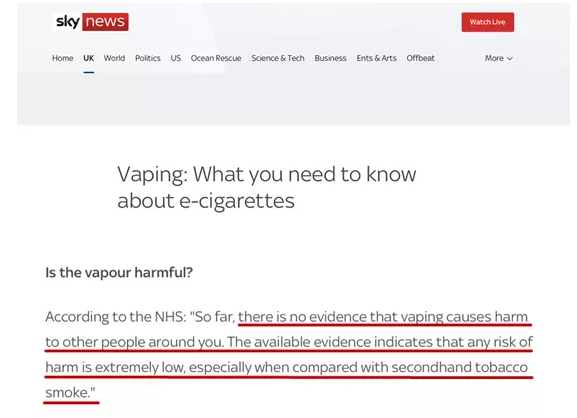
The UK National Health Service stated: "So far, there is no evidence that smoking e-cigarettes harms those around you. Existing evidence suggests that any risk of harm is extremely low, especially compared to secondhand smoke."
Both the UK National Health Service and the UK Department of Health support the use of e-cigarettes instead of smoking, with the UK Department of Health suggesting last year that hospitals should sell e-cigarettes and provide e-cigarette lounges for patients to encourage people to switch from traditional tobacco to e-cigarettes.
The New Zealand government and experts are also outraged by the e-cigarette rumors.
"Recent news from the U.S. has raised concerns about e-cigarettes and severe lung diseases," confirmed Caroline McElnay, New Zealand's Director of Public Health, stating that there have been no reports of respiratory diseases caused by e-cigarettes in New Zealand. "The main issue is that some facts have been overlooked. In some cases of illness, THC (tetrahydrocannabinol) from unregulated sources purchased on the street has been confirmed as the cause."
Professor Janet Hoek from the University of Otago in New Zealand believes: "Most importantly, people should not panic. If people purchase and use legitimate e-cigarette products, e-cigarettes will always be safer than traditional smoking."
Professor Janet Hoek lamented: "For people, quitting smoking and then starting again is a regrettable thing because smoking is still much more harmful than continuing to smoke." The University of Otago is ranked in the top 1% of universities worldwide and is New Zealand's first university, with over 150 years of history.
"These rumor headlines are destructive because they do not reflect legitimate e-cigarette products," said Ben Pryor, head of New Zealand's largest e-cigarette company. "These reports from the U.S. refer to black market products containing cannabis components, not legitimate e-cigarettes from regulated channels."
Pryor further warned that clickbait headlines could cost New Zealanders their lives and may hinder the progress of smokers trying to quit. "Every person who reads a misleading headline and puts down their e-cigarette to pick up a pack of traditional tobacco could unnecessarily lose 20 years of life on average."
The e-cigarette industry has made headlines again! After all, human life is at stake, and it even briefly trended on Weibo.
In fact, this is a completely unfounded rumor and fake news. The source of the news is a report from U.S. media such as The Washington Post on August 23, but it has been completely distorted in China.
The U.S. 'e-cigarette death' rumor sparks global condemnation
Sky News in the UK cited the views of the UK Department of Health in its report on the aforementioned news, stating: "E-cigarette vapor does not contain tar or carbon monoxide, which are the two most harmful elements in tobacco smoke. E-cigarettes do contain some chemicals also found in tobacco smoke, but in much lower quantities." Previous studies by the department have shown that e-cigarettes are about 95% less harmful than smoking traditional cigarettes.
The UK National Health Service stated: "So far, there is no evidence that smoking e-cigarettes harms those around you. Existing evidence suggests that any risk of harm is extremely low, especially compared to secondhand smoke."
Both the UK National Health Service and the UK Department of Health support the use of e-cigarettes instead of smoking, with the UK Department of Health suggesting last year that hospitals should sell e-cigarettes and provide e-cigarette lounges for patients to encourage people to switch from traditional tobacco to e-cigarettes.
The New Zealand government and experts are also outraged by the e-cigarette rumors.
"Recent news from the U.S. has raised concerns about e-cigarettes and severe lung diseases," confirmed Caroline McElnay, New Zealand's Director of Public Health, stating that there have been no reports of respiratory diseases caused by e-cigarettes in New Zealand. "The main issue is that some facts have been overlooked. In some cases of illness, THC (tetrahydrocannabinol) from unregulated sources purchased on the street has been confirmed as the cause."
Professor Janet Hoek from the University of Otago in New Zealand believes: "Most importantly, people should not panic. If people purchase and use legitimate e-cigarette products, e-cigarettes will always be safer than traditional smoking."
Professor Janet Hoek lamented: "For people, quitting smoking and then starting again is a regrettable thing because smoking is still much more harmful than continuing to smoke." The University of Otago is ranked in the top 1% of universities worldwide and is New Zealand's first university, with over 150 years of history.
"These rumor headlines are destructive because they do not reflect legitimate e-cigarette products," said Ben Pryor, head of New Zealand's largest e-cigarette company. "These reports from the U.S. refer to black market products containing cannabis components, not legitimate e-cigarettes from regulated channels."
Pryor further warned that clickbait headlines could cost New Zealanders their lives and may hinder the progress of smokers trying to quit. "Every person who reads a misleading headline and puts down their e-cigarette to pick up a pack of traditional tobacco could unnecessarily lose 20 years of life on average."
Related Articles

Vaping News
Ahead of a Nationwide Ban, Hundreds of Russian Retailers Voluntarily Stop Selling Vapes
2026-04-16

Vaping News
Illegal Vape Brands Try to Evade FDA Scrutiny by Posing as “Made in the USA”
2026-04-08

Vaping News
Jordan’s New Tobacco Control Rules: Waterpipe Tobacco Market Set for Major Changes
2026-03-17