
FLOW Fuloo Announces Completion of Angel and Pre-A Funding Rounds
Few would deny that the current boom in e-cigarettes has been fueled by capital. As a result, strong financing has become a key feature distinguishing these emerging e-cigarette brands from the traditional vaping industry. Funding for e-cigarette brands c
The current wave of electronic cigarettes is driven by capital, and no one can deny this fact.
Thus, "having money" has become a hallmark distinguishing these emerging electronic cigarette brands from traditional tobacco industries. The continuous financing of electronic cigarette brands is ongoing—today (May 23), the electronic cigarette brand flow, founded by former Smartisan Technology Vice President Zhu Xiaomu, announced the completion of angel and Pre-A funding rounds, with investments from several well-known domestic investment institutions, totaling $10,891,978 across both rounds.

"We provided precise figures down to the unit," Zhu Xiaomu said with a smile during a media interview at FLOW Fuloo's office.
Zhu Xiaomu told the media that the funds from this round of financing will mainly be used for hardware production research and development and promotional activities. In less than a year of entrepreneurship, where has Zhu Xiaomu's journey and the electronic cigarette wave taken him?
Challenges in Promotion and Channels
Hardware, promotion, and channels are the three specific uses for the financing that Zhu Xiaomu mentioned.
For Zhu Xiaomu, who has a background in Smartisan Technology, product hardware should not pose a significant problem. FLOW Fuloo will soon launch a disposable vaping device. Currently, the main headache for him and many electronic cigarette practitioners is likely the promotion and sales channels, as the public still holds ambiguous views on the relationship between electronic cigarettes and traditional tobacco.
So, are electronic cigarettes and traditional tobacco the same thing? Zhu Xiaomu provides an absolute denial.
"It should be clarified that electronic cigarettes are not illegal in terms of promotion right now," Zhu Xiaomu told the media. "The advertising law pertains to (traditional) tobacco, while electronic cigarettes (vaping devices) are not traditional tobacco."
In the public's perception, some of the most dangerous substances found in traditional tobacco include tar, carbon monoxide, and formaldehyde, which was named in the "315" event. Currently, mainstream electronic cigarette products claim to be tar-free, and FLOW Fuloo states that their low-temperature vaporization products do not undergo high-temperature combustion, so they assert that their products do not produce tar or carbon monoxide.
As for formaldehyde, "it is present," Zhu Xiaomu said, "but according to our testing reports from national laboratories, its content in electronic cigarettes is comparable to that in the air, and it does not reach levels that could harm the body."
The testing Zhu Xiaomu refers to is conducted by the third-party testing agency TCT. The results provided by FLOW Fuloo show that the formaldehyde intake per 100 puffs varies by flavor, ranging from 0.00306mg to 0.352mg, while the indoor air quality standard in China limits formaldehyde to 0.08mg per cubic meter.
Regarding nicotine, which overlaps directly with traditional tobacco, Zhu Xiaomu stated: "Discussing toxicity without considering dosage is misleading." Currently, FLOW Fuloo's pod-based electronic cigarettes use a new type of nicotine salt e-liquid, with a nicotine content marked at 3%.
The debate over the health implications of electronic cigarettes seems far from over, as various parties hold differing positions. From an industry perspective, the most immediate pain point for the electronic cigarette industry remains promotion and marketing.
Due to the sensitivity of the industry, after the "315" event, television variety shows and elevator advertisements have explicitly prohibited electronic cigarette-related ads, and even social media platforms like Weibo are tightening restrictions on commercial promotions for electronic cigarette products. This has created challenges for electronic cigarette brands in terms of advertising. In the face of various unwritten restrictions, effectively and safely promoting their brands has become a skillful endeavor.
Currently, electronic cigarette promotions are primarily concentrated online.
With a team inherently carrying the Smartisan gene and having had Luo Zhiqiang as a spokesperson, FLOW Fuloo has always been a topic of discussion and interest since its inception. Smartisan has traditionally excelled in brand promotion and online marketing, so online lottery events, Weibo and WeChat interactive competitions are now common promotional methods for FLOW Fuloo.
Tiger Sniff has also noticed that major music festivals have become a primary venue for electronic cigarette promotions. For instance, recently, FLOW Fuloo sponsored the Strawberry Music Festival, setting up a booth there. However, while promotions are allowed, not all music festivals permit vendors to sell electronic cigarettes directly; it depends on the specific festival's regulations.
Like promotion, some uncertainties also exist in sales channels.
As is well known, online platforms and WeChat mini-programs are the primary sales channels relied upon by these emerging electronic cigarette brands. Recently, brands like FLOW Fuloo faced a wave of removals from WeChat mini-programs due to suspected tobacco-related issues. Earlier this month, electronic cigarette retail mini-programs, including RELX, FLOW Fuloo, and YOOZ, all suspended services, with the mini-program pages indicating that the suspension was due to content falling outside the platform's permitted service scope.
Tiger Sniff has received feedback from some electronic cigarette practitioners that the removals were not directly related to electronic cigarettes but were due to certain mini-programs violating WeChat's multi-level distribution and traffic diversion restrictions. WeChat's official response to the media stated that these mini-programs were suspected of engaging in the sale of electronic cigarettes and other tobacco products, violating the "WeChat Mini-Program Platform Operation Specifications," leading to their removal.
Currently, the aforementioned electronic cigarette mini-programs have been reinstated.
Although there is no clear legal definition for electronic cigarettes, most practitioners believe that electronic cigarettes are not tobacco; they are a type of fast-moving consumer product. And fast-moving consumer products naturally require robust offline sales channels.
Zhu Xiaomu revealed to Tiger Sniff that currently, FLOW Fuloo's sales are primarily derived from offline electronic cigarette shops and supermarkets, rather than online.
"This market is a blue ocean, but due to people's lack of understanding of electronic cigarettes, very few truly know what they are. Therefore, we still need a lot of education, which includes online advertising and offline channels," Zhu Xiaomu said.
Thus, the high-profit electronic cigarette product faces challenges due to the presence of offline distributors, leading to different perceptions for Zhu Xiaomu before and after starting his business. "Many people think this is a high-margin, high-repeat purchase, and a great business, but in reality, we provide significant policies and profit support to offline distributors." Zhu Xiaomu did not disclose specific sales figures but indicated that sales from supermarkets and electronic cigarette shops account for the largest share.
The challenges in promotion and channels stem partly from policy—this is a sword of Damocles hanging over the electronic cigarette industry.
An Uncertain Question
How will electronic cigarettes ultimately be defined—consumer products, tobacco, or something else? This will determine the fate of the electronic cigarette industry and these brands.
Currently, there is only one explicit legal provision regarding electronic cigarettes: last year, the State Administration for Market Regulation and the State Tobacco Monopoly Administration issued a notice prohibiting the sale of electronic cigarettes to minors. However, there is currently no unified regulatory standard for product production and e-liquid safety in China.
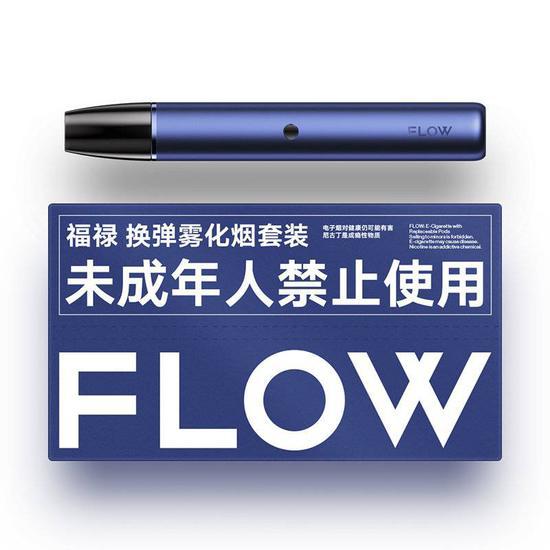
FLOW Fuloo has marked its packaging with a prominent "Prohibited for Minors" label.
The exposure during the "315" event highlighted the chaotic production conditions in the electronic cigarette industry in the absence of regulatory standards and policies. Currently, the nicotine content labeling of e-liquids on the market is inconsistent, with some exceeding safe limits, and e-liquids containing formaldehyde, propylene glycol, and glycerin, which can strongly irritate the respiratory tract when vaporized.
Although FLOW Fuloo claims its products have undergone rigorous testing and meet EU safety standards, due to policy uncertainties, it, along with other leading brands, still has to contend with the public's distrust stemming from the lack of regulation in the domestic market.
Now, everyone is certain that policies will intervene; they just don't know when or how.
Zhu Xiaomu stated that policies will not be "one-size-fits-all." "I wholeheartedly welcome the establishment of standards; if we could issue licenses like Didi in the future, that would be even better," Zhu Xiaomu said.
His reasoning is as follows: first, the number of businesses entering the electronic cigarette market has grown from over 4,000 at the beginning of the year to the current "battle of thousands of brands," indicating that the industry has reached a certain scale; second, although the electronic cigarette industry is not yet mature, "this industry is not just a passing trend but a long-term direction and trend"; third, the trend in traditional tobacco is that more people are smoking thin and flavored cigarettes, which reflects smokers' pursuit of lower tar and flavor diversity. "The ultimate expression of lower tar and flavor diversity is electronic cigarettes," Zhu Xiaomu said.
Zhu Xiaomu and FLOW Fuloo are currently among the more notable players in the electronic cigarette industry. Meanwhile, the electronic cigarette brand market continues to grow rapidly, with more participants joining this still chaotic market. A year is enough time for a brand to distinguish itself from others. "Give me another year, and who knows what we can achieve," Zhu Xiaomu remarked.
In terms of policy, the electronic cigarette industry still has unresolved issues. However, with capital flowing in, it is not difficult for new entrants to carve out a share of the market; the challenge lies in ensuring long-term survival and profitability once the landscape expands and policies are enacted.
Thus, "having money" has become a hallmark distinguishing these emerging electronic cigarette brands from traditional tobacco industries. The continuous financing of electronic cigarette brands is ongoing—today (May 23), the electronic cigarette brand flow, founded by former Smartisan Technology Vice President Zhu Xiaomu, announced the completion of angel and Pre-A funding rounds, with investments from several well-known domestic investment institutions, totaling $10,891,978 across both rounds.
"We provided precise figures down to the unit," Zhu Xiaomu said with a smile during a media interview at FLOW Fuloo's office.
Zhu Xiaomu told the media that the funds from this round of financing will mainly be used for hardware production research and development and promotional activities. In less than a year of entrepreneurship, where has Zhu Xiaomu's journey and the electronic cigarette wave taken him?
Challenges in Promotion and Channels
Hardware, promotion, and channels are the three specific uses for the financing that Zhu Xiaomu mentioned.
For Zhu Xiaomu, who has a background in Smartisan Technology, product hardware should not pose a significant problem. FLOW Fuloo will soon launch a disposable vaping device. Currently, the main headache for him and many electronic cigarette practitioners is likely the promotion and sales channels, as the public still holds ambiguous views on the relationship between electronic cigarettes and traditional tobacco.
So, are electronic cigarettes and traditional tobacco the same thing? Zhu Xiaomu provides an absolute denial.
"It should be clarified that electronic cigarettes are not illegal in terms of promotion right now," Zhu Xiaomu told the media. "The advertising law pertains to (traditional) tobacco, while electronic cigarettes (vaping devices) are not traditional tobacco."
In the public's perception, some of the most dangerous substances found in traditional tobacco include tar, carbon monoxide, and formaldehyde, which was named in the "315" event. Currently, mainstream electronic cigarette products claim to be tar-free, and FLOW Fuloo states that their low-temperature vaporization products do not undergo high-temperature combustion, so they assert that their products do not produce tar or carbon monoxide.
As for formaldehyde, "it is present," Zhu Xiaomu said, "but according to our testing reports from national laboratories, its content in electronic cigarettes is comparable to that in the air, and it does not reach levels that could harm the body."
The testing Zhu Xiaomu refers to is conducted by the third-party testing agency TCT. The results provided by FLOW Fuloo show that the formaldehyde intake per 100 puffs varies by flavor, ranging from 0.00306mg to 0.352mg, while the indoor air quality standard in China limits formaldehyde to 0.08mg per cubic meter.
Regarding nicotine, which overlaps directly with traditional tobacco, Zhu Xiaomu stated: "Discussing toxicity without considering dosage is misleading." Currently, FLOW Fuloo's pod-based electronic cigarettes use a new type of nicotine salt e-liquid, with a nicotine content marked at 3%.
The debate over the health implications of electronic cigarettes seems far from over, as various parties hold differing positions. From an industry perspective, the most immediate pain point for the electronic cigarette industry remains promotion and marketing.
Due to the sensitivity of the industry, after the "315" event, television variety shows and elevator advertisements have explicitly prohibited electronic cigarette-related ads, and even social media platforms like Weibo are tightening restrictions on commercial promotions for electronic cigarette products. This has created challenges for electronic cigarette brands in terms of advertising. In the face of various unwritten restrictions, effectively and safely promoting their brands has become a skillful endeavor.
Currently, electronic cigarette promotions are primarily concentrated online.
With a team inherently carrying the Smartisan gene and having had Luo Zhiqiang as a spokesperson, FLOW Fuloo has always been a topic of discussion and interest since its inception. Smartisan has traditionally excelled in brand promotion and online marketing, so online lottery events, Weibo and WeChat interactive competitions are now common promotional methods for FLOW Fuloo.
Tiger Sniff has also noticed that major music festivals have become a primary venue for electronic cigarette promotions. For instance, recently, FLOW Fuloo sponsored the Strawberry Music Festival, setting up a booth there. However, while promotions are allowed, not all music festivals permit vendors to sell electronic cigarettes directly; it depends on the specific festival's regulations.
Like promotion, some uncertainties also exist in sales channels.
As is well known, online platforms and WeChat mini-programs are the primary sales channels relied upon by these emerging electronic cigarette brands. Recently, brands like FLOW Fuloo faced a wave of removals from WeChat mini-programs due to suspected tobacco-related issues. Earlier this month, electronic cigarette retail mini-programs, including RELX, FLOW Fuloo, and YOOZ, all suspended services, with the mini-program pages indicating that the suspension was due to content falling outside the platform's permitted service scope.
Tiger Sniff has received feedback from some electronic cigarette practitioners that the removals were not directly related to electronic cigarettes but were due to certain mini-programs violating WeChat's multi-level distribution and traffic diversion restrictions. WeChat's official response to the media stated that these mini-programs were suspected of engaging in the sale of electronic cigarettes and other tobacco products, violating the "WeChat Mini-Program Platform Operation Specifications," leading to their removal.
Currently, the aforementioned electronic cigarette mini-programs have been reinstated.
Although there is no clear legal definition for electronic cigarettes, most practitioners believe that electronic cigarettes are not tobacco; they are a type of fast-moving consumer product. And fast-moving consumer products naturally require robust offline sales channels.
Zhu Xiaomu revealed to Tiger Sniff that currently, FLOW Fuloo's sales are primarily derived from offline electronic cigarette shops and supermarkets, rather than online.
"This market is a blue ocean, but due to people's lack of understanding of electronic cigarettes, very few truly know what they are. Therefore, we still need a lot of education, which includes online advertising and offline channels," Zhu Xiaomu said.
Thus, the high-profit electronic cigarette product faces challenges due to the presence of offline distributors, leading to different perceptions for Zhu Xiaomu before and after starting his business. "Many people think this is a high-margin, high-repeat purchase, and a great business, but in reality, we provide significant policies and profit support to offline distributors." Zhu Xiaomu did not disclose specific sales figures but indicated that sales from supermarkets and electronic cigarette shops account for the largest share.
The challenges in promotion and channels stem partly from policy—this is a sword of Damocles hanging over the electronic cigarette industry.
An Uncertain Question
How will electronic cigarettes ultimately be defined—consumer products, tobacco, or something else? This will determine the fate of the electronic cigarette industry and these brands.
Currently, there is only one explicit legal provision regarding electronic cigarettes: last year, the State Administration for Market Regulation and the State Tobacco Monopoly Administration issued a notice prohibiting the sale of electronic cigarettes to minors. However, there is currently no unified regulatory standard for product production and e-liquid safety in China.
FLOW Fuloo has marked its packaging with a prominent "Prohibited for Minors" label.
The exposure during the "315" event highlighted the chaotic production conditions in the electronic cigarette industry in the absence of regulatory standards and policies. Currently, the nicotine content labeling of e-liquids on the market is inconsistent, with some exceeding safe limits, and e-liquids containing formaldehyde, propylene glycol, and glycerin, which can strongly irritate the respiratory tract when vaporized.
Although FLOW Fuloo claims its products have undergone rigorous testing and meet EU safety standards, due to policy uncertainties, it, along with other leading brands, still has to contend with the public's distrust stemming from the lack of regulation in the domestic market.
Now, everyone is certain that policies will intervene; they just don't know when or how.
Zhu Xiaomu stated that policies will not be "one-size-fits-all." "I wholeheartedly welcome the establishment of standards; if we could issue licenses like Didi in the future, that would be even better," Zhu Xiaomu said.
His reasoning is as follows: first, the number of businesses entering the electronic cigarette market has grown from over 4,000 at the beginning of the year to the current "battle of thousands of brands," indicating that the industry has reached a certain scale; second, although the electronic cigarette industry is not yet mature, "this industry is not just a passing trend but a long-term direction and trend"; third, the trend in traditional tobacco is that more people are smoking thin and flavored cigarettes, which reflects smokers' pursuit of lower tar and flavor diversity. "The ultimate expression of lower tar and flavor diversity is electronic cigarettes," Zhu Xiaomu said.
Zhu Xiaomu and FLOW Fuloo are currently among the more notable players in the electronic cigarette industry. Meanwhile, the electronic cigarette brand market continues to grow rapidly, with more participants joining this still chaotic market. A year is enough time for a brand to distinguish itself from others. "Give me another year, and who knows what we can achieve," Zhu Xiaomu remarked.
In terms of policy, the electronic cigarette industry still has unresolved issues. However, with capital flowing in, it is not difficult for new entrants to carve out a share of the market; the challenge lies in ensuring long-term survival and profitability once the landscape expands and policies are enacted.
Related Articles

Vaping News
Ahead of a Nationwide Ban, Hundreds of Russian Retailers Voluntarily Stop Selling Vapes
2026-04-16

Vaping News
Illegal Vape Brands Try to Evade FDA Scrutiny by Posing as “Made in the USA”
2026-04-08

Vaping News
Jordan’s New Tobacco Control Rules: Waterpipe Tobacco Market Set for Major Changes
2026-03-17