
Four Northeastern US Governors Seek Joint E-Cigarette Regulation
On Thursday, October 17, local US time, Democratic governors from New York, Connecticut, New Jersey, and Pennsylvania met with health and legislative officials in New York City to discuss public health, cannabis, and e-cigarette regulation. They said they
On Thursday, October 17, local time in the US, Democratic governors from New York, Connecticut, New Jersey, and Pennsylvania met in New York City with health and legislative officials to discuss public health and the regulation of cannabis and e-cigarettes. They expressed a desire to work together to promote regulation of cannabis and e-cigarettes.
According to CBS News, Connecticut Governor Ned Lamont stated at the meeting: "What we want to do is coordinate this work across these states, and pointed out that 'the implementation of cannabis regulations in certain fragmented areas makes no sense at all.'" He mentioned that the group proposed a "very preliminary" plan on how to regulate legalized recreational cannabis, suggesting that states should adopt consistent policies regarding THC content, edibility, advertising, and taxation, so that the public does not need to purchase related products on the black market.
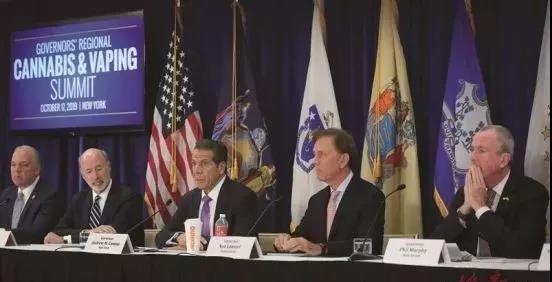 The four governors at the regional summit on cannabis and e-cigarettes. (AP Photo)
Lamont said, "Different states will have different timelines" to pass corresponding legislation, and it is almost impossible for different states to launch completely consistent legislation at the same time. Relevant government officials from different states will continue to cooperate on this project.
Regarding e-cigarettes, Lamont stated that given the significant appeal of e-cigarettes to teenagers and the increasing number of lung disease cases caused by vaping, there should be a consensus among most officials to ban flavored e-cigarettes within the next year.
Earlier this month, New York Governor Andrew Cuomo attempted to implement a 90-day emergency ban on e-cigarette products, but it was temporarily blocked by an appeals court due to a lawsuit from the e-cigarette industry against the ban. In Massachusetts, Republican Governor Charlie Baker announced a statewide ban on the sale of e-cigarette products last month, which has also faced legal challenges. Meanwhile, a new law recently took effect in Connecticut, raising the minimum age for purchasing e-cigarette products to 21.
Cuomo stated that the federal government has been inactive in regulating cannabis and e-cigarettes, which means states need to take action.
Last year, several governors pushed for the sale of recreational cannabis but were unsuccessful. Officials from these four states are discussing the next steps.
Cuomo noted that the use of cannabis is widespread, so states should consider this when contemplating the legalization of recreational cannabis.
According to ACB7, the crisis surrounding cannabis and e-cigarettes has led to over thirty deaths. Following the death of a 17-year-old boy from the Bronx due to vaping, calls to ban e-cigarettes have increased.
According to the latest data released by the Centers for Disease Control and Prevention (CDC) on Thursday, there have been 1,479 reported cases related to e-cigarettes across the US, with 33 deaths. Most patients are males under 35, many of whom reported using e-cigarette products containing THC. The ages of the publicly reported death cases range from 17 to 71 years old.
On the same day, the e-cigarette brand Juul announced it would stop selling flavored e-cigarette oils in the US and acknowledged the public's "lack of trust" in the e-cigarette industry. Health department officials urged people to stop smoking, and the CDC is also committed to studying the link between vaping and fatal lung diseases. A recent survey showed that one in four high school students smoke at least once a month, with more teenagers becoming addicted to smoking.
Note: Content sourced from the American Urban Network, for reference only.
According to CBS News, Connecticut Governor Ned Lamont stated at the meeting: "What we want to do is coordinate this work across these states, and pointed out that 'the implementation of cannabis regulations in certain fragmented areas makes no sense at all.'" He mentioned that the group proposed a "very preliminary" plan on how to regulate legalized recreational cannabis, suggesting that states should adopt consistent policies regarding THC content, edibility, advertising, and taxation, so that the public does not need to purchase related products on the black market.
The four governors at the regional summit on cannabis and e-cigarettes. (AP Photo)Lamont said, "Different states will have different timelines" to pass corresponding legislation, and it is almost impossible for different states to launch completely consistent legislation at the same time. Relevant government officials from different states will continue to cooperate on this project.
Regarding e-cigarettes, Lamont stated that given the significant appeal of e-cigarettes to teenagers and the increasing number of lung disease cases caused by vaping, there should be a consensus among most officials to ban flavored e-cigarettes within the next year.
Earlier this month, New York Governor Andrew Cuomo attempted to implement a 90-day emergency ban on e-cigarette products, but it was temporarily blocked by an appeals court due to a lawsuit from the e-cigarette industry against the ban. In Massachusetts, Republican Governor Charlie Baker announced a statewide ban on the sale of e-cigarette products last month, which has also faced legal challenges. Meanwhile, a new law recently took effect in Connecticut, raising the minimum age for purchasing e-cigarette products to 21.
Cuomo stated that the federal government has been inactive in regulating cannabis and e-cigarettes, which means states need to take action.
Last year, several governors pushed for the sale of recreational cannabis but were unsuccessful. Officials from these four states are discussing the next steps.
Cuomo noted that the use of cannabis is widespread, so states should consider this when contemplating the legalization of recreational cannabis.
According to ACB7, the crisis surrounding cannabis and e-cigarettes has led to over thirty deaths. Following the death of a 17-year-old boy from the Bronx due to vaping, calls to ban e-cigarettes have increased.
According to the latest data released by the Centers for Disease Control and Prevention (CDC) on Thursday, there have been 1,479 reported cases related to e-cigarettes across the US, with 33 deaths. Most patients are males under 35, many of whom reported using e-cigarette products containing THC. The ages of the publicly reported death cases range from 17 to 71 years old.
On the same day, the e-cigarette brand Juul announced it would stop selling flavored e-cigarette oils in the US and acknowledged the public's "lack of trust" in the e-cigarette industry. Health department officials urged people to stop smoking, and the CDC is also committed to studying the link between vaping and fatal lung diseases. A recent survey showed that one in four high school students smoke at least once a month, with more teenagers becoming addicted to smoking.
Note: Content sourced from the American Urban Network, for reference only.
Related Articles

Vaping News
Ahead of a Nationwide Ban, Hundreds of Russian Retailers Voluntarily Stop Selling Vapes
2026-04-16

Vaping News
Illegal Vape Brands Try to Evade FDA Scrutiny by Posing as “Made in the USA”
2026-04-08

Vaping News
Jordan’s New Tobacco Control Rules: Waterpipe Tobacco Market Set for Major Changes
2026-03-17