
The Health Commission Is Busy Regulating Vaping
At 4 p.m. on July 22, two breaking news reports published by The Beijing News began trending. The first, titled 'National Health Commission: studying legislation to regulate e-cigarettes,' stated as follows: Beijing News Express (Reporter Xu Wen) — the he
On July 22 at 4 PM, two breaking news reports from the Beijing News gained significant attention.
The first report stated, "National Health Commission: Researching Legislative Regulation of E-Cigarettes." The original text is as follows:
"Beijing News reported (Reporter Xu Wen) that the health hazards of e-cigarettes are increasingly drawing attention. Mao Qun'an, Director of the Planning Department of the National Health Commission, revealed today (July 22) at a press conference that the National Health Commission is conducting research on e-cigarette regulation in collaboration with relevant departments, planning to regulate e-cigarettes through legislation.
Regarding the health hazards of e-cigarettes, Mao Qun'an stated that the aerosol produced by e-cigarettes contains many toxic and harmful substances, and the unclear labeling of nicotine content can lead to excessive consumption by smokers. Additionally, e-cigarettes pose risks of explosion and burns.
He noted that e-cigarette usage in China is at a relatively low level, but according to a 2018 survey by the Chinese Center for Disease Control and Prevention, the proportions of people who have heard of, previously used, and currently use e-cigarettes have all increased compared to 2015. The use of e-cigarettes can easily lead to traditional tobacco use among young people, accelerating the trend of younger smokers.
Mao Qun'an emphasized that, in light of this, strict regulation of e-cigarettes must be strengthened. He revealed that the National Health Commission is currently conducting research on e-cigarette regulation and plans to regulate e-cigarettes through legislation."
The second report stated, "National Health Commission: Researching the Possibility of Adjusting Tobacco Taxes and Prices in Collaboration with Relevant Departments." The original text is as follows:
"Beijing News reported (Reporter Xu Wen) that the State Council recently issued opinions on implementing the Healthy China Initiative, proposing to control smoking through comprehensive measures such as taxation and price adjustments. Mao Qun'an, Director of the Planning Department of the National Health Commission, responded today (July 22) that they will collaborate with relevant departments to further study the possibility of tax and price adjustments.
Mao Qun'an stated that, in fact, China conducted a tobacco tax and price adjustment in 2015, which was the fourth adjustment of tobacco taxes in the country. Through tax and price adjustments, tobacco consumption was reduced.
He revealed that the National Health Commission recently held a seminar on reducing tobacco consumption with the World Health Organization, inviting international and domestic experts to discuss, "Currently, we are discussing with international organizations and experts about tobacco consumption and the possibility of tax and price adjustments, as this involves adjustments to fiscal and tax policies. The National Health Commission will actively support this, and we will collaborate with relevant departments to further study the possibility of tax and price adjustments."
So, who is the National Health Commission?
The full name of the National Health Commission is the National Health Commission of the People's Republic of China, which is mainly responsible for formulating national health policies, coordinating and promoting the deepening of medical and health system reforms, organizing the formulation of the national essential drug system, supervising and managing public health, medical services, and health emergencies, and is responsible for family planning management and services, as well as formulating policies and measures to address population aging and the integration of medical care and nursing.
What is the relationship between the National Health Commission and e-cigarettes?
First, let's discuss its relationship with tobacco. The National Health Commission also has a responsibility in the tobacco sector, which is to "lead the implementation of the Framework Convention on Tobacco Control."
For a long time, the leadership position of the implementation group for the Framework Convention on Tobacco Control has been occupied by the higher-level industrial departments representing the tobacco industry, which has often been a target of criticism for ineffective tobacco control.
The Framework Convention on Tobacco Control was approved by the World Health Assembly in May 2003. China officially signed the convention on November 10, 2003. The convention came into effect in China in January 2006.
Sixteen months after the convention took effect in China, in April 2007, the State Council approved the establishment of the inter-ministerial coordination leadership group for the implementation of the Framework Convention on Tobacco Control (referred to as the implementation group). Initially, the implementation group included eight departments, with the National Development and Reform Commission as the leading unit, and the Ministry of Health and the Ministry of Foreign Affairs as deputy leading units, with member units including the Ministry of Finance, the General Administration of Customs (Anti-Smuggling Bureau), the former General Administration of Industry and Commerce, the former General Administration of Quality Supervision, Inspection and Quarantine, and the Tobacco Bureau.
At that time, the Tobacco Monopoly Bureau was under the National Development and Reform Commission. In January 1984, the State Council restructured the Ministry of Light Industry's Tobacco Monopoly Bureau into the National Tobacco Monopoly Bureau, which operates under the China National Tobacco Corporation. Subsequently, the National Tobacco Monopoly Bureau was transferred to the National Economic and Trade Commission and then to the National Development and Reform Commission.
In 2008, the State Council's institutional reform established the Ministry of Industry and Information Technology, and the National Tobacco Monopoly Bureau has been managed by the Ministry of Industry and Information Technology ever since. The leading unit of the implementation group was also changed to the Ministry of Industry and Information Technology, while the National Development and Reform Commission withdrew from the list of tobacco control implementation groups.
China's government joining the Framework Convention on Tobacco Control is a demonstration of support for tobacco control, but for more than a decade, the main leading department responsible for implementation has been the higher-level industrial department affiliated with the Tobacco Monopoly Bureau.
It wasn't until March 2018 that the State Council's institutional reform made another adjustment, transferring the implementation functions of the convention led by the Ministry of Industry and Information Technology to the National Health Commission. The health department's role shifted from a deputy leading unit to a leading unit, achieving one of the tobacco control community's long-standing goals.
This decision means that China's tobacco control implementation group is gradually being liberated from tobacco interests and returning to the public health sector. A health department-led implementation group is expected to have the opportunity to completely free itself from tobacco industry interference and to formulate and implement comprehensive measures for national tobacco control legislation, tobacco tax and price adjustments, graphic warnings on tobacco packaging, and more.
As a nicotine delivery system, e-cigarettes have not yet been clearly defined as electronic products, drugs, or tobacco products, but they still fall under the management of tobacco control agencies, and signatory countries must adhere to the Framework Convention on Tobacco Control.
Looking back at the recent industry hot topic of "National Standards for E-Cigarettes."
According to information provided by the National Standard Information Service Platform, the implementation unit and supervisory department for the "National Standards for E-Cigarettes" belong to the "National Tobacco Monopoly Bureau," which is the former implementation group mentioned earlier and does not have a direct subordinate relationship with the National Health Commission that held the press conference today.
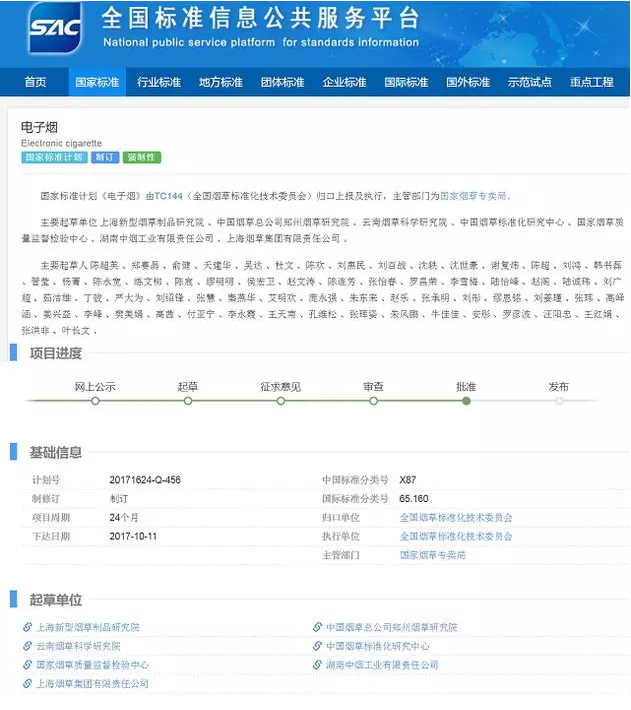
The national standards mainly regulate e-cigarette devices, e-liquid, and emissions. The national standards are currently in the review stage. The implementation of national standards will bring the e-cigarette industry back to focus on products and services themselves.
The National Tobacco Bureau oversees the "national standards," while the National Health Commission is responsible for "regulation." Who will hold the future discourse power over e-cigarettes?
For traditional tobacco and e-cigarettes, health is the foundation of policy formulation and the ethical high ground, while taxation influences the speed and intensity of policy implementation.
The potential risks of e-cigarettes cannot be ignored, but these risks are controllable and based on the harm reduction of new tobacco products. Policies will become a new challenge for the fate of e-cigarettes, as well as a new hope.
The first report stated, "National Health Commission: Researching Legislative Regulation of E-Cigarettes." The original text is as follows:
"Beijing News reported (Reporter Xu Wen) that the health hazards of e-cigarettes are increasingly drawing attention. Mao Qun'an, Director of the Planning Department of the National Health Commission, revealed today (July 22) at a press conference that the National Health Commission is conducting research on e-cigarette regulation in collaboration with relevant departments, planning to regulate e-cigarettes through legislation.
Regarding the health hazards of e-cigarettes, Mao Qun'an stated that the aerosol produced by e-cigarettes contains many toxic and harmful substances, and the unclear labeling of nicotine content can lead to excessive consumption by smokers. Additionally, e-cigarettes pose risks of explosion and burns.
He noted that e-cigarette usage in China is at a relatively low level, but according to a 2018 survey by the Chinese Center for Disease Control and Prevention, the proportions of people who have heard of, previously used, and currently use e-cigarettes have all increased compared to 2015. The use of e-cigarettes can easily lead to traditional tobacco use among young people, accelerating the trend of younger smokers.
Mao Qun'an emphasized that, in light of this, strict regulation of e-cigarettes must be strengthened. He revealed that the National Health Commission is currently conducting research on e-cigarette regulation and plans to regulate e-cigarettes through legislation."
The second report stated, "National Health Commission: Researching the Possibility of Adjusting Tobacco Taxes and Prices in Collaboration with Relevant Departments." The original text is as follows:
"Beijing News reported (Reporter Xu Wen) that the State Council recently issued opinions on implementing the Healthy China Initiative, proposing to control smoking through comprehensive measures such as taxation and price adjustments. Mao Qun'an, Director of the Planning Department of the National Health Commission, responded today (July 22) that they will collaborate with relevant departments to further study the possibility of tax and price adjustments.
Mao Qun'an stated that, in fact, China conducted a tobacco tax and price adjustment in 2015, which was the fourth adjustment of tobacco taxes in the country. Through tax and price adjustments, tobacco consumption was reduced.
He revealed that the National Health Commission recently held a seminar on reducing tobacco consumption with the World Health Organization, inviting international and domestic experts to discuss, "Currently, we are discussing with international organizations and experts about tobacco consumption and the possibility of tax and price adjustments, as this involves adjustments to fiscal and tax policies. The National Health Commission will actively support this, and we will collaborate with relevant departments to further study the possibility of tax and price adjustments."
So, who is the National Health Commission?
The full name of the National Health Commission is the National Health Commission of the People's Republic of China, which is mainly responsible for formulating national health policies, coordinating and promoting the deepening of medical and health system reforms, organizing the formulation of the national essential drug system, supervising and managing public health, medical services, and health emergencies, and is responsible for family planning management and services, as well as formulating policies and measures to address population aging and the integration of medical care and nursing.
What is the relationship between the National Health Commission and e-cigarettes?
First, let's discuss its relationship with tobacco. The National Health Commission also has a responsibility in the tobacco sector, which is to "lead the implementation of the Framework Convention on Tobacco Control."
For a long time, the leadership position of the implementation group for the Framework Convention on Tobacco Control has been occupied by the higher-level industrial departments representing the tobacco industry, which has often been a target of criticism for ineffective tobacco control.
The Framework Convention on Tobacco Control was approved by the World Health Assembly in May 2003. China officially signed the convention on November 10, 2003. The convention came into effect in China in January 2006.
Sixteen months after the convention took effect in China, in April 2007, the State Council approved the establishment of the inter-ministerial coordination leadership group for the implementation of the Framework Convention on Tobacco Control (referred to as the implementation group). Initially, the implementation group included eight departments, with the National Development and Reform Commission as the leading unit, and the Ministry of Health and the Ministry of Foreign Affairs as deputy leading units, with member units including the Ministry of Finance, the General Administration of Customs (Anti-Smuggling Bureau), the former General Administration of Industry and Commerce, the former General Administration of Quality Supervision, Inspection and Quarantine, and the Tobacco Bureau.
At that time, the Tobacco Monopoly Bureau was under the National Development and Reform Commission. In January 1984, the State Council restructured the Ministry of Light Industry's Tobacco Monopoly Bureau into the National Tobacco Monopoly Bureau, which operates under the China National Tobacco Corporation. Subsequently, the National Tobacco Monopoly Bureau was transferred to the National Economic and Trade Commission and then to the National Development and Reform Commission.
In 2008, the State Council's institutional reform established the Ministry of Industry and Information Technology, and the National Tobacco Monopoly Bureau has been managed by the Ministry of Industry and Information Technology ever since. The leading unit of the implementation group was also changed to the Ministry of Industry and Information Technology, while the National Development and Reform Commission withdrew from the list of tobacco control implementation groups.
China's government joining the Framework Convention on Tobacco Control is a demonstration of support for tobacco control, but for more than a decade, the main leading department responsible for implementation has been the higher-level industrial department affiliated with the Tobacco Monopoly Bureau.
It wasn't until March 2018 that the State Council's institutional reform made another adjustment, transferring the implementation functions of the convention led by the Ministry of Industry and Information Technology to the National Health Commission. The health department's role shifted from a deputy leading unit to a leading unit, achieving one of the tobacco control community's long-standing goals.
This decision means that China's tobacco control implementation group is gradually being liberated from tobacco interests and returning to the public health sector. A health department-led implementation group is expected to have the opportunity to completely free itself from tobacco industry interference and to formulate and implement comprehensive measures for national tobacco control legislation, tobacco tax and price adjustments, graphic warnings on tobacco packaging, and more.
As a nicotine delivery system, e-cigarettes have not yet been clearly defined as electronic products, drugs, or tobacco products, but they still fall under the management of tobacco control agencies, and signatory countries must adhere to the Framework Convention on Tobacco Control.
Looking back at the recent industry hot topic of "National Standards for E-Cigarettes."
According to information provided by the National Standard Information Service Platform, the implementation unit and supervisory department for the "National Standards for E-Cigarettes" belong to the "National Tobacco Monopoly Bureau," which is the former implementation group mentioned earlier and does not have a direct subordinate relationship with the National Health Commission that held the press conference today.
The national standards mainly regulate e-cigarette devices, e-liquid, and emissions. The national standards are currently in the review stage. The implementation of national standards will bring the e-cigarette industry back to focus on products and services themselves.
The National Tobacco Bureau oversees the "national standards," while the National Health Commission is responsible for "regulation." Who will hold the future discourse power over e-cigarettes?
For traditional tobacco and e-cigarettes, health is the foundation of policy formulation and the ethical high ground, while taxation influences the speed and intensity of policy implementation.
The potential risks of e-cigarettes cannot be ignored, but these risks are controllable and based on the harm reduction of new tobacco products. Policies will become a new challenge for the fate of e-cigarettes, as well as a new hope.
Related Articles

Vaping News
Ahead of a Nationwide Ban, Hundreds of Russian Retailers Voluntarily Stop Selling Vapes
2026-04-16

Vaping News
Illegal Vape Brands Try to Evade FDA Scrutiny by Posing as “Made in the USA”
2026-04-08

Vaping News
Jordan’s New Tobacco Control Rules: Waterpipe Tobacco Market Set for Major Changes
2026-03-17