
China Tobacco Hong Kong Shares Surge as Vaping Funding Heats Up
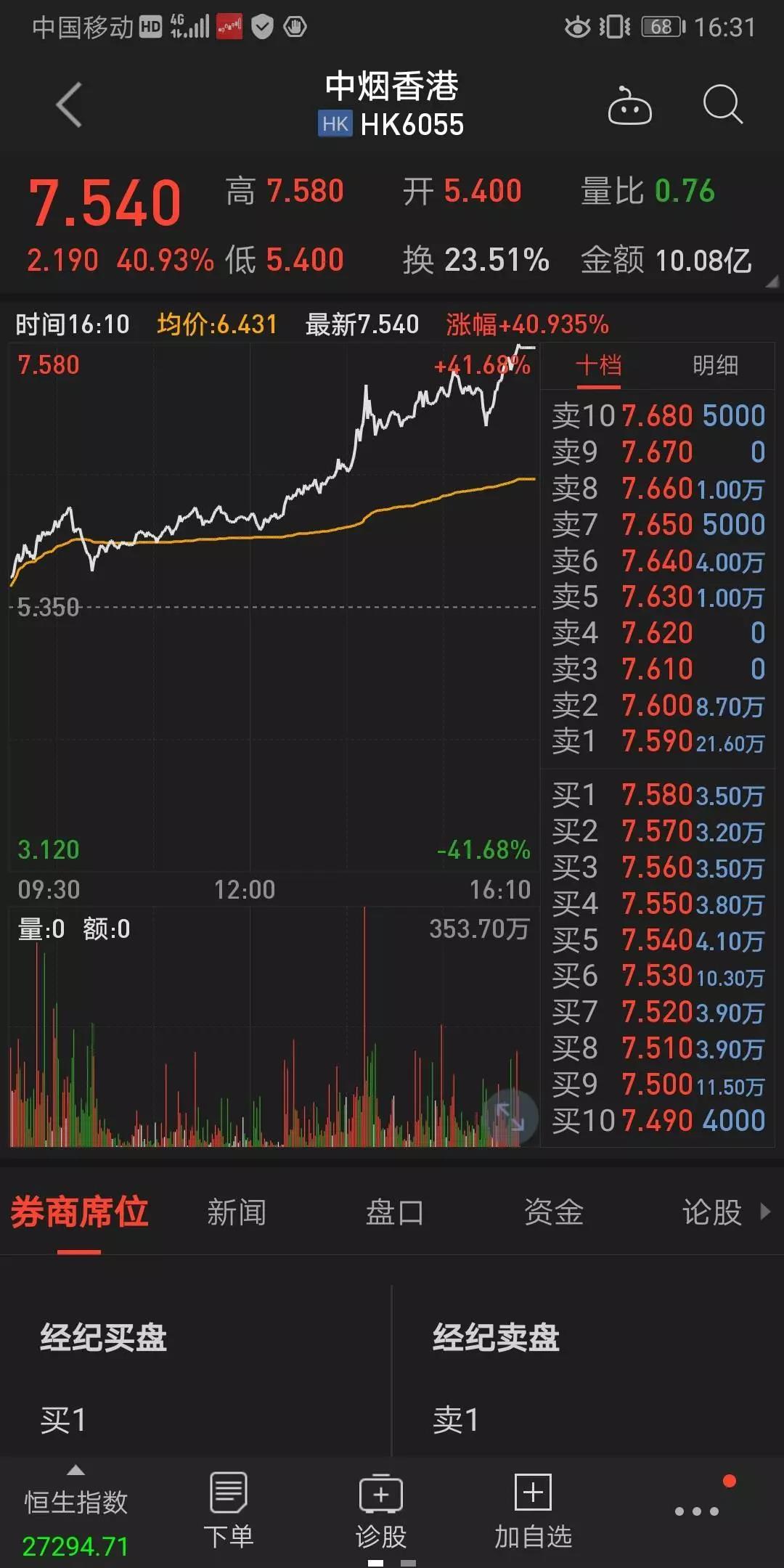
On June 12, China Tobacco Hong Kong (06055.HK) was listed on the main board of the Hong Kong Stock Exchange, with its share price once surging nearly 20%. With average revenue generated per employee exceeding HK$250 million and average annual pay nearing
On June 12, China Tobacco Hong Kong (06055.HK) was listed on the main board of the Hong Kong Stock Exchange, with its stock price soaring nearly 20% at one point. The company generates over 250 million HKD in revenue per capita, with an average annual salary of nearly 1 million HKD. How did China Tobacco Hong Kong achieve this?
Backed by over 300 million smokers in China and nearly monopolizing the business, it possesses strong bargaining power over upstream and downstream operations, which may be key factors in its success.
China Tobacco Hong Kong's share issue price was 4.88 HKD per share, raising a net amount of approximately 735 million HKD. According to media reports, during the listing ceremony, Zhao Jianmin, the general manager of China Tobacco Hong Kong, expressed gratitude to investors for recognizing the company's value and favoring its stock. The listing marks a solid step for Chinese tobacco to expand overseas and opens up more financing channels.
Public information shows that China Tobacco Hong Kong is the designated overseas platform responsible for capital market operations and international business expansion for China Tobacco International, which is a wholly-owned subsidiary of the China National Tobacco Corporation (CNTC), responsible for managing and operating the international business of CNTC. The CNTC group is the only entity in China engaged in the production, sale, and import/export of tobacco products according to the national tobacco monopoly system.
According to the prospectus, as of the end of 2018, China Tobacco Hong Kong had only 28 employees in Hong Kong, including 5 senior management personnel, with a total employee cost of approximately 25.914 million HKD, resulting in an average annual salary of nearly 1 million HKD. Based on an operating revenue of 7.033 billion HKD, the company generates over 250 million HKD in revenue per capita.
In discussing its "competitive advantages" in the prospectus, China Tobacco Hong Kong stated: "We are the exclusive operating entity in the business areas we are engaged in." "We have strong bargaining power with suppliers and customers, and we have sufficient cash flow."
The prospectus indicates that China Tobacco Hong Kong's exclusive business operations include "import business of tobacco leaf products": "We mainly procure tobacco leaf products from original countries or regions around the world (such as Brazil, the USA, Argentina, Canada, Zambia, etc.) and sell imported tobacco leaf products to China Tobacco International for resale to Chinese cigarette manufacturers."
Regarding the "export business of tobacco leaf products": "We are the exclusive operating entity for the export business of tobacco leaf products to Southeast Asia, Taiwan, Hong Kong, and Macau." This includes the export of cigarette products to duty-free shops in Thailand, Singapore, and other markets, as well as the export of new tobacco products to global markets.
From 2016 to 2018, China Tobacco Hong Kong's revenues were approximately 6.31 billion HKD, 7.807 billion HKD, and 7.033 billion HKD, with profits attributable to equity holders of approximately 335 million HKD, 344 million HKD, and 259 million HKD, respectively; net cash from operating activities was approximately 53.9 million HKD, 359 million HKD, and 758 million HKD; and return on equity was 21.1%, 15.9%, and 18.2%, respectively.
Analyst Li Yunyi from Anxin International stated that the global tobacco market is currently dominated by traditional tobacco products such as cigarettes, pipe tobacco, and cigars, while emerging tobacco products like electronic cigarettes and non-combustible tobacco products are becoming increasingly popular worldwide. In recent years, the global anti-smoking movement has intensified, putting pressure on the consumption of tobacco products. China has the largest number of smokers in the world, with 306 million in 2018, and cigarette sales reached 1.4405 trillion yuan, accounting for 44.6% of global cigarette consumption. As disposable income continues to rise, it drives the upgrade of tobacco product consumption in China, optimizing the structure of the tobacco market, and increasing the consumption of high-end tobacco products.
According to Zhongtai International, due to the restrictions of the national tobacco monopoly system, currently only the China National Tobacco Corporation and its directly affiliated companies are authorized to monopolize the tobacco trade in China. Although anti-smoking campaigns have strengthened globally in recent years, the number of smokers remains substantial, creating a rigid demand in China, and the monopoly position is solid, with no market competition in the short term.
However, with the listing of China Tobacco Hong Kong driving up the stock prices of some companies related to the tobacco business, electronic cigarettes may become its most formidable competitor, thus attracting significant "attention." This attention partly stems from mainstream media's suppression, exemplified by the 315 incident this year, where major media outlets ignored research conclusions from the UK Department of Health and developed countries like Japan that electronic cigarettes are relatively less harmful than traditional cigarettes, and without systematic data to support their claims, they have aimed their criticism at electronic cigarettes. As Lu Xun once said: "I have always been skeptical of the worst intentions of the Chinese people, yet I did not expect them to be so cruel."
On the other hand, compared to the media's malice, capital with an international perspective is more calmly recognizing the future. Since the beginning of this year, several electronic cigarette companies have announced the completion of financing, significantly increasing the investment heat in the electronic cigarette industry.
Multiple Financing Completed
According to IT Juzi data, as of June 2019, there have been 14 financing events for electronic cigarette companies in China, with a total financing amount of approximately 574 million yuan, surpassing the total investment amount for the entire previous year. Among them, FLOW electronic cigarette is a notable company. On May 24, the company announced the completion of angel and Pre-A rounds of financing, with a cumulative amount reaching 10.89 million USD. It is reported that the FLOW electronic cigarette brand was founded by Zhu Xiaomu, former vice president of product at Smartisan Technology, and its founding team members come from companies like Smartisan Technology, Motorola, Huawei, and Ogilvy.
Another institution, Qianzhan Network, reported that Shenzhen Meizhonglian Technology Co., Ltd., which focuses on the electronic cigarette technology manufacturing industry, completed Pre-A round financing of several tens of millions of yuan in June 2019. Meizhonglian Technology Co., Ltd. is dedicated to providing solutions for pod products and was previously a Sino-American joint venture operating as Shenzhen Meizhonglian International Trade Co., Ltd. Additionally, on the evening of June 3, Weike Technology announced that to seek new profit growth points, the company plans to purchase 10% of the equity of Shenzhen Zhuolineng Electronic Co., Ltd., an electronic cigarette supply chain company, from individual Zuo Hong for 100 million yuan.
Low Penetration Rate
The "Market Demand Forecast and Investment Strategy Planning Analysis Report for the Chinese Tobacco Products Industry" released by Qianzhan Industry Research Institute shows that China is the largest production center for electronic cigarettes globally but not the largest consumer country. Currently, the market size of electronic cigarettes in China is around 4 billion yuan. The penetration rate of electronic cigarettes in China is extremely low, with the consumption scale not reaching 15% of that of the largest consumer market, the United States. Although the penetration rate of electronic cigarettes in China is low and the market size is small, as the world's largest production center for electronic cigarettes, the development of the global electronic cigarette market also provides significant development opportunities for Chinese electronic cigarette manufacturing. The report also indicates that it is estimated that by 2017, the number of electronic cigarette consumers worldwide reached 35 million, with sales of electronic cigarettes amounting to approximately 12 billion USD, a 13-fold increase compared to 2010, with a compound annual growth rate of about 45%. The global electronic cigarette market is developing rapidly, with the United States being the largest consumer market. In 2017, the sales of electronic cigarettes in the United States were around 4.63 billion USD, far ahead of other countries.
Some institutions analyze that this year, national standards for electronic cigarette manufacturing and regulation are expected to be implemented, and small and medium-sized brands that do not meet production standards will be eliminated, benefiting leading enterprises with research and development capabilities and standardized production. Moreover, currently, domestic electronic cigarette manufacturing enterprises still focus on exports. For export-oriented enterprises, the introduction of domestic manufacturing standards will increase production costs, and in the future, relying solely on manufacturing for export may lose competitiveness. Enhancing brand strength in the electronic cigarette market may become a way out for domestic electronic cigarette companies, creating their own brands, increasing product added value to offset standardization costs, and improving the international competitiveness of domestic products.
Backed by over 300 million smokers in China and nearly monopolizing the business, it possesses strong bargaining power over upstream and downstream operations, which may be key factors in its success.
China Tobacco Hong Kong's share issue price was 4.88 HKD per share, raising a net amount of approximately 735 million HKD. According to media reports, during the listing ceremony, Zhao Jianmin, the general manager of China Tobacco Hong Kong, expressed gratitude to investors for recognizing the company's value and favoring its stock. The listing marks a solid step for Chinese tobacco to expand overseas and opens up more financing channels.
Public information shows that China Tobacco Hong Kong is the designated overseas platform responsible for capital market operations and international business expansion for China Tobacco International, which is a wholly-owned subsidiary of the China National Tobacco Corporation (CNTC), responsible for managing and operating the international business of CNTC. The CNTC group is the only entity in China engaged in the production, sale, and import/export of tobacco products according to the national tobacco monopoly system.
According to the prospectus, as of the end of 2018, China Tobacco Hong Kong had only 28 employees in Hong Kong, including 5 senior management personnel, with a total employee cost of approximately 25.914 million HKD, resulting in an average annual salary of nearly 1 million HKD. Based on an operating revenue of 7.033 billion HKD, the company generates over 250 million HKD in revenue per capita.
In discussing its "competitive advantages" in the prospectus, China Tobacco Hong Kong stated: "We are the exclusive operating entity in the business areas we are engaged in." "We have strong bargaining power with suppliers and customers, and we have sufficient cash flow."
The prospectus indicates that China Tobacco Hong Kong's exclusive business operations include "import business of tobacco leaf products": "We mainly procure tobacco leaf products from original countries or regions around the world (such as Brazil, the USA, Argentina, Canada, Zambia, etc.) and sell imported tobacco leaf products to China Tobacco International for resale to Chinese cigarette manufacturers."
Regarding the "export business of tobacco leaf products": "We are the exclusive operating entity for the export business of tobacco leaf products to Southeast Asia, Taiwan, Hong Kong, and Macau." This includes the export of cigarette products to duty-free shops in Thailand, Singapore, and other markets, as well as the export of new tobacco products to global markets.
From 2016 to 2018, China Tobacco Hong Kong's revenues were approximately 6.31 billion HKD, 7.807 billion HKD, and 7.033 billion HKD, with profits attributable to equity holders of approximately 335 million HKD, 344 million HKD, and 259 million HKD, respectively; net cash from operating activities was approximately 53.9 million HKD, 359 million HKD, and 758 million HKD; and return on equity was 21.1%, 15.9%, and 18.2%, respectively.
Analyst Li Yunyi from Anxin International stated that the global tobacco market is currently dominated by traditional tobacco products such as cigarettes, pipe tobacco, and cigars, while emerging tobacco products like electronic cigarettes and non-combustible tobacco products are becoming increasingly popular worldwide. In recent years, the global anti-smoking movement has intensified, putting pressure on the consumption of tobacco products. China has the largest number of smokers in the world, with 306 million in 2018, and cigarette sales reached 1.4405 trillion yuan, accounting for 44.6% of global cigarette consumption. As disposable income continues to rise, it drives the upgrade of tobacco product consumption in China, optimizing the structure of the tobacco market, and increasing the consumption of high-end tobacco products.
According to Zhongtai International, due to the restrictions of the national tobacco monopoly system, currently only the China National Tobacco Corporation and its directly affiliated companies are authorized to monopolize the tobacco trade in China. Although anti-smoking campaigns have strengthened globally in recent years, the number of smokers remains substantial, creating a rigid demand in China, and the monopoly position is solid, with no market competition in the short term.
However, with the listing of China Tobacco Hong Kong driving up the stock prices of some companies related to the tobacco business, electronic cigarettes may become its most formidable competitor, thus attracting significant "attention." This attention partly stems from mainstream media's suppression, exemplified by the 315 incident this year, where major media outlets ignored research conclusions from the UK Department of Health and developed countries like Japan that electronic cigarettes are relatively less harmful than traditional cigarettes, and without systematic data to support their claims, they have aimed their criticism at electronic cigarettes. As Lu Xun once said: "I have always been skeptical of the worst intentions of the Chinese people, yet I did not expect them to be so cruel."
On the other hand, compared to the media's malice, capital with an international perspective is more calmly recognizing the future. Since the beginning of this year, several electronic cigarette companies have announced the completion of financing, significantly increasing the investment heat in the electronic cigarette industry.
Multiple Financing Completed
According to IT Juzi data, as of June 2019, there have been 14 financing events for electronic cigarette companies in China, with a total financing amount of approximately 574 million yuan, surpassing the total investment amount for the entire previous year. Among them, FLOW electronic cigarette is a notable company. On May 24, the company announced the completion of angel and Pre-A rounds of financing, with a cumulative amount reaching 10.89 million USD. It is reported that the FLOW electronic cigarette brand was founded by Zhu Xiaomu, former vice president of product at Smartisan Technology, and its founding team members come from companies like Smartisan Technology, Motorola, Huawei, and Ogilvy.
Another institution, Qianzhan Network, reported that Shenzhen Meizhonglian Technology Co., Ltd., which focuses on the electronic cigarette technology manufacturing industry, completed Pre-A round financing of several tens of millions of yuan in June 2019. Meizhonglian Technology Co., Ltd. is dedicated to providing solutions for pod products and was previously a Sino-American joint venture operating as Shenzhen Meizhonglian International Trade Co., Ltd. Additionally, on the evening of June 3, Weike Technology announced that to seek new profit growth points, the company plans to purchase 10% of the equity of Shenzhen Zhuolineng Electronic Co., Ltd., an electronic cigarette supply chain company, from individual Zuo Hong for 100 million yuan.
Low Penetration Rate
The "Market Demand Forecast and Investment Strategy Planning Analysis Report for the Chinese Tobacco Products Industry" released by Qianzhan Industry Research Institute shows that China is the largest production center for electronic cigarettes globally but not the largest consumer country. Currently, the market size of electronic cigarettes in China is around 4 billion yuan. The penetration rate of electronic cigarettes in China is extremely low, with the consumption scale not reaching 15% of that of the largest consumer market, the United States. Although the penetration rate of electronic cigarettes in China is low and the market size is small, as the world's largest production center for electronic cigarettes, the development of the global electronic cigarette market also provides significant development opportunities for Chinese electronic cigarette manufacturing. The report also indicates that it is estimated that by 2017, the number of electronic cigarette consumers worldwide reached 35 million, with sales of electronic cigarettes amounting to approximately 12 billion USD, a 13-fold increase compared to 2010, with a compound annual growth rate of about 45%. The global electronic cigarette market is developing rapidly, with the United States being the largest consumer market. In 2017, the sales of electronic cigarettes in the United States were around 4.63 billion USD, far ahead of other countries.
Some institutions analyze that this year, national standards for electronic cigarette manufacturing and regulation are expected to be implemented, and small and medium-sized brands that do not meet production standards will be eliminated, benefiting leading enterprises with research and development capabilities and standardized production. Moreover, currently, domestic electronic cigarette manufacturing enterprises still focus on exports. For export-oriented enterprises, the introduction of domestic manufacturing standards will increase production costs, and in the future, relying solely on manufacturing for export may lose competitiveness. Enhancing brand strength in the electronic cigarette market may become a way out for domestic electronic cigarette companies, creating their own brands, increasing product added value to offset standardization costs, and improving the international competitiveness of domestic products.
Related Articles

Vaping News
Ahead of a Nationwide Ban, Hundreds of Russian Retailers Voluntarily Stop Selling Vapes
2026-04-16

Vaping News
Illegal Vape Brands Try to Evade FDA Scrutiny by Posing as “Made in the USA”
2026-04-08

Vaping News
Jordan’s New Tobacco Control Rules: Waterpipe Tobacco Market Set for Major Changes
2026-03-17