
Which Is More Harmful: Vaping or Cigarettes? A PhD Answers on Zhihu
Which is more harmful, vaping or cigarettes? The answer is relatively clear: in terms of harm, vaping is significantly less harmful than conventional cigarettes. This is also an important reason why vaping was initially used as an alternative to tradition
Which Is More Harmful: Vaping or Cigarettes? A PhD Answers on Zhihu
Is vaping or smoking more harmful? The answer to this question is quite definitive. From a harm perspective, e-cigarettes are clearly less harmful than regular cigarettes, which is one of the main reasons e-cigarettes were initially used as a substitute for traditional cigarettes to treat nicotine addiction. As the saying goes, when faced with two evils, choose the lesser one. So, some users may ask why e-cigarettes are less harmful than regular cigarettes?
In terms of harm, e-cigarettes and regular cigarettes have two main differences: the composition of tobacco and the method of vaporization. Today, let's discuss these in detail.
1. From a composition perspective, e-cigarettes are far less harmful than regular cigarettes.
Tar
The most harmful component of regular cigarettes is tar, which refers to the brown oily substance that remains in the cigarette filter during smoking, commonly known as cigarette oil. A very visual change during smoking is that the filter darkens with each puff, and the fingers holding the cigarette also become discolored. Of course, the teeth also get stained after smoking, and the root cause of this is tar.

Tar is not just about discoloration; in fact, it is a product of incomplete combustion of organic matter under low oxygen conditions, containing many harmful substances, many of which are carcinogenic, such as benzo[a]pyrene, cadmium, arsenic, beta-naphthylamine, nitrosamines, and other carcinogenic substances, as well as phenolic compounds and fumaric acid, which promote cancer. For this reason, regular tobacco has been classified as a Group 1 carcinogen by the International Agency for Research on Cancer under the World Health Organization, meaning it is clearly carcinogenic. Additionally, tar accelerates the aging of blood vessels in the human body, leading to gradual hardening and loss of elasticity, resulting in cardiovascular diseases. Many other diseases are often caused by tar, which is why doctors often recommend quitting smoking for many illnesses.
So, is tar unavoidable? The answer is basically yes; tar is unavoidable. Someone once became an academician in tobacco research by reducing tar, but faced massive opposition, including hundreds of academicians jointly writing to the state requesting the cancellation of his qualification. Yang Gonghuan, director of the Chinese Tobacco Control Office, stated that the "harm reduction and tar reduction" method for cigarettes is a deadly scam. Numerous studies at home and abroad have shown that "low tar" does not mean "low harm"; the idea of "reducing tar to reduce harm" is itself a fallacy, and any results based on this premise are untenable. Moreover, low tar leads to users smoking more, ultimately increasing harm.
So, do e-cigarettes contain tar? The answer is no; one of the biggest advantages of e-cigarettes is that they do not contain tar, instead using safe VG (glycerin) and PG (propylene glycol) as substitutes. Both are common organic solvents, and you can find these ingredients in skincare products, making them very safe components. At least, there is currently no sufficient evidence to suggest they are harmful.
Nicotine
Nicotine is another important component of tobacco and is well-known as a tobacco component. Nicotine, commonly known as nicotine, does not pose as severe physiological harm as tar does, but it has a troublesome issue: its addictive nature. Nicotine can lead to addiction, which is why it is difficult for smokers to quit. In this regard, both e-cigarettes and regular cigarettes contain nicotine. However, there are differences because the nicotine in regular tobacco is a product secreted during the growth of the tobacco plant, making it very difficult to reduce nicotine in regular tobacco (since tobacco undergoes physical processing, nicotine does not decrease; if chemical methods are used to reduce nicotine, it will inevitably change the flavor of the tobacco, affecting its sales). In contrast, e-cigarettes can control the nicotine content since nicotine is added directly, and it can even be made to contain 0 nicotine.
Of course, some may recall that during the 315 event this year, CCTV mentioned that e-cigarettes had excessive formaldehyde. I had previously written a counter-response because CCTV's claim compared e-cigarettes to regular air. If we compare e-cigarettes to tobacco, the answer is still that regular cigarettes are more harmful. In fact, the combustion of regular cigarettes produces high concentrations of formaldehyde, which gives the impression of a wolf questioning a fox.

Moreover, the presence of formaldehyde is mainly due to substandard e-liquids. Of course, at present, there are no national standards for e-cigarettes, so when purchasing, one can only choose brands recognized by many e-cigarette companies.
#p#分页标题#e#
In addition to the aforementioned chemical composition differences, there is another important difference between regular cigarettes and e-cigarettes: vaporization.
Combustion vs. Vaporization
We know that regular cigarettes require combustion to be smoked, and this combustion process is also when a large number of harmful substances are generated. It is well known that combustion is a chemical reaction process; regular tobacco, after combustion, produces a large number of substances. Since the combustion of tobacco is not uniform, the temperature varies greatly in different locations, leading to diverse chemical reaction conditions, thus resulting in the production of many harmful substances, which is a major factor in the harm of tobacco.
E-cigarettes, on the other hand, do not burn but simply heat and vaporize. Generally, the vaporization temperature of e-cigarettes is controlled between 250-350°C, and some e-cigarettes can even achieve low-temperature vaporization at 220-250°C, which is much lower than the 700-800°C of regular tobacco, greatly reducing the harm of e-cigarettes and lowering the generation of harmful substances. This is another important reason why e-cigarettes are less harmful.

Additionally, the generation of particulate matter is also an important factor. In recent years, the impact of haze has made us more aware of environmental protection and health. We have come to understand that there is a substance called suspended particles, which are very harmful, such as PM2.5, which are particles with a diameter around 2.5μm that can enter the body and cause serious harm, such as cardiovascular diseases. The combustion of traditional tobacco produces a large amount of solid suspended particulate matter. The following image shows the contribution of tobacco combustion to indoor particulate pollution, where we can see that after tobacco consumption, there is a tenfold increase in particulate matter from PM1.0 to PM10. These solid particles are inhaled into the body, adhering to the throat, trachea, lungs, etc., and cannot be decomposed. Over the years, this can lead to irreversible diseases such as throat cancer, tracheal cancer, and lung cancer.

In contrast, e-cigarettes can also produce particles during vaporization, but these particles are liquid particles that can be absorbed or expelled by the body. For example, the clinical use of nebulization for medication is based on this principle, where the nebulized medication is absorbed by the body. Moreover, advancements in modern vaporization technology have improved the level of vaporization; for instance, McWell's FEELM can achieve 1μm vaporization, meaning that the vapor produced does not contain particulate matter in the PM1-PM10 range, thus not causing solid particle damage to individuals.
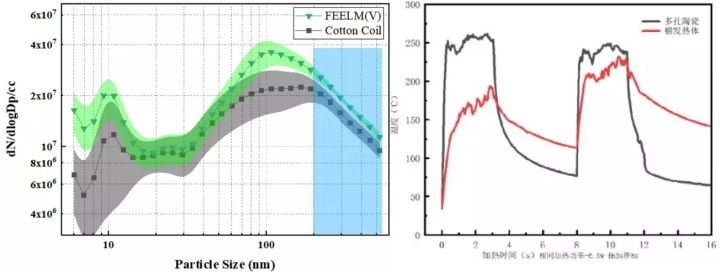
Of course, the vaporization materials themselves also significantly affect the harmful substance emissions of e-cigarettes and the vaping experience. The following image shows the development history of e-cigarette vaporization technology, from fiber ropes, organic cotton, stainless steel mesh to today's porous ceramic heating elements, showcasing different stages of development.

These improvements not only enhance the vaping experience (left image) but also reduce the release of harmful substances from e-cigarettes (right image). For example, porous ceramics have higher thermal conductivity, thus reducing vaporization time.
At this point, from an intuitive perspective, we can see that e-cigarettes are much less harmful than regular cigarettes, reflected in:
1. Regular cigarettes contain harmful tar, while e-cigarettes do not.
2. The nicotine content in regular cigarettes is fixed and difficult to eliminate, while the nicotine in e-cigarettes is an added component that can be adjusted to different concentrations.
3. Regular cigarette combustion produces a large amount of indigestible solid particulate matter like PM2.5 that accumulates in the throat, trachea, and lungs, causing harm to the body, while e-cigarette technology produces liquid particles that can be absorbed or expelled by the body, essentially not causing particulate harm.
For these reasons, the emergence of e-cigarettes serves as a substitute for regular cigarettes. The benefits include reducing health damage from harmful substances like tar in regular cigarettes for those unable to quit smoking; on the other hand, the components of e-cigarettes can be controlled, such as continuously lowering nicotine content, thereby reducing dependence on nicotine and facilitating quitting. Thus, they are used for smoking cessation.
#p#分页标题#e#
Is vaping or smoking more harmful? Of course, it should be noted that neither regular tobacco nor e-cigarettes are harmless; it is merely a matter of choosing the lesser of two evils. Not smoking is the best option, and we must resolutely prevent youth from smoking, even e-cigarettes.
This article is reproduced from Zhihu, with the answer by user Li Lei, and copyright belongs to the author. For commercial reproduction, please contact the author for authorization; for non-commercial reproduction, please indicate the source.
Is vaping or smoking more harmful? The answer to this question is quite definitive. From a harm perspective, e-cigarettes are clearly less harmful than regular cigarettes, which is one of the main reasons e-cigarettes were initially used as a substitute for traditional cigarettes to treat nicotine addiction. As the saying goes, when faced with two evils, choose the lesser one. So, some users may ask why e-cigarettes are less harmful than regular cigarettes?
In terms of harm, e-cigarettes and regular cigarettes have two main differences: the composition of tobacco and the method of vaporization. Today, let's discuss these in detail.
1. From a composition perspective, e-cigarettes are far less harmful than regular cigarettes.
Tar
The most harmful component of regular cigarettes is tar, which refers to the brown oily substance that remains in the cigarette filter during smoking, commonly known as cigarette oil. A very visual change during smoking is that the filter darkens with each puff, and the fingers holding the cigarette also become discolored. Of course, the teeth also get stained after smoking, and the root cause of this is tar.
Tar is not just about discoloration; in fact, it is a product of incomplete combustion of organic matter under low oxygen conditions, containing many harmful substances, many of which are carcinogenic, such as benzo[a]pyrene, cadmium, arsenic, beta-naphthylamine, nitrosamines, and other carcinogenic substances, as well as phenolic compounds and fumaric acid, which promote cancer. For this reason, regular tobacco has been classified as a Group 1 carcinogen by the International Agency for Research on Cancer under the World Health Organization, meaning it is clearly carcinogenic. Additionally, tar accelerates the aging of blood vessels in the human body, leading to gradual hardening and loss of elasticity, resulting in cardiovascular diseases. Many other diseases are often caused by tar, which is why doctors often recommend quitting smoking for many illnesses.
So, is tar unavoidable? The answer is basically yes; tar is unavoidable. Someone once became an academician in tobacco research by reducing tar, but faced massive opposition, including hundreds of academicians jointly writing to the state requesting the cancellation of his qualification. Yang Gonghuan, director of the Chinese Tobacco Control Office, stated that the "harm reduction and tar reduction" method for cigarettes is a deadly scam. Numerous studies at home and abroad have shown that "low tar" does not mean "low harm"; the idea of "reducing tar to reduce harm" is itself a fallacy, and any results based on this premise are untenable. Moreover, low tar leads to users smoking more, ultimately increasing harm.
So, do e-cigarettes contain tar? The answer is no; one of the biggest advantages of e-cigarettes is that they do not contain tar, instead using safe VG (glycerin) and PG (propylene glycol) as substitutes. Both are common organic solvents, and you can find these ingredients in skincare products, making them very safe components. At least, there is currently no sufficient evidence to suggest they are harmful.
Nicotine
Nicotine is another important component of tobacco and is well-known as a tobacco component. Nicotine, commonly known as nicotine, does not pose as severe physiological harm as tar does, but it has a troublesome issue: its addictive nature. Nicotine can lead to addiction, which is why it is difficult for smokers to quit. In this regard, both e-cigarettes and regular cigarettes contain nicotine. However, there are differences because the nicotine in regular tobacco is a product secreted during the growth of the tobacco plant, making it very difficult to reduce nicotine in regular tobacco (since tobacco undergoes physical processing, nicotine does not decrease; if chemical methods are used to reduce nicotine, it will inevitably change the flavor of the tobacco, affecting its sales). In contrast, e-cigarettes can control the nicotine content since nicotine is added directly, and it can even be made to contain 0 nicotine.
Of course, some may recall that during the 315 event this year, CCTV mentioned that e-cigarettes had excessive formaldehyde. I had previously written a counter-response because CCTV's claim compared e-cigarettes to regular air. If we compare e-cigarettes to tobacco, the answer is still that regular cigarettes are more harmful. In fact, the combustion of regular cigarettes produces high concentrations of formaldehyde, which gives the impression of a wolf questioning a fox.
Moreover, the presence of formaldehyde is mainly due to substandard e-liquids. Of course, at present, there are no national standards for e-cigarettes, so when purchasing, one can only choose brands recognized by many e-cigarette companies.
#p#分页标题#e#
In addition to the aforementioned chemical composition differences, there is another important difference between regular cigarettes and e-cigarettes: vaporization.
Combustion vs. Vaporization
We know that regular cigarettes require combustion to be smoked, and this combustion process is also when a large number of harmful substances are generated. It is well known that combustion is a chemical reaction process; regular tobacco, after combustion, produces a large number of substances. Since the combustion of tobacco is not uniform, the temperature varies greatly in different locations, leading to diverse chemical reaction conditions, thus resulting in the production of many harmful substances, which is a major factor in the harm of tobacco.
E-cigarettes, on the other hand, do not burn but simply heat and vaporize. Generally, the vaporization temperature of e-cigarettes is controlled between 250-350°C, and some e-cigarettes can even achieve low-temperature vaporization at 220-250°C, which is much lower than the 700-800°C of regular tobacco, greatly reducing the harm of e-cigarettes and lowering the generation of harmful substances. This is another important reason why e-cigarettes are less harmful.
Additionally, the generation of particulate matter is also an important factor. In recent years, the impact of haze has made us more aware of environmental protection and health. We have come to understand that there is a substance called suspended particles, which are very harmful, such as PM2.5, which are particles with a diameter around 2.5μm that can enter the body and cause serious harm, such as cardiovascular diseases. The combustion of traditional tobacco produces a large amount of solid suspended particulate matter. The following image shows the contribution of tobacco combustion to indoor particulate pollution, where we can see that after tobacco consumption, there is a tenfold increase in particulate matter from PM1.0 to PM10. These solid particles are inhaled into the body, adhering to the throat, trachea, lungs, etc., and cannot be decomposed. Over the years, this can lead to irreversible diseases such as throat cancer, tracheal cancer, and lung cancer.
In contrast, e-cigarettes can also produce particles during vaporization, but these particles are liquid particles that can be absorbed or expelled by the body. For example, the clinical use of nebulization for medication is based on this principle, where the nebulized medication is absorbed by the body. Moreover, advancements in modern vaporization technology have improved the level of vaporization; for instance, McWell's FEELM can achieve 1μm vaporization, meaning that the vapor produced does not contain particulate matter in the PM1-PM10 range, thus not causing solid particle damage to individuals.
Of course, the vaporization materials themselves also significantly affect the harmful substance emissions of e-cigarettes and the vaping experience. The following image shows the development history of e-cigarette vaporization technology, from fiber ropes, organic cotton, stainless steel mesh to today's porous ceramic heating elements, showcasing different stages of development.
These improvements not only enhance the vaping experience (left image) but also reduce the release of harmful substances from e-cigarettes (right image). For example, porous ceramics have higher thermal conductivity, thus reducing vaporization time.
At this point, from an intuitive perspective, we can see that e-cigarettes are much less harmful than regular cigarettes, reflected in:
1. Regular cigarettes contain harmful tar, while e-cigarettes do not.
2. The nicotine content in regular cigarettes is fixed and difficult to eliminate, while the nicotine in e-cigarettes is an added component that can be adjusted to different concentrations.
3. Regular cigarette combustion produces a large amount of indigestible solid particulate matter like PM2.5 that accumulates in the throat, trachea, and lungs, causing harm to the body, while e-cigarette technology produces liquid particles that can be absorbed or expelled by the body, essentially not causing particulate harm.
For these reasons, the emergence of e-cigarettes serves as a substitute for regular cigarettes. The benefits include reducing health damage from harmful substances like tar in regular cigarettes for those unable to quit smoking; on the other hand, the components of e-cigarettes can be controlled, such as continuously lowering nicotine content, thereby reducing dependence on nicotine and facilitating quitting. Thus, they are used for smoking cessation.
#p#分页标题#e#
Is vaping or smoking more harmful? Of course, it should be noted that neither regular tobacco nor e-cigarettes are harmless; it is merely a matter of choosing the lesser of two evils. Not smoking is the best option, and we must resolutely prevent youth from smoking, even e-cigarettes.
This article is reproduced from Zhihu, with the answer by user Li Lei, and copyright belongs to the author. For commercial reproduction, please contact the author for authorization; for non-commercial reproduction, please indicate the source.
Related Articles

Vaping News
Ahead of a Nationwide Ban, Hundreds of Russian Retailers Voluntarily Stop Selling Vapes
2026-04-16

Vaping News
Illegal Vape Brands Try to Evade FDA Scrutiny by Posing as “Made in the USA”
2026-04-08

Vaping News
Jordan’s New Tobacco Control Rules: Waterpipe Tobacco Market Set for Major Changes
2026-03-17