30+ Global Experts Urge an End to E-Cigarette Stigma
Recently, one of the most influential public health conferences on e-cigarettes, the "2021 E-Cigarette Summit," was held in the United States. Over 30 experts discussed the latest evidence on e-cigarette harm reduction and smoking cessation, with many experts urging public health agencies to actively disseminate these research findings and immediately stop stigmatizing e-cigarettes to regain public trust.
 Image: Screenshot from the 2021 U.S. E-Cigarette Summit website
The theme of this summit was "Exploring the Impact of E-Cigarettes on Smoking Rates." Attendees included executives from the U.S. Food and Drug Administration (FDA) and renowned experts from various fields such as public health, medicine, tobacco control, and drug reform.
However, shortly after the conference began, experts expressed their dissatisfaction with the stigmatization of e-cigarettes by public health agencies and the media, and the theme of the conference shifted to "How to Regain Trust on the E-Cigarette Issue." Some experts suggested timely dissemination of accurate e-cigarette information, while others stated that protecting youth and helping smokers quit should not conflict, and a "bridge" should be sought between the two.
What are the serious consequences of smokers reverting to cigarettes and public health agencies losing trust due to the stigmatization of e-cigarettes?
Professor Kenneth Warner, the honorary dean of the University of Michigan School of Public Health, was the first expert to speak at this summit. In his view, most U.S. policymakers, public health agencies, and the media focus on issues related to youth concerning e-cigarettes, which is "not wrong." However, exaggerating the dangers of e-cigarettes for this reason is absolutely wrong.
Numerous studies worldwide have confirmed the harm reduction and smoking cessation efficacy of e-cigarettes. The internationally recognized authoritative medical organization Cochrane has pointed out that e-cigarettes have smoking cessation efficacy and are more effective than nicotine replacement therapies. At this summit, Jamie Hartmann-Boyce, a senior researcher from the Cochrane Tobacco Addiction Group, reiterated this conclusion.
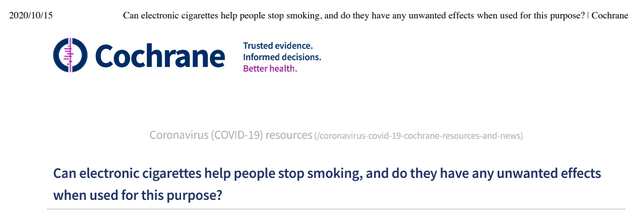 Image: Cochrane indicates that the effectiveness of using e-cigarettes for smoking cessation is better than that of nicotine replacement therapies.
"We see from scientific evidence that e-cigarettes can assist smokers in quitting and have great potential in reducing smoking rates and even mortality," said Professor Kenneth Warner. "However, due to the stigmatization of e-cigarettes, many members of the public, including smokers, mistakenly believe that the harms of e-cigarettes are as great as those of cigarettes. This has led to many concerning phenomena."
The most direct consequence is the rising smoking rate in the United States. Professor Abigail Friedman from the Yale School of Public Health pointed out that the ban on e-cigarette flavors (such as fruit flavors) has caused many smokers to revert to cigarettes. "Data shows that after San Francisco implemented the e-cigarette flavor ban, the local youth smoking rate doubled, which will significantly increase our future smoking cessation costs." Furthermore, the continuous dissemination of misinformation will cause public health agencies and the media to lose the basic trust of society.
"Establishing and maintaining public trust in public health agencies is a core element of a successful public health campaign. However, due to the distortion of the truth by some public health agencies, public trust is declining," said Professor Mike Cummings from the University of South Carolina, whose speech was titled "Do We Have to Risk Losing Public Trust?"
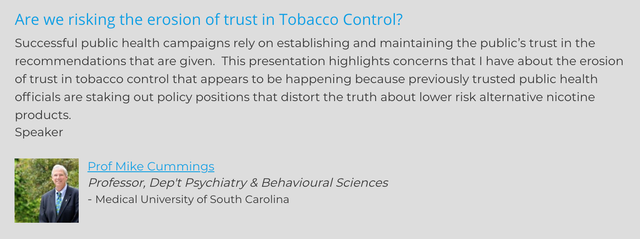 Image: Summary of Professor Mike Cummings' keynote speech.
Regaining Public Trust: Clarifying Rumors and Balancing Smokers' Needs is Key
During the summit's discussion session on "Nicotine, Policy, and Regulation," Cliff Douglas, former vice president of tobacco control at the American Cancer Society, emphasized the need to find common ground between "harm reductionists" and "prohibitionists": "Protecting youth and supporting adult smokers in quitting can and must be achieved simultaneously. At the same time, we cannot ignore the demands of e-cigarette users."
Cliff Douglas's viewpoint was echoed by many experts. Ethan Nadelmann, founder of the Drug Policy Alliance and an internationally renowned drug policy expert, stated that public health agencies cannot focus solely on the "potential harms" of e-cigarettes while ignoring the voices of current smokers and consumers. Cheryl Healton, a professor at New York University's Global School of Public Health, directly pointed out that smokers have the right to choose harm reduction strategies that suit them and should seek "new social equity" for them.
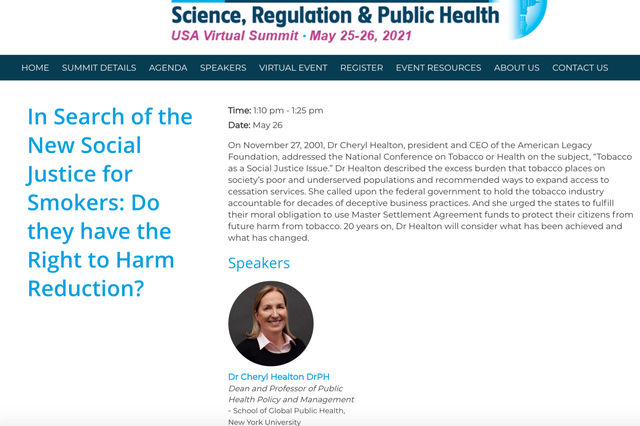 Image: Professor Cheryl Healton's keynote speech titled "Seeking New Social Equity for Smokers: Do They Have the Right to Reduce Harm?"
Some countries have clearly supported the use of e-cigarettes as a smoking cessation tool. During this summit, Ann McNeill, a tobacco addiction expert from King's College London, detailed the UK's e-cigarette policy, stating that the UK Department of Health has included the promotion of e-cigarettes as part of its "smoke-free goal for 2030" strategy.
"The UK's support for e-cigarettes is backed by substantial scientific evidence. Public health agencies should focus on disseminating this evidence of e-cigarette harm reduction, which is crucial," said Ann McNeill. She noted that the UK Department of Health had released a research report on e-cigarettes as early as 2015, indicating that e-cigarettes could reduce 95% of the harm of cigarettes, with harmful chemical content being almost negligible.
"We also need to clarify some rumors to reduce public misunderstandings about e-cigarettes," said Matthew Holman, director of the FDA's Center for Tobacco Products. For instance, the rumor of "e-cigarette lung disease" ("popcorn lung") has been clarified by the CDC: the culprit is vitamin E acetate found in illegal THC products, and legitimate nicotine e-cigarettes do not contain this substance.
Image: The domestic e-cigarette brand RELX also clarified the "e-cigarette lung disease" rumor through official channels: "Popcorn lung is not the lung turning into popcorn; it is all due to excessive and random additives!"
Matthew Holman also revealed that the FDA "will help adult smokers access e-cigarettes and switch to e-cigarettes." According to reports from foreign media Filter regarding the summit, if e-cigarette products pass the FDA's premarket tobacco application (PMTA), they will remain on the market under the label of "beneficial to public health." This would mean that the U.S. government officially recognizes the harm reduction efficacy of e-cigarettes.
Related Articles

Ahead of a Nationwide Ban, Hundreds of Russian Retailers Voluntarily Stop Selling Vapes

Illegal Vape Brands Try to Evade FDA Scrutiny by Posing as “Made in the USA”