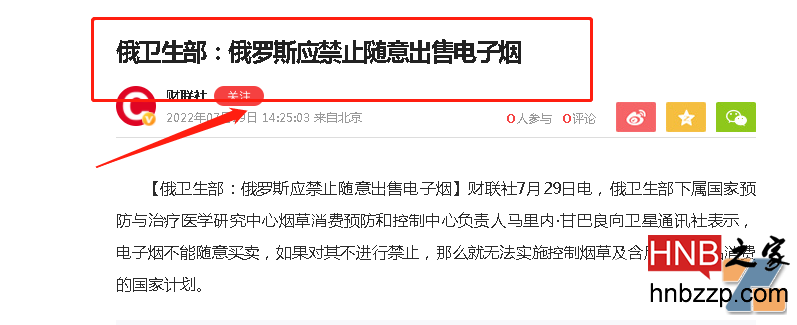
Russian Health Ministry: Russia Should Ban Unrestricted Sales of E-Cigarettes
Reports suggest Russia may move to tighten restrictions on vaping products. Russia is a major e-cigarette market, second only to parts of Europe and North America, and only formally recognized e-cigarettes as nicotine products in 2020. According to local
Today I came across surprising news that Russia is looking to restrict e-cigarettes? <\/span><\/div>
<\/div>
Russia is a significant market for e-cigarettes, ranking just behind some regions in Europe and North America, and it only officially recognized e-cigarettes as nicotine products in 2020.
 <\/span><\/div>
<\/span><\/div>
<\/div>
According to reports from the Financial Associated Press, the head of the Tobacco Consumption Prevention and Control Center at the National Center for Prevention and Treatment Medicine under the Russian Ministry of Health, Marine Gambaryan, stated that e-cigarettes cannot be bought and sold freely. If they are not banned, it will be impossible to implement the national plan to control the consumption of tobacco and nicotine products.<\/span><\/div>
<\/div>
Gambaryan believes that controlling the consumption growth trend of these products is essential for implementing the national plan.<\/span><\/div>
<\/div>
(Is the e-cigarette landscape in Eastern Europe changing?)<\/span><\/div>
<\/div>
However, the Deputy Director of the Commodity Electronic Labeling and Legal Circulation Department of the Russian Ministry of Industry and Trade, Zaslavsky, stated, "A complete ban on the sale of e-cigarettes will only lead to budget losses and the formation of a black market. However, to combat counterfeit products, it is necessary to enforce the use of electronic labels."<\/span><\/div>
<\/div>
It is worth noting whether the ban on the free trade of e-cigarettes indicates that new regulations will be introduced for e-cigarettes?<\/span><\/div>
<\/div>
Currently, Russia is implementing a plan to control the consumption of cigarettes and other nicotine products by 2035. The goal is to reduce tobacco consumption, gradually withdraw tobacco products from civilian circulation, and decrease the incidence and mortality rates associated with smoking-related diseases.<\/span><\/div>
<\/div>
Regarding the Russian e-cigarette market, last year a set of data showed that it accounted for 8% of the global share. In 2021, the domestic e-cigarette export scale reached 138.3 billion yuan, a year-on-year increase of 180%. The top four destination countries or regions for exports were the United States, the European Union, Russia, and the United Kingdom, accounting for 58%, 15%, 8%, and 7%, respectively. Specifically, the U.S. market accounted for the largest share at 58% (73.3 billion), the EU and the UK accounted for 24% (34 billion), and Russia accounted for 8% (9.7 billion), indicating that Russia has approximately a 100 billion e-cigarette market share.<\/span><\/div>
<\/div>
With a population of 130 million, 32% of Russians have a smoking habit, with 94% of smokers aged 28 and above. This number is over 20 million.<\/span><\/div>
<\/div>
In terms of market characteristics, one person stated, "Although the mainstream category in the Russian market is still liquid e-cigarettes, especially disposable and some refillable small devices, solid categories do not need to compete with them for existing market share; they just need to continue to tap into traditional smokers." It is evident that Russia is not like some European countries with large vapor clouds, but rather focuses on disposables. The disposable cigarette market in Russia has rapidly taken off since 2019 and accelerated growth in 2021. I remember at that time, a brand that was popular in Japan and South Korea with a 2ML capacity disposable device was successfully sold in Russia.<\/span><\/div>
<\/div>
Some channel insiders mentioned that disposable products from domestic brands were everywhere in the Russian market at that time, ranging from 200 puffs to 800 puffs, and were basically sold out. "Russia cannot produce this product themselves; their light industry is too lacking, and young people find it novel."<\/span><\/div>
<\/div>
Currently, there is a certain number of smokers in Russia using HNB systems, representing a market that can be further developed, and it is indeed an opportunity now.<\/span><\/div>
<\/div>
However, most e-cigarettes in Russia are sold in tobacco shops. The terminal channels in Russia do not exhibit the diverse forms seen in other countries; unlike domestic brand specialty stores, collection stores, and tobacco shops, all categories are unified within tobacco shops.<\/span><\/div>
<\/div>
The Russian Ministry of Health's suggestion to restrict the free trade of e-cigarettes may signal that "regulation of e-cigarettes" is on the horizon!<\/span><\/div>